Related: Walking Pad vs Treadmill: Which One Actually Fits Your Apartment
I have unboxed, folded, wheeled, and run on more than 30 treadmills inside a 680-square-foot apartment in Austin, Texas, and the short version on treadmills for small apartments is this: most people buy twice the machine they need. The thing that decides whether you actually use the thing has almost nothing to do with horsepower. It is whether the belt fits your stride, whether the motor is quiet enough to hear the TV over it, and whether you can move it by yourself once it is folded.
Austin gives me about four months a year where running outside is pleasant. The rest is heat that sits on you like a wet blanket, or a cold snap that shuts the trails down. That is why I ended up buying a cheap foldable treadmill for my own living room in the first place, and why I now coach clients through the same purchase every month. When a runner asks me what to buy for an apartment, I do not answer from a spec sheet. I answer from the floor of my own living room.
This guide covers four machines at four different jobs: a full treadmill that shows up assembled, a folding machine with a high weight rating, a handrail model built for balance, and a walking pad for desk use. I am not going to quote prices here, because they move constantly. Every link goes to the current listing so you can check today's number yourself.
Best Overall: Sunny Health & Fitness Fully Assembled Auto Incline Treadmill for Home Gym
This is the one I point runners to first. The name tells you the two things that matter most about it: it arrives fully assembled, and the incline is automatic.
Fully assembled sounds like a small thing until you have spent a Saturday on your knees with an Allen wrench and a bag of bolts, watching a YouTube video made by someone who has clearly never seen the machine. Assembly is where cheap treadmills lose people. If the box shows up ready to walk on, you are already ahead.
Auto incline is the bigger deal. On budget machines, incline often means plastic risers under the deck that you set before you start. They work, but they wobble slightly, and once you are moving you are not going to stop and change them. Auto incline lets you change the grade from the console while you are mid-session. For anyone training for hills without hills, that is the feature that earns its place.
The tradeoff is honest: this is a home gym treadmill, not a living room treadmill. It takes up real floor space, and floor space is the one thing a small apartment does not have. Before you buy anything full size, measure the spot, measure the folded footprint, and walk the path you would push it along. If you cannot picture it living somewhere specific, it is going to live in the middle of your living room forever.
Best Folding Pick: FUNMILY Folding Treadmill with Incline, 400lbs Capacity
The listed capacity on this one is 400 pounds, and that number does more than sort buyers by weight. A machine rated for a heavy user is usually built with a stiffer frame and a wider stance, because it has to be. If two people in the house share one machine, or if you are a bigger runner who has been told to buy a walking pad and knows it is not enough, this is the folding option I would look at first.
It folds, it inclines, and it is a real running surface rather than a strip of belt under a console.
Here is the folding rule I use, and it has saved me from recommending some genuinely bad machines: folding only counts if you can actually move the thing when it is folded. A folded treadmill that weighs too much to tip onto its wheels is just an unfolded treadmill with extra steps. So when you look at this listing, look at the folded dimensions and the wheels first, and the incline setting second. If the folded footprint does not fit behind a couch or in a closet you can reach without rearranging furniture, the fold is decoration.
Incline on a folding machine is worth having. Just check how it is implemented. If the incline system feels like plastic blocks propping up the deck, expect a little wobble, and expect that wobble to show up everywhere else on the machine, because that is how budget builds work. They are honest about it. The question is whether the honesty matches the price.
Best for Balance and Support: Redliro Treadmill for Seniors with Long Handrail
The long handrail is the whole point of this machine, and it is not only for older buyers. I recommend a rail like this to anyone coming back from an injury, anyone whose balance is not what it was, and anyone who wants to walk at home without holding onto a wall.
A standard treadmill gives you a short console and two side rails you have to reach for. A long handrail runs the length of the walking area, so there is something under your hands at every point in your stride. That changes how confident you feel stepping on, and confidence is what makes a machine get used instead of dusted.
Be clear about what it is: a walking treadmill with support, not a running machine. If you are running, a long handrail changes your arm swing and pulls your posture forward. That is fine for rehab walks and daily steps, and it is the wrong tool for training paces. The right buyer is someone who wants to walk, every day, without worrying about the surface moving under them.
Best Budget Walking Pad: TREAFLOW Walking Pad with Incline, Under Desk Treadmills for Home
This is the smallest commitment on the list, and for a lot of apartments it is the correct one. It slides under a desk, it stores upright against a wall, and it turns dead meeting time into steps. The incline gives you a little more work out of the same walk.
I will say the same thing I say about every pad: a walking pad is a walking pad. If you want to actually run, you need a deck that fits your stride, and most pads do not have one. Buy this for walking, for the two o'clock slump, for the days when the weather is a wall of heat and you just need to move. Buy a real treadmill if running is the goal. There is no version of this purchase where a slim pad under a desk replaces a running machine, and pretending otherwise is how people end up with a $120 rug.
The pitch here is simple: low profile, easy to store, incline included, and a price that does not require a speech to your partner. For someone coming off a couch year, that is plenty.
The four questions I ask before I recommend any treadmill
When I look at a new machine, I run it through the same five checks. This is the whole method.
First, will my full stride fit the deck, or will I be taking smaller than normal steps? Deck length is the first spec I check. If your stride does not fit the belt, nothing else on the machine matters. A short deck does not announce itself. You just gradually shorten your gait, and your hips pay for it later.
Second, is the motor quiet enough for a conference call at walking speed? Quiet matters more than horsepower at home. A motor that makes you turn up the TV is a failed purchase no matter how fast it goes, and in an apartment, a motor you can hear through the wall is a neighbor problem.
Third, can I fold it and move it myself, in the space I actually have? Wheels and weight are the real specs here, not the word foldable on the box.
Fourth, does the incline actually work, or does it wobble like plastic blocks? The incline mechanism is the tell. If it feels like risers propping up the deck, the whole machine is cutting corners somewhere.
Fifth, would I still recommend it after 200 miles? That is the test that matters. Everything looks good in the first week.
What actually matters in a small apartment
Deck length is not a luxury spec, it is the spec. Full size gym treadmills belong in gyms. In a small living room, they are a two thousand dollar coat rack. But undersized decks are just as bad, because they quietly break your stride. The right deck is the one your normal running stride fits on, and no amount of cushioning or app content fixes a deck that is too short.
Noise is the second filter. Nobody prints a decibel number on the box, which is exactly why you should treat every whisper quiet claim as marketing until proven otherwise. At walking speed, the fan and the belt are usually louder than the motor. At running speed, the footfalls are louder than everything. If your floor is someone else's ceiling, put a mat under the machine, and be honest about which hours you plan to run.
Folding is the third. Folding only counts if the machine rolls, and rolling only counts if the path between the storage spot and the workout spot is clear. I have moved machines that fold beautifully and still need two people to budge. Check the wheels before you check the fold.
Incline is the fourth. Auto incline beats manual risers every time, because you will use it. Manual incline blocks are fine, but they wobble, and nobody stops mid workout to change them.
And the safety lanyard is the one feature I check on every machine, no exceptions. It clips to you and kills the belt if you fall. If a listing buries that detail, ask about it before you buy.
The treadmill comparison table
| Machine | What it is | Features in the name | Best for |
|---|---|---|---|
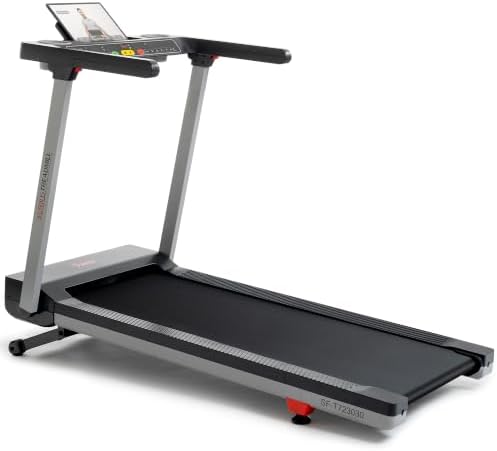 Visit on Amazon → Visit on Amazon →Sunny Health & Fitness Fully Assembled Auto Incline Treadmill |
Full size home treadmill | Fully assembled, auto incline | Runners who want hills and no assembly |
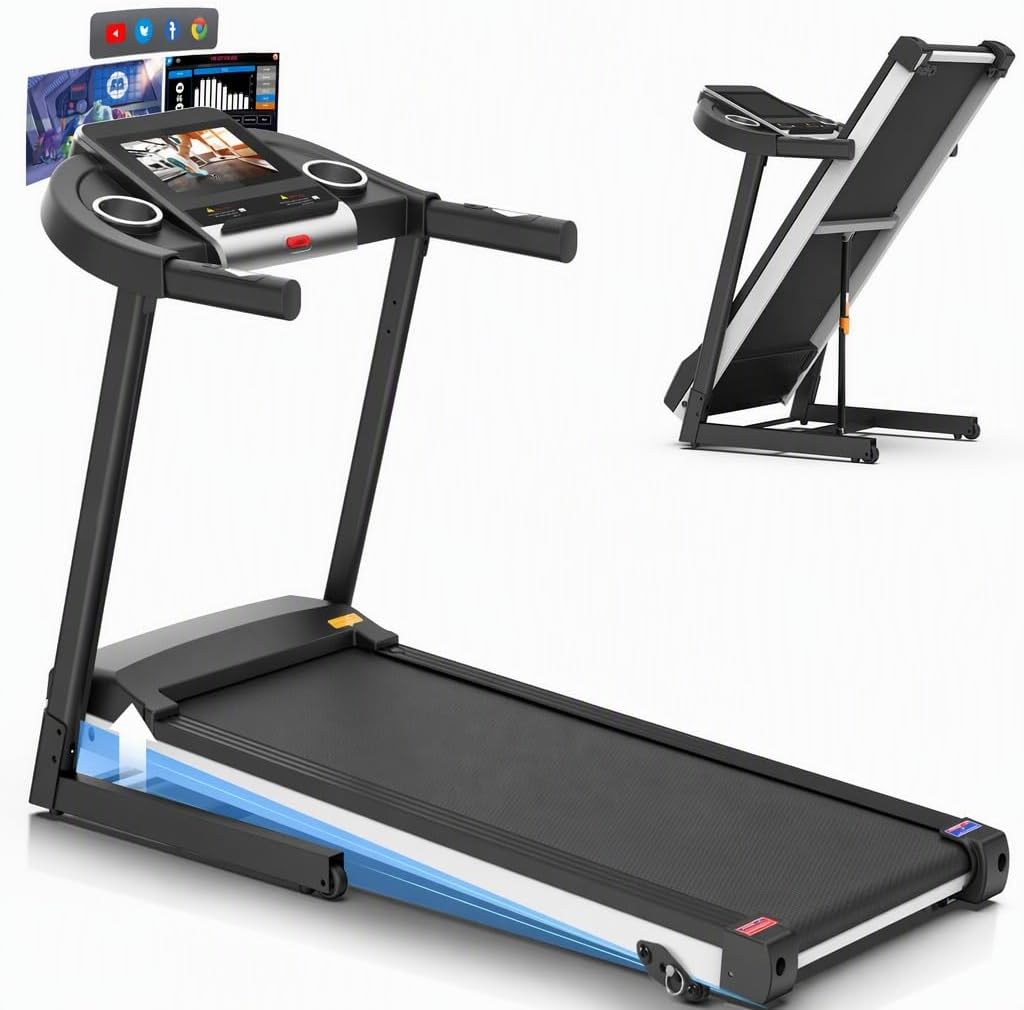 Visit on Amazon → Visit on Amazon →FUNMILY Folding Treadmill with Incline |
Folding treadmill | 400 lbs capacity, incline, folds | Heavier users and shared households |
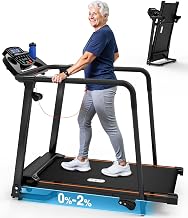 Visit on Amazon → Visit on Amazon →Redliro Treadmill for Seniors with Long Handrail |
Walking treadmill with support | Long handrail | Seniors, injury recovery, daily walking |
 Visit on Amazon → Visit on Amazon →TREAFLOW Walking Pad with Incline |
Under desk walking pad | Slim, incline, stores upright | Desk workers and small spaces |
| Any of the four | How to buy | Visit on Amazon → |
Check every listing before you buy |
Should you buy the Sunny Health & Fitness Fully Assembled Auto Incline Treadmill?
If you are a runner who wants a real machine and you have a spot to park it, yes. Fully assembled out of the box saves you an afternoon. Auto incline saves you from stopping mid run to fiddle with plastic risers. It is the machine that behaves most like the treadmill at a gym, and it is the one I would hand to someone training for a race.
The only reason to say no is floor space. If you cannot point at where it lives and where it goes when it is not in use, do not buy a full size machine. That is not a knock on this treadmill. That is a knock on buying a treadmill you cannot house.
Should you buy the FUNMILY Folding Treadmill?
Yes, if your household is heavy, or two people share one machine, or you want a running surface that folds. The 400 pound listed capacity is the reason to look here, and a frame built for that rating is stiffer underfoot than a frame built for half of it.
Just do the folding math before you buy. Look at the folded dimensions, look at the wheels, and picture the trip from your living room to your storage spot. If that trip works with one person, this is a strong pick.
Should you buy the Redliro Treadmill with the long handrail?
Yes, if walking with support is what you need, whether that is age, balance, or recovery from an injury. The long rail is genuinely useful, and it is the kind of feature that turns a machine from intimidating into something you step onto without thinking.
No, if you plan to run. A rail that runs the length of the deck is a walking feature. For running paces you want a normal console and free arms.
Should you buy the TREAFLOW Walking Pad with Incline?
Yes, if you want to walk more and you have a desk or a wall to store it against. It is the least expensive way to add movement to a day that is mostly sitting, and the incline makes the walk worth more than a flat stroll.
No, if you are shopping for running. A walking pad is a walking pad, and no incline setting changes that. Buy a walking pad for walking, a treadmill for running, and stop expecting one machine to be both.