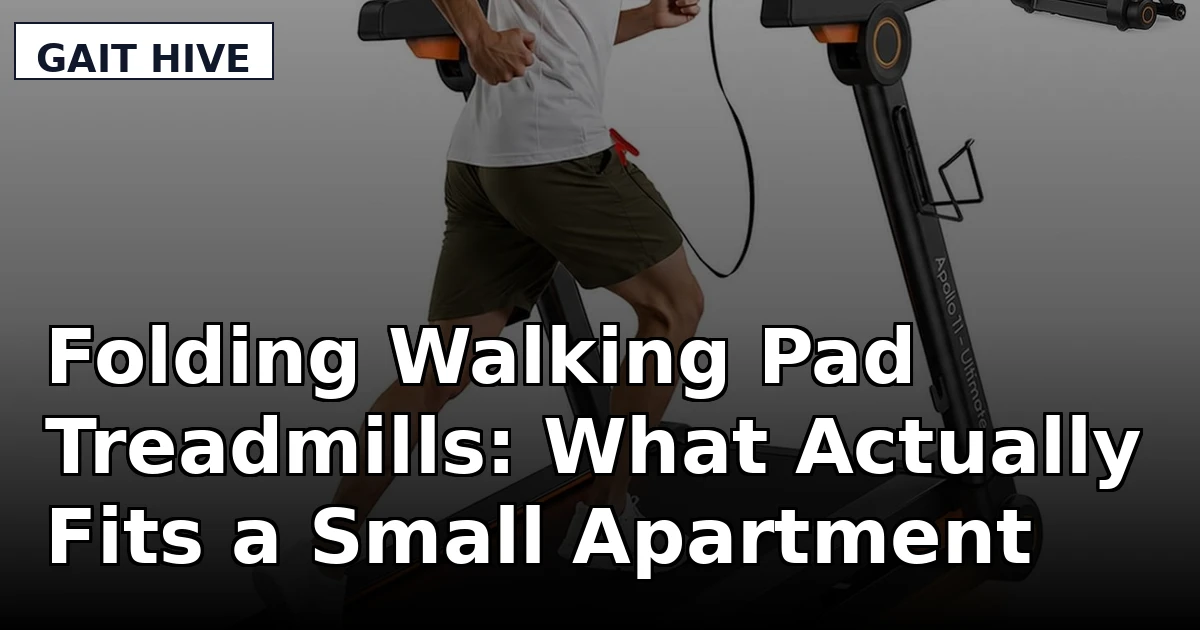
A folding walking pad treadmill solves a problem that a full-size machine creates: it has to live somewhere in your home, and in a small apartment that somewhere is usually the same few square feet you also need for a couch, a coffee table, or a door that has to open. Every machine below folds or stores flat, and every one of them sits at a different point on the same trade-off. The more deck and incline you get, the more machine you have to move when you are done with it. This is an explainer, not a ranking. The goal is to help you match a folding walking pad treadmill to the walking or running you will actually do, because that decision matters far more than any spec sheet headline.
Related: How Long Should a Treadmill Deck Be for Your Stride? →
Quick answer
Match the machine to the job. If your plan is walking while you answer email, a slim under-desk pad with a remote control is the right tool, and a long deck is weight you will never use. If your plan includes running or long incline walks, belt length is the spec that matters first, and the Vitalwalk is the only machine here that lists its deck measurement, at 49 by 18 inches, along with 20 percent and 25 percent auto incline settings. The LONTEK adds an 18 percent incline and a handle bar. The two slim pads trade deck length for stowability and a lower barrier to entry. None of these is a gym treadmill, and that is the point.
Four useful options
| Model | Best fit | What stands out |
|---|---|---|
| Vitalwalk Foldable Walking Pad Treadmill with Incline 20%/25% Auto, 49"x18" | Longer strides and incline walking | 49 x 18 inch deck with 20% and 25% auto incline |
| LONTEK 18% Incline Treadmills for Home with Handle Bar | Incline walking with a handhold | 18% incline plus a handle bar |
| Walking Pad Treadmill for Home - Folding Treadmills with Handle Bar Portable Compact Fold up Indoor Foldable Handles Electric Walk Pads Small Spaces Mini Running Quiet Under Bed Office | Folding down and stowing under furniture | Foldable handle bars and a fold-flat frame |
| Walking Pad Treadmill for Home - Under Desk Walking and Running with Remote Control Portable Electric Machine Adjustable Slim Compact with 0.6-4.0MPH Modes Max up 265 Lbs for Home Office | Walking while you work | Remote control, 0.6 to 4.0 MPH range, 265 lb listed capacity |
The deck and incline pick: Vitalwalk Foldable Walking Pad Treadmill with Incline 20%/25% Auto, 49"x18"
Deck length is the first number worth checking, and it is the number most listings leave out. A 49 inch belt is short by running-treadmill standards, where 55 to 60 inches is common, but it is long for this category, where slim pads often run in the low 40s. That difference shows up in how you land. On a short belt, a walker with a long stride starts taking smaller than normal steps without noticing, and the hips and cadence pay for it. The 18 inch width also gives you a little lateral room, which matters on incline sessions when you are not tracking a perfectly straight line. The trade-off is size and weight when folded. A machine with a deck this long is not going to disappear into a closet the way a slim pad will.
The incline treadmill with a handle bar: LONTEK 18% Incline Treadmills for Home with Handle Bar
An 18 percent grade is steep. Most home treadmills top out around 10 to 12 percent, so this machine is aimed at walkers who want real climbing rather than a token tilt. The catch with budget incline systems is the mechanism. On cheaper machines, the incline is often a set of plastic risers under the deck that lift the front end and wobble slightly when you are on it. That does not make the machine useless, but it does tell you where the corners were cut, and it is worth standing on the deck at full incline before you commit to a long session. If the front end feels vague underfoot, keep your incline work shorter and hold the bar.
The folding pad with handle bars: Walking Pad Treadmill for Home - Folding Treadmills with Handle Bar Portable Compact Fold up Indoor Foldable Handles Electric Walk Pads Small Spaces Mini Running Quiet Under Bed Office
The folding claim is only worth what the folded machine does for you. Before buying anything in this shape, measure the gap under your bed or couch and compare it to the folded height, then check whether the unit has wheels. A pad you can fold but cannot roll is a pad you will leave set up, and a pad you leave set up is furniture. The foldable handle bars are the useful part here, because they give you a handhold during incline or faster walking without leaving a frame sticking up in the middle of the room when the session ends. Handle bars on a folding pad are for balance and confidence, not for carrying your body weight.
The under-desk walking pad: Walking Pad Treadmill for Home - Under Desk Walking and Running with Remote Control Portable Electric Machine Adjustable Slim Compact with 0.6-4.0MPH Modes Max up 265 Lbs for Home Office
Under-desk walking is its own discipline. Most people settle somewhere between 1.5 and 2.5 MPH, fast enough to feel like movement and slow enough to type, and a remote matters more than it sounds because reaching down to a console mid-sentence is how people stop using these machines. The 265 pound capacity is a real limit, not a suggestion, and it is worth checking against your own weight plus whatever you carry. There is also a height question: the belt adds thickness under your feet, so your desk needs to be high enough that your forearms stay level while you walk. If your desk is fixed at a standard height, a slim pad may put your wrists in a position you will feel by the afternoon.
Prices and availability may change. Product images, names, and retailer links must be matched by verified ASIN. Do not state a current price, rating, stock status, or measured result without current evidence.
Why deck length decides whether you walk or run
Walking and running do not need the same machine, and the belt is where that shows up. A walking stride is short and your foot lands close to your center of mass. A running stride is longer, your foot lands further ahead, and you spend part of each step in the air. On a short belt, that longer stride has nowhere to go, so you shorten it. You take smaller than normal steps, your cadence climbs to compensate, and the whole gait feels cramped rather than powerful.
That is why deck length is the first spec to check, before motor size, before app support, before anything on a feature list. If your stride does not fit the belt, nothing else about the machine matters.
As a rough guide, a belt in the low 40s of inches is a walking surface. A belt around 49 inches, like the Vitalwalk here, is a long walking surface and a usable jogging surface for a shorter stride. Belts in the mid 50s and up start to be genuinely comfortable for running. Width works the same way. Most walking pads are narrow, and 18 inches gives you room to drift without stepping off.
You can measure this at home in about a minute. Put a piece of tape on the floor at the length of the belt you are considering, stand at one end, and take five normal running steps. If your fifth step lands past the tape, the belt is short for you.
Incline: what it changes and where budget incline wobbles
Incline raises the cost of every step. At a grade, your glutes and calves do more of the work, your heart rate climbs at the same pace, and walking suddenly becomes a training session instead of a commute. That is why an incline walking pad is more useful than it looks, and why the numbers on this page are worth reading carefully.
The Vitalwalk lists 20 percent and 25 percent automatic settings. The LONTEK lists 18 percent. For context, a steep hiking trail is often somewhere in the 10 to 15 percent range, so these are not gentle tilts. Two things to check before you buy into a big incline number.
First, is the incline automatic or manual? Automatic settings change with a button or remote. Manual incline often means lifting the front of the deck onto risers, which is fine for a fixed session and annoying if you want to vary it mid-walk.
Second, how does the incline mechanism feel? Budget machines sometimes use plastic blocks under the deck, and they wobble slightly when you are standing on them. That wobble is not automatically a dealbreaker, but it is a signal about where the money went, and it is the reason a handle bar is worth having on an incline machine.
One more item, and it is not optional in my book: the magnetic safety lanyard. That is the clip that kills the belt if you fall. Confirm the listing includes one, and use it every single session.
- Measure your normal walking and running stride, then compare it to the listed belt length. If the deck is short, decide whether you are okay walking only.
- Decide whether you need incline. If you do, check whether it is automatic or manual, and whether a handle bar comes with it.
- Measure the space where the machine will live, both set up and folded. Include the gap under your bed or couch if that is the storage plan.
- Check the weight limit and the folded weight against your own body and your ability to move the machine alone.
- Confirm the safety features on the listing, including a magnetic safety lanyard, and confirm your desk height if you plan to walk while working.
Setting up a walking pad in a small apartment
- Put the machine where you will actually use it, not where it looks tidy. A pad stored behind a couch is a pad that stays behind a couch.
- Leave the safety lanyard clipped on permanently so it becomes part of the routine rather than a step you skip.
- Walk at a speed you can hold for twenty minutes before you chase a bigger number. Most under-desk sessions land between 1.5 and 2.5 MPH.
- Wipe the belt and check the deck for debris weekly, and follow the manufacturer's lubrication guidance for your specific model.
- Give the machine a little clearance on all sides. Incline walking moves your feet around more than flat walking, and a wall behind the belt is a bad place for a heel strike.
Which option should you choose?
Choose the Vitalwalk Foldable Walking Pad Treadmill with Incline 20%/25% Auto, 49"x18" when you want the longest deck on this list and automatic incline, and you have a permanent spot for a larger folding machine. Choose the LONTEK 18% Incline Treadmills for Home with Handle Bar when incline walking is the goal and you want a handhold for balance. Choose the Walking Pad Treadmill for Home - Folding Treadmills with Handle Bar Portable Compact Fold up Indoor Foldable Handles Electric Walk Pads Small Spaces Mini Running Quiet Under Bed Office when storage is the binding constraint and the machine needs to fold flat and slide under furniture between sessions. Choose the Walking Pad Treadmill for Home - Under Desk Walking and Running with Remote Control Portable Electric Machine Adjustable Slim Compact with 0.6-4.0MPH Modes Max up 265 Lbs for Home Office when the machine is going under a desk and the plan is walking, not running.
The caveat here is straightforward. These are spec-level distinctions drawn from what each listing states, and a spec sheet is not a living room. Deck feel, motor noise at your walking speed, and how the incline mechanism behaves underfoot are things you only learn by using a machine, and those are the details that decide whether a purchase sticks. Verify the details that matter to you on the current listing, and check the belt and frame against your own stride and space before you commit.
The bottom line
All four of these machines fold, and all four are honest about what they are once you read the specs closely. The Vitalwalk is the one with a published deck size and steep automatic incline, so it suits walkers with longer strides and anyone who wants grade work. The LONTEK brings an 18 percent incline and a handle bar to the budget end of the category. The two slim pads trade deck length for a small footprint, and the under-desk model is built around slow, steady walking under a desk. Pick the one whose limits match your habits, not the one with the longest feature list, and you will still be using it in six months.