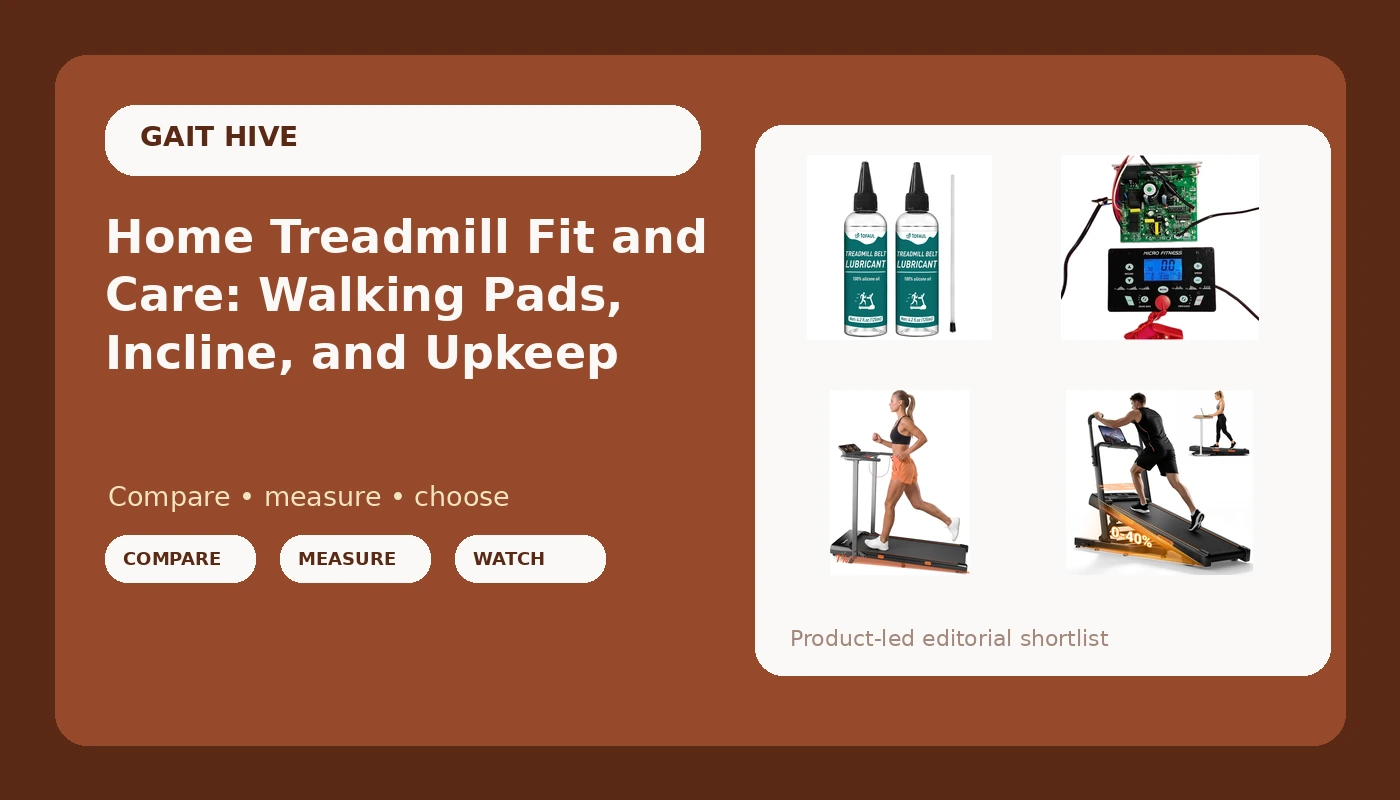
Most people shopping for a treadmill at home are really shopping for two different machines at once: something to walk on while a call runs long, and something to actually run on when the weather keeps them indoors. Those two goals collide hardest in a small apartment, where a walking pad, a compact incline model, a tube of belt lubricant, and a spare motor controller all end up competing for the same few hundred dollars. Home treadmill fit and care comes down to three questions. Does your stride fit the deck? Can you fold it and move it without help? And can you keep the belt and the electronics alive past the first year?
This is an explainer, not a scoreboard. There are no lab numbers below and no claims about which motor is quietest, because a quiet claim needs a measurement this article does not have. What follows is what each listed product actually is, how the categories differ, and how to decide which one belongs in your apartment.
Related: How to Fold and Store a Treadmill in a Small Apartment →
Quick answer
For most apartments, the right first purchase is a walking pad or a compact folding treadmill sized to your stride, plus a belt lubricant on a schedule and a plan for the electronics. If you intend to run, buy for deck length first and ignore horsepower marketing. If you only walk, a low-profile pad is plenty. Nothing here is labeled the quietest, fastest, or safest, because those distinctions need evidence this article does not claim.
4 useful options
| Model | Best fit | What stands out |
|---|---|---|
| Cybergoing T16 Treadmill for Home Powered By Bosch®, Walking Pad | Everyday walking in a small room | Walking pad form factor, with a Bosch-branded motor named in the listing |
| LONTEK 40% Incline Treadmill for Home Walking Pad with Incline & Handle Bar | Walkers who want incline and a handhold | A listed 40% incline range and an included handle bar |
| 1DFAUL Treadmill Lubricant for Belt, 250ml Silicone Treadmill Oil Belt | Routine belt maintenance | 250ml of silicone belt oil in a single tube |
| bdfndjnm Universal Treadmill Circuit Board & Console Display | Replacing a failed controller or console | Listed compatibility with 1HP to 4.0HP motors, with a 4HP lower controller variant |
The everyday walker: Cybergoing T16 Treadmill for Home Powered By Bosch®, Walking Pad
The trade-off with any walking pad is the deck. A pad is designed around walking speed, which means the belt is usually shorter and narrower than what a runner needs to stride out. That is not a defect, it is the category. If your plan is thirty to sixty minutes of walking while you answer email, the pad is the honest choice and the money you save belongs in your pocket. If your plan involves intervals at a pace you would call running, this is the wrong shape of machine, no matter how good the motor is. Buy the deck that fits the job, then worry about the rest.
The incline option: LONTEK 40% Incline Treadmill for Home Walking Pad with Incline & Handle Bar
Incline is the most underrated feature on a walking machine, because it raises your effort without raising your speed, which means less pounding and less noise for the same training effect. A handle bar matters more than people expect too. On a steep incline you naturally reach for something, and reaching for a wall or a countertop is how people end up standing awkwardly on a moving belt. The honest caveat: steep incline systems on budget machines vary a lot in how they are built, and a wobbling incline block is a tell that corners were cut somewhere. Look at the mechanism, not just the number.
The maintenance pick: 1DFAUL Treadmill Lubricant for Belt, 250ml Silicone Treadmill Oil Belt
A dry belt is the quiet killer of home treadmills. Friction between the belt and the deck raises motor load, raises heat, and eventually raises the noise you hear through the wall. Lubrication is not a one-time job either. It is a repeating one, and the interval depends on how much you walk, how much you weigh, and what the belt manufacturer recommends. Buy the oil before the belt starts squeaking, not after. Follow the machine maker's instructions for how much to apply and where, because over-lubricating can be its own problem.
The repair part: bdfndjnm Universal Treadmill Circuit Board & Console Display
Electronics are where budget treadmills usually die. The belt and the deck can be revived with oil, but a blown controller turns a working machine into a heavy object. This is the part that makes repair possible instead of replacement, and it is worth knowing it exists before you need it. Two cautions. First, "universal" describes a compatibility range, not a guarantee for your specific machine, so match the specifications and connector layout against what you have before ordering. Second, anything that involves opening a machine and working near a motor is a job for someone comfortable with the wiring, or for a technician.
Prices and availability may change. Product images, names, and retailer links are matched to verified listings. No current price, rating, stock status, or measured result is stated here without current evidence.
Deck length and stride: the spec that decides everything
Deck length is the first thing to check and the last thing most buyers look at. The deck is the running surface under the belt. Your stride is the distance from one footfall to the next. When the deck is long enough, you land where you expect to land and push off normally. When it is too short, you unconsciously shorten your steps to stay on the belt, and you can feel it in your hips and your shins after twenty minutes.
The measurement that matters is not the total machine length, it is the usable belt length, and it shrinks further once you account for where your feet actually land. There is a practical test you can run in a store or after delivery: stand on the belt, walk normally, then walk at the fastest pace you intend to use. If you find yourself aiming your feet at a spot rather than just walking, the deck is too short for that pace.
Walking pads and running treadmills are sized for different jobs, and the gap between them is real. A pad is built around walking, which is why pads are short, narrow, and light. A running deck is built around a longer stride and a heavier landing. Most apartment buyers overestimate how much running they will do and underestimate how much walking they will do. Be honest with yourself about the ratio, because the machine you buy should match the majority of your sessions, not the version of you that exists in January.
Height and gait matter too. Taller walkers and runners with a long natural stride need more belt, and no console feature compensates for a short deck. If you are between two sizes and you plan to run at all, size up.
What actually wears out on a budget treadmill
Budget machines are not automatically bad machines. They are honest machines, and the question is whether the honesty matches the price. To answer that, it helps to know the short list of parts that fail.
The belt and deck wear against each other. Every step creates friction, and lubrication is what keeps that friction from turning into heat. This is the single most controllable variable in a treadmill's lifespan, and it costs less than a lunch.
The motor is usually more durable than people fear, but it is only as healthy as the load it is asked to carry. A dry belt, an overloaded deck, or a machine used at the top of its speed range every day will shorten its life.
The controller board is the part that most often ends a budget treadmill's career. It manages power to the motor and it is sensitive to heat, dust, and voltage problems. When a machine powers on but the belt will not move, the controller is a common suspect. That is why a replacement controller and console is a legitimate repair path rather than a novelty.
The console is mostly cosmetic until it is not. If the display dies and the controller goes with it, the machine becomes unusable even though the motor and deck are fine.
If you want a repeatable way to decide, work through this:
- Measure your stride at walking pace and at the fastest pace you plan to use, then compare it against the usable belt length, not the machine length.
- Measure your floor space including the folded footprint and the clearance you need to wheel the machine out, because a treadmill you cannot deploy is a treadmill you will not use.
- Decide whether you are a walker or a runner, and let that answer pick the category before you look at any spec sheet.
- Budget for maintenance on day one, including belt lubricant and the time to apply it on a schedule.
- Check whether the electronics are serviceable, and whether a replacement controller is available for the machine you are considering.
Setting up a small-space treadmill so you actually use it
- Put the machine where you can see a screen or a window at eye level, because looking down at a phone on a belt is how necks get angry.
- Lubricate on a schedule rather than on a squeak, and follow the belt maker's guidance for how much and how often.
- Check the magnetic safety lanyard clip before every session. It is the one safety feature worth being fussy about.
- Keep the controller area ventilated and free of dust and pet hair, since heat is what kills electronics.
- Fold, wheel, and redeploy the machine at least once in the first week. If moving it is a chore, you have learned something important while it is still returnable.
Which option should you choose?
Choose the Cybergoing T16 Treadmill for Home Powered By Bosch®, Walking Pad when your sessions are mostly walking and your space is genuinely tight. Choose the LONTEK 40% Incline Treadmill for Home Walking Pad with Incline & Handle Bar when you want to make flat walking harder without going faster, and you want a handhold while you do it. Choose the 1DFAUL Treadmill Lubricant for Belt, 250ml Silicone Treadmill Oil Belt when you already own a treadmill and want the cheapest possible insurance on the belt and deck. Choose the bdfndjnm Universal Treadmill Circuit Board & Console Display when a machine you own has power but no movement, and you have confirmed the specifications match before ordering.
A caveat worth repeating: compatibility ranges and product names are claims made by listings, and incline systems, motor noise, and deck feel are all things this article does not measure. Verify the current listing, your machine's specs, and your own stride before you spend.
The bottom line
For a small apartment, the order of operations is fit, then care, then repair. Fit means a deck that matches your stride and a footprint you can actually live with. Care means belt lubricant applied on a schedule, plus a clean, ventilated controller area. Repair means knowing that a replacement controller and console exists, so a dead board is a decision rather than a funeral. The walking pad and the incline pad solve the first problem. The lubricant and the controller solve the second and third. Buy in that order and you will spend less than the person who bought a gym-sized machine for a living room.