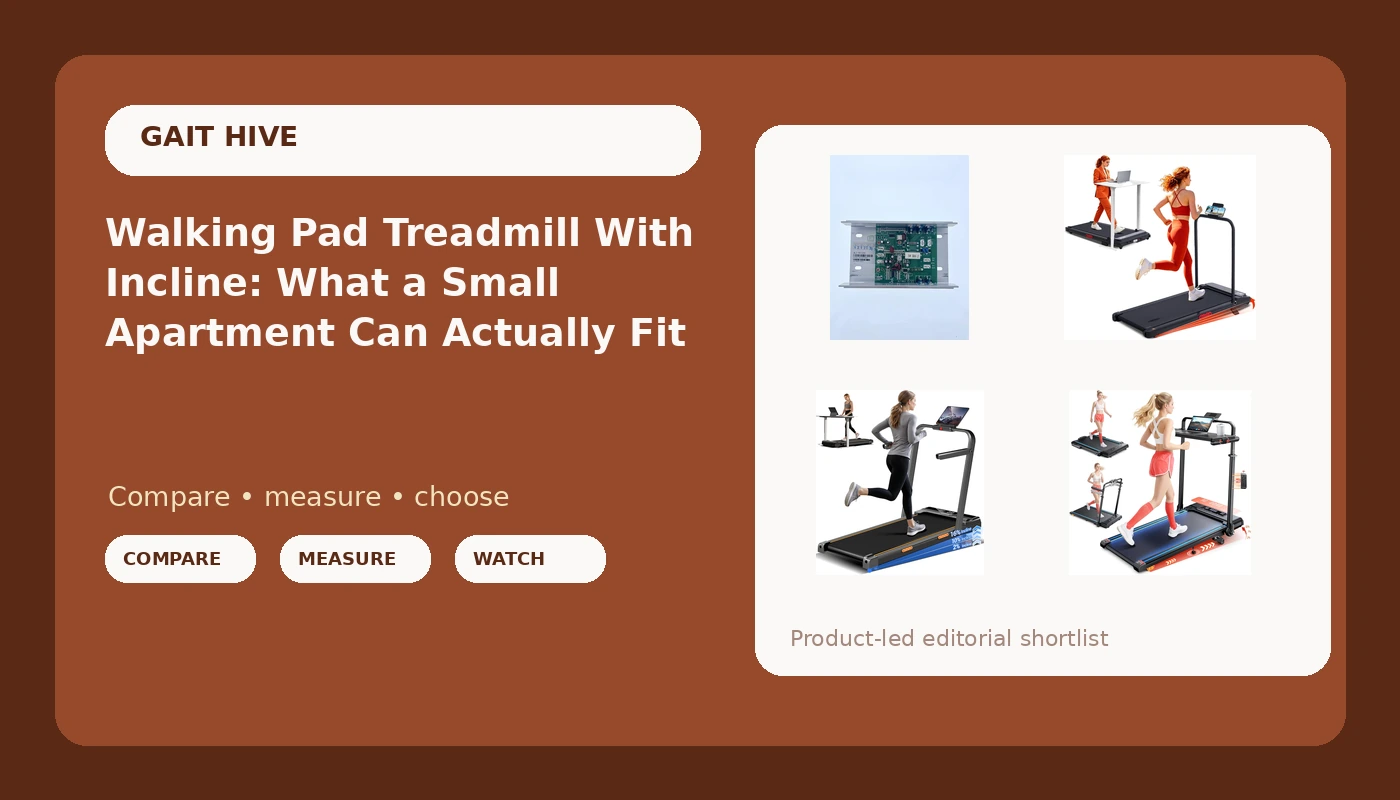
Most people shopping for a walking pad treadmill with incline are not choosing between a home machine and a gym membership. They are choosing whether the thing gets unfolded on a Tuesday night or becomes a very heavy coat rack in the corner of a small apartment. The listings all sound identical now: foldable, portable, compact, desk treadmill, 2 in 1, app controlled, quiet. Strip the language back and the real questions are short. Is the deck long enough for your stride? Can you fold it and move it by yourself, in the room you actually have? Does the incline change how the walk feels, or is it a plastic riser that wobbles underfoot? And when the electronics eventually give out, is there a part you can buy? This guide works through those questions in order, then maps four options to the situations they genuinely fit.
Related: How to Fold and Store a Walking Pad in a Small Apartment →
Quick answer
For a walking-focused household in a small space, a foldable pad with a handle bar and a real incline setting covers the most ground for the least commitment, and the 16% Walking Pad Treadmill with Incline is the most direct version of that idea. If you want a wider spread of incline positions, a higher stated weight capacity, and app plus remote control, the Walking Pad Treadmill with Incline 2%-7%-12% is built around exactly those. The Portable Treadmills for Home Compact Walking Pad is the smallest and simplest of the three machines. The Treadmill Doctor MC-60 Upgraded Treadmill Motor Control Board is not a treadmill at all; it is the replacement part that keeps a full-size machine running when its controller fails.
Four useful options
| Model | Best fit | What stands out |
|---|---|---|
| 16% Walking Pad Treadmill with Incline, Foldable Treadmill with Handle Bar | Walkers who want a handhold and a steeper grade in a small room | Foldable frame, handle bar, 16% incline setting |
| Walking Pad Treadmill with Incline 2%-7%-12%, 2.75-3.0HP Foldable Desk Treadmill for Home with LED Display, Remote&APP Control, Max 330LBS Capacity | Desk workers who want adjustable grade and app control | Three incline positions, LED display, remote and app control, 330 lb stated capacity |
| Portable Treadmills for Home Compact Walking Pad with Handle Bar Incline | The smallest footprint and the least setup | Compact build, handle bar, incline |
| Treadmill Doctor MC-60 Upgraded Treadmill Motor Control Board | Repairing a treadmill whose motor controller has failed | Replacement control board, upgraded version of the MC-60 platform |
The walking-first pick: 16% Walking Pad Treadmill with Incline, Foldable Treadmill with Handle Bar
The trade-off with a fixed incline is choice: you get one grade, not a menu. That is fine if you plan to walk at that grade and adjust effort with speed and time instead. The handle bar matters more than people expect. On a short deck, a handhold is what lets you relax your shoulders and walk normally rather than shuffling with your arms out for balance, and it is also where most people hang a towel. Before you buy any pad with an incline, check the folded height against the gap under your bed or behind a door, and check the unfolded length against the floor space you are willing to give up permanently. A pad that only fits when the coffee table moves is a pad that stops getting used.
The incline-range pick: Walking Pad Treadmill with Incline 2%-7%-12%, 2.75-3.0HP Foldable Desk Treadmill for Home with LED Display, Remote&APP Control, Max 330LBS Capacity
Multiple incline positions are a real upgrade over a single fixed grade, because you can warm up flat-ish at 2%, hold 7% for the middle of a session, and use 12% for a short hard finish without changing machines. The catch is mechanical. Every incline system on a folding pad is a compromise between range and rigidity, so pay attention to how the deck feels when it is raised and whether the frame settles or rocks at the highest setting. App control is a genuine convenience for desk use, but treat it as a bonus rather than a requirement: a remote and a physical display are what you will still be using when a phone update breaks the app. Also worth noting, a stated 330 lb capacity is a design ceiling, not a comfort target, and a heavier rider will feel more flex in any folding frame at the top of its range.
The compact pick: Portable Treadmills for Home Compact Walking Pad with Handle Bar Incline
Be honest about what a compact pad is for. A walking pad is a walking pad. If your goal is running, you need a deck long enough that your foot lands where it normally lands, and most pads do not have one. What the compact category does well is remove excuses: it is light enough to move with one hand, short enough to tuck beside a couch, and low enough that you do not have to climb onto it. The things to verify before buying are unglamorous. Does the handle bar attach and detach without tools? Does the belt run straight when you walk near the edge? Is there a magnetic safety lanyard, and does it actually cut the belt when pulled? That last one is non-negotiable on every machine in this guide.
The repair part: Treadmill Doctor MC-60 Upgraded Treadmill Motor Control Board
A dead control board is the most common reason a perfectly good treadmill ends up on the curb. The motor and deck are still fine, but the machine will not start, or it starts and then cuts out, or the belt surges at low speed. If your machine uses the MC-60 controller, replacing the board is usually far cheaper than replacing the treadmill, and it is the kind of repair a careful owner can do with the belt unplugged, the deck lowered, and photos taken of every connector before anything is removed. Confirm the board matches your machine's existing controller and voltage before ordering, because listings in this category look alike. The practical rule: if the frame, deck, and motor are sound, repair is worth pricing. If the frame is cracked or the deck is delaminating, a new board just delays the inevitable.
Prices and availability may change. Product images, names, and retailer links are matched to verified listings. No current price, rating, stock status, or measured result is stated here without current evidence.
Deck length and stride: check this before anything else
Deck length is the first spec to check, and it is the one most buyers skip. Your stride is the distance from one footfall to the next, and if the belt is shorter than that, you will unconsciously shorten your steps to stay safe. That is the failure mode nobody warns you about: the machine does not hurt, it just quietly teaches you to walk worse, and you feel it in your hips and lower back before you figure out why. To test your own stride, put a strip of tape on the floor, walk ten normal steps, and measure the distance from the first heel strike to the last. Then add a hand's width of margin at both ends. Walking needs less room than running, which is exactly why a pad works for one and not the other. If you are a runner buying a folding treadmill, the deck is the spec to spend on, not the motor rating.
Incline, noise, and the parts that fail
Incline percentages are grades, not difficulty levels. Two percent is a gentle nudge that takes pressure off your knees and adds a little work. Seven percent turns a walk into something you feel in your calves. Twelve percent and above is serious climbing, and at that grade you will want the handle bar. The tell on budget machines is the incline system itself: if it feels like plastic blocks tilting the deck, it will wobble slightly, and a wobbly deck is a machine that cut corners somewhere else too. Noise matters as much as grade in an apartment. A motor you can hear through a wall is a failed purchase no matter how fast it goes, so test at walking speed during a call or a show, not at max. Electronics are the other long-term risk, which is why the control board deserves a mention in a buying guide.
- Measure your stride on the floor with tape, then add a hand's width of margin at each end.
- Decide walking or running first, because a walking pad cannot become a running deck.
- Check the folded dimensions against the exact spot you plan to store it, not an ideal one.
- Confirm the incline system feels solid at its highest setting before you commit.
- Check that the motor, deck, and controller are replaceable before you buy anything.
Living with one in a small space
- Weigh the machine against what you can lift alone, since folding only counts if you can move it when folded.
- Look for wheels or rollers, because dragging a pad across a wood floor is how floors get scratched.
- Walk at a pace you can hold for a full episode, not a sprint you will avoid repeating.
- Lubricate the belt on the schedule in the manual; belt wear is the most common early failure.
- Keep the safety lanyard clipped every single time, even for a ten minute walk.
- Leave the machine set up if you can. The one you fold away is the one you stop using.
Which option should you choose?
Choose the 16% Walking Pad Treadmill with Incline, Foldable Treadmill with Handle Bar when you want a simple walking machine with a handhold and a genuinely steep grade, and you are happy to control effort with speed and time. Choose the Walking Pad Treadmill with Incline 2%-7%-12%, 2.75-3.0HP Foldable Desk Treadmill for Home with LED Display, Remote&APP Control, Max 330LBS Capacity when you want several grades, a stated 330 lb capacity, and controls that work from a desk chair. Choose the Portable Treadmills for Home Compact Walking Pad with Handle Bar Incline when floor space is the binding constraint and you want the smallest, lightest thing that still walks. Choose the Treadmill Doctor MC-60 Upgraded Treadmill Motor Control Board when your existing treadmill uses the MC-60 controller and has stopped running properly.
One caveat on all of this. The features described above come from the product listings, and listings do not always match the box, which is why reviewers who post photos of what actually arrived are worth reading. Verify dimensions, capacity, and included accessories on the current listing before you order, and check that the return window is long enough to cover a first week of real use.
The bottom line
Match the machine to the walking you will actually do, not the training you imagine doing. For most small apartments, a foldable walking pad with a handle bar and a workable incline is the honest buy, and the 16% Walking Pad Treadmill with Incline is the most straightforward version of it. Step up to the Walking Pad Treadmill with Incline 2%-7%-12% if you want adjustable grades and app control. Go smallest with the Portable Treadmills for Home Compact Walking Pad if space wins. And if a full-size treadmill has gone quiet on you, price the Treadmill Doctor MC-60 Upgraded Treadmill Motor Control Board before you price a replacement machine. Check current Amazon price on each, confirm the specs on the live listing, and buy the deck that fits your stride.