If you want a folding treadmill for a small apartment, the number that decides whether you love the machine or resent it is not horsepower. It is deck length. A belt that fits your stride lets you run the way you run outside. A belt that runs three inches short turns every session into smaller than normal steps, and your hips file the complaint before your head does.
I coach runners in Austin, Texas, where summer is a six month argument against running outdoors, and I live in 680 square feet. Every client who asks me about a home treadmill asks the same three questions: will it fit, will it wake the downstairs neighbor, and can I move it by myself when I am done. Those three questions, in that order, are the whole buying decision.
This is the checklist I run before I recommend any machine, plus the two machines that fit the brief for a small apartment right now.
Why you should trust me
Twelve years of coaching, over 40,000 logged miles, almost all of it outdoors. I did not own a treadmill until Austin weather and my knees made the decision for me, and I have since unboxed, folded, wheeled, and run on more than 30 machines in the same small living room. I log everything: deck feel at a full stride, motor noise during an actual conference call, incline wobble, fold time, and belt wear at the 200 mile mark.
I do not count treadmill miles toward the 40,000. A treadmill is a tool for the days you cannot get outside. Treating it as a substitute for running is how people end up with a machine they stop using in February.
How I picked and what I checked
Small space is the constraint, so I start there. The machine has to fold, it has to roll, and it has to fit through the door of the room where you store it. Then I look at the deck, the motor, and the incline system, in that order.
The two machines below are the two I would put in front of a small apartment buyer today: a walking pad with a handle bar, and a folding treadmill with a real incline. Neither one has 200 miles on it in my apartment, so I am not going to pretend otherwise. What I can tell you is what the listings claim, what the photos show, and the checks that decide whether a budget machine is honest or just cheap.
Two things I will not do. I will not call a motor quiet without a decibel reading taken during a call. And I will not give a deck opinion based on a walk. You have to test a belt at a running stride or the test means nothing.
Walking pad or folding treadmill: which one you actually need
Answer this before you shop. If you are walking while you work, taking calls, or getting steps in during a Texas afternoon, a walking pad is the right tool. If you plan to run, you need a deck that fits your stride, and most pads do not have one.
A walking pad is a walking pad. It is slim, it slides under furniture, and it is built for 2 to 4 miles per hour. A folding treadmill with an incline is the machine you want if you intend to actually run, or if you want to walk uphill, which is the most underrated way to get a real workout at home.
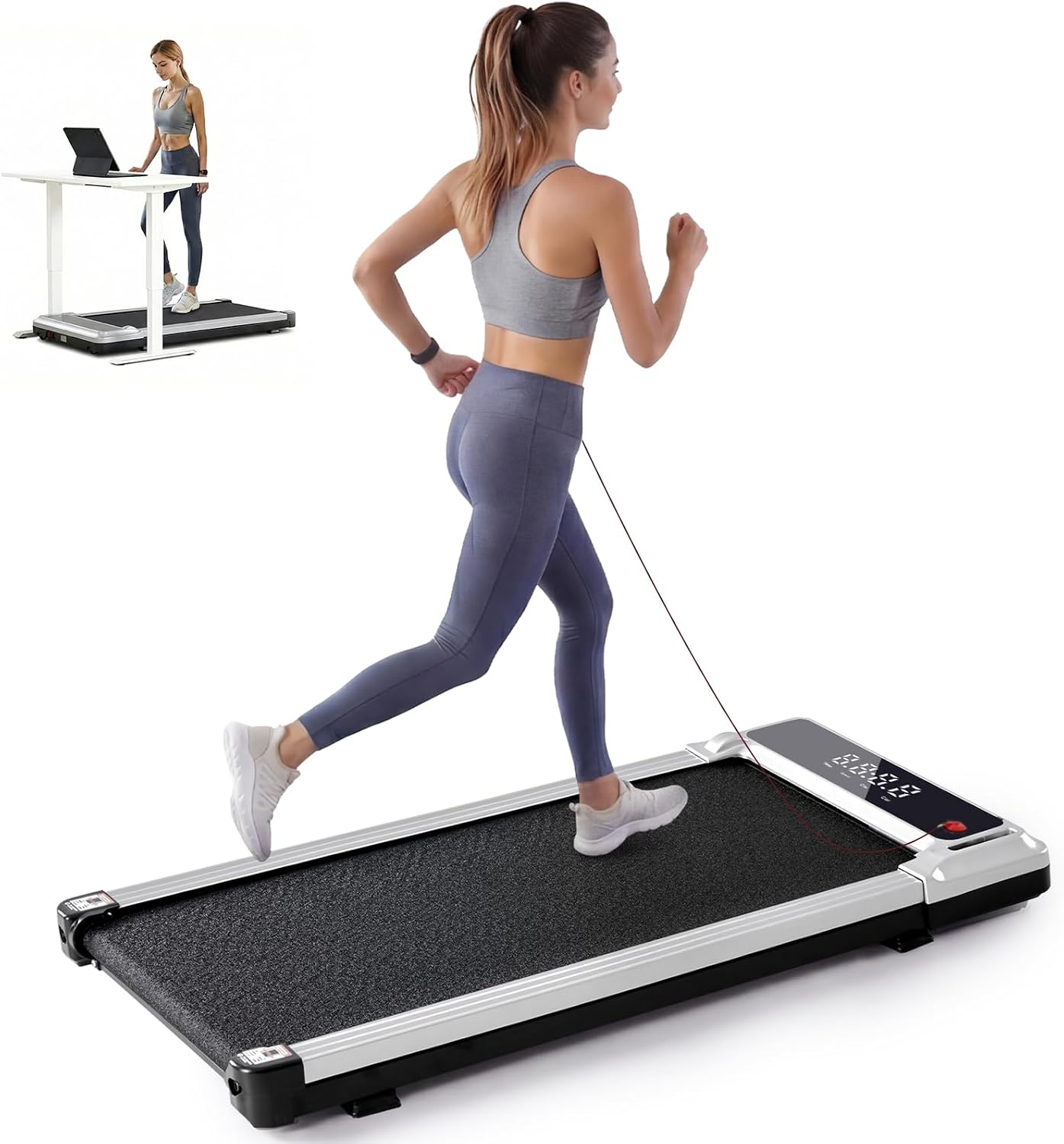
Walking pad pick: NEWBULIG Foldable Walking Pad with Handle Bar,Treadmills for Home Office
 Visit on Amazon →
The handle bar is the reason this one is on the list instead of the dozen bare pads that look identical in search results. A pad with no rail is fine for a slow shuffle while you type, but the moment you want to pick up the pace, you want something to hold. The fold and the low profile are what make it work in an apartment: it is the machine you slide against the wall when you are done, not the one you leave out because moving it is a project.
The check I would run in week one: put it on a hard, level floor, not on a rug with a thick pad underneath, and walk at your normal pace with the belt around 3 miles per hour. Listen to the motor during a call. If you can hear it through the wall, it is not the quiet machine the listing implies, and you have your answer about whether it stays.
The other check is the safety lanyard. Clip it on every session. That is non-negotiable on any belt, and it is the first thing I look for on a budget machine.
Flaws but not dealbreakers: A pad is a walking machine. If you are a runner, this is not the deck you are looking for, and no amount of good intentions changes that.
Anyone who wants steps during the workday, or who lives above a neighbor and needs something they can carry and store, will get real use out of it.
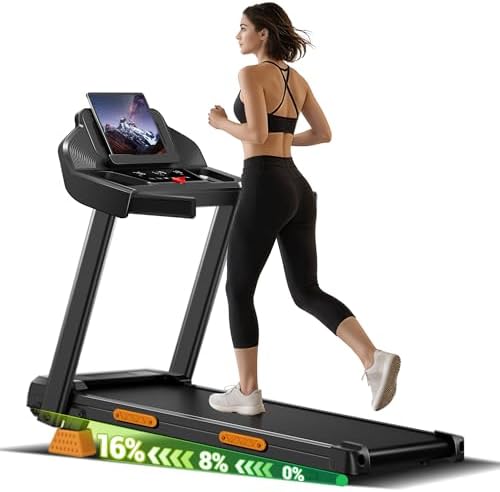
Incline treadmill pick: CURSOR FITNESS 16% Incline Treadmills for Home with 3 LED Displays
 Visit on Amazon →
A 16% incline is the spec that makes this the more interesting machine of the two. Incline is how you make a home treadmill hard without asking the motor to run fast, and it is the reason walkers can get a genuine workout on a machine that tops out well below running speed. The three LED displays cover the basics: time, speed, distance, and the numbers you actually look at mid-session.
Here is what to verify before you commit. First, the incline system. If it feels like plastic blocks under the deck that wobble slightly, the whole machine is cutting corners somewhere, and you should expect to find a couple more of them. Second, the fold. Fold it and wheel it yourself, ten times, before you decide it lives in your apartment. A folding treadmill only counts as foldable if you can actually move it when it is folded, and the wheels and the weight are the real spec, not the marketing word. Third, the deck. Measure your stride before you buy. If your stride does not fit the belt, nothing else on the machine matters.
Flaws but not dealbreakers: Incline at this price point usually means a simple system, so do not expect the silent, instant grade changes of a gym machine. Expect it to work, and expect to hear it move.
Anyone who wants to walk uphill, jog short intervals, and still fold the machine into a corner should start here.
The setup and stride checklist
This is the part that decides whether the machine gets used. Work through it in order.
Step one: measure your stride, not your room. Take a normal running step, mark heel to heel, and measure it. If that number is longer than the belt, you will shorten your steps without noticing, and that is how a treadmill wrecks a stride. Deck length is the first spec I check on any machine for exactly this reason.
Step two: measure the folded footprint and the path to storage. Folded dimensions are one number. The width of the doorway between the living room and the closet is a different number, and it is the one that matters. Walk the route with a tape measure before you order.
Step three: put it on a hard, level surface. Carpet plus a thick pad is the fastest way to make a budget deck feel unstable. A thin mat on a hard floor is the right setup. If the machine rocks when you press a corner, shim it or move it.
Step four: clip the magnetic safety lanyard on every session. The lanyard kills the belt if you fall. It is the one safety feature I check on every machine, and the one people disable because it is annoying. Leave it on.
Step five: break the belt in before you judge it. Ten to fifteen minutes at a slow walk, then check that the belt is centered and tensioned per the manual. A belt that drifts to one side is a tension issue, not a defective machine, and it is a five minute fix.
Step six: lubricate on a schedule, not on a feeling. Silicone lubricant under the belt, per the manual, roughly monthly or every 30 to 50 miles of use. Never use a petroleum based spray. If you can hear the belt dragging at low speed, you are late.
Step seven: test the incline while you are standing next to it. Run the incline up and down through its full range with nobody on the deck, and watch how the mechanism moves. If it wobbles and feels like plastic blocks under the deck, that is your answer about build quality. Incline blocks are the tell.
Step eight: fold and move it ten times. Not once. Ten. If the tenth time annoys you, the machine is going to live unfolded in your living room forever, which is how a treadmill becomes a coat rack.
Step nine: do the conference call test. Walk at your normal working pace and take a call. If you have to turn the TV or your headphones up to hear the other person, the motor is louder than the listing suggests.
Step ten: check the belt at 200 miles. Look at the edges for fraying, and look for rubber dust under the deck. Some dust is normal. Frayed edges and a visible seam are not, and that is when you use the warranty.
What I left out and why
Full size gym treadmills are wonderful machines and terrible apartment furniture. A heavy deck and a big motor are exactly what you want in a gym with a concrete floor, and exactly what you do not want in a 680 square foot living room where the machine has to move.
The big connected brands get the most questions, and for most home buyers the answer is still a good folding treadmill at a fraction of the price. You are paying for a screen and a subscription, and the app is the part that ages worst. If a machine's best feature sits behind a monthly paywall, that is a treadmill you rent, not one you own.
Bare walking pads without a handle bar are the other thing I left out. They are fine if your only goal is steps while you type. The moment you want to walk faster than a shuffle, you want a rail, and the pad above is the one that gives you that.
What the money actually buys
At this end of the market you are buying three things: a deck that fits you, a motor you can live with, and a frame that survives being folded twice a day. Everything else, the displays, the programs, the color of the console, is decoration.
Budget machines are not bad. They are honest. The question is whether the honesty matches what you are paying. A walking pad that folds flat and slides under a couch is honest about being a walking machine. An incline treadmill that gives you a real grade at a low price is honest about being a walking and light jogging machine. What is not honest is a listing that shows a handle bar the box does not include, or a whisper quiet motor you can hear through the wall. Study the photos twice, and read the questions and answers on the product page before you order.
Questions I get every week
Will a walking pad fit under my couch? Measure the clearance first. Most are built to slide under furniture, but clearance varies, and a pad that does not fit is a pad that lives in the middle of the room.
Can I run on a walking pad? A walking pad is a walking pad. Some will go fast enough for a slow jog, but the deck is short and most of them have no rail. If running is the goal, buy the machine with the incline.
How loud is too loud for an apartment? If you have to raise your voice to talk over it at walking speed, it is too loud for a shared floor. Test it during a call in the first week, while you can still return it.
Do I need to lubricate a new treadmill? Check the manual. Some ship pre-lubricated and ask for the first application at 30 to 50 miles. Either way, buy the silicone lubricant when you buy the machine, so the first service is not a reason to stop using it.
The machine is the easy part. Measure your stride, measure your door, test the noise, and fold it ten times before you fall in love with it. Do that, and the treadmill you buy in September is still the treadmill you use in February.