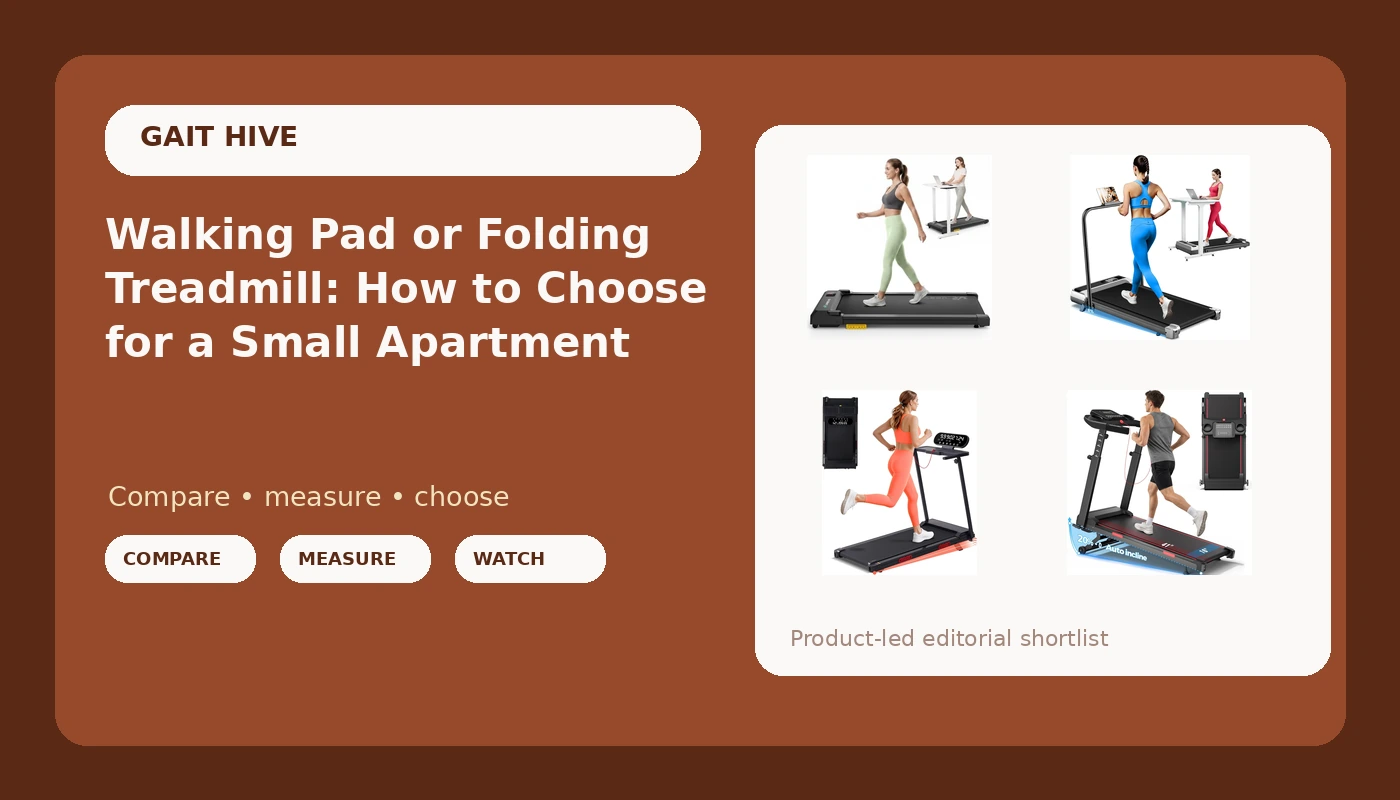
Most people who start shopping for a walking pad with handle bar in a small apartment are really asking two questions: can this machine do the job I actually have, and can I get it out of the way when I am finished with it? Those questions pull in different directions, and the four machines below answer them differently. One is built around a steep auto incline and a bar to hold. One is a desk-first walking pad with app tracking and dual shock absorption. Two fold down and slide under a desk or against a wall, and one of those adds a speed range that reaches into jogging. None of them is a gym treadmill, and none of them needs to be. The match that matters is between the machine and the way you actually move, not the number printed on the motor.
Related: Walking pad vs. folding treadmill: which one belongs in a small apartment? →
Quick answer
Match the deck and the top speed to how you will really use the machine, then sort out the rest. If your goal is walking while you work, a low-profile desk walking pad with app tracking is the simpler fit. If you want incline and something to hold, a folding under-desk treadmill with a built-in incline and handle bar covers more ground in the same floor space. If you want to walk or jog at higher speeds with a handle for balance, look at the compact pad with the wider speed range. Every detail below comes from the manufacturer listings. Nothing here is a measured result, and no machine is called the quietest, fastest, or best.
Four useful options
| Model | Best fit | What stands out |
|---|---|---|
| Treadmill for Home with 20% Auto Incline, Walking Pad with Handle Bar | Walkers and joggers who want the steepest incline and a bar to hold | Automatic incline rated up to 20 percent |
| UREVO Smart Walking Pad, Standing Desk Treadmill with Double Shock Absorption, Quiet Operation, Workout APP with Track Insights and MIIT Mode, Plug and Play, Remote or APP Control for Home Office | Desk workers who want app-tracked walking | Double shock absorption, app with track insights, plug and play setup |
| MCRG Portable Walking Pad Treadmill with Handle Bar Incline for Home Small, 3.5HP Electric Walking Pad Treadmill with Incline, Compact Mini Treadmill with Handles for Exercising, 0.6-10MPH, 400LBS | Higher-speed walking and light jogging in a compact frame | Speed range of 0.6 to 10 MPH and a 400 lb capacity rating |
| Walking Pad Treadmill with 8% Incline for Home Office,3.0HP Low Noise Portable Folding Under Desk Treadmill with Remote Control,Jogging Running Machine,350 Lbs Capacity,Handle Bar | Folding under a desk with a moderate incline | Folding frame, 8 percent incline, remote control |
The incline-focused option: Treadmill for Home with 20% Auto Incline, Walking Pad with Handle Bar
The trade-off with an incline frame is that it is heavier and bulkier than a flat pad, and it raises the deck height, which matters if you plan to keep it under a desk. If your plan is walking at 2 to 3 MPH while answering email, a 20 percent tilt is more machine than the job requires. If your plan is to make a walk genuinely harder without leaving the apartment, this is the direction to look.
The desk-walking option: UREVO Smart Walking Pad, Standing Desk Treadmill with Double Shock Absorption, Quiet Operation, Workout APP with Track Insights and MIIT Mode, Plug and Play, Remote or APP Control for Home Office
There is no handle bar here, which is the honest limitation. If you want to jog, you want something to hold, and this pad is not that machine. It is also worth checking what the app unlocks before you lean on it. Apps that put the useful numbers behind a subscription are a common frustration in this category, so read the app listing carefully and decide whether you care.
The folding option with a moderate incline: Walking Pad Treadmill with 8% Incline for Home Office,3.0HP Low Noise Portable Folding Under Desk Treadmill with Remote Control,Jogging Running Machine,350 Lbs Capacity,Handle Bar
The honest test of any folding treadmill is not whether it folds, but whether the folded machine is something you can lift and roll on your own, ten times a week, without dreading it. Wheels and folded weight are the real specs. If the folded unit is awkward to move, it will end up staying where it is, and a treadmill that never moves has stopped being a folding treadmill.
The compact speed option: MCRG Portable Walking Pad Treadmill with Handle Bar Incline for Home Small, 3.5HP Electric Walking Pad Treadmill with Incline, Compact Mini Treadmill with Handles for Exercising, 0.6-10MPH, 400LBS
Higher listed speed does not automatically mean a longer deck, so this is the machine where you should check belt length most carefully against your natural stride. A compact frame that reaches jogging speed is a real option for small spaces, but it only works if your feet have somewhere to land. If you are tall or you take long steps, compare the belt length to the other three before deciding.
Prices and availability may change. Product images, names, and retailer links are matched to verified listings. No current price, rating, stock status, or measured result is stated here without current evidence.
What deck length and stride really mean at home
Your stride is the distance from one footfall to the next. The deck is the surface you land on. Those two numbers decide whether a machine feels natural or whether you spend the whole session taking smaller than normal steps without realizing it, which changes your gait and puts strain where you do not want it.
Walking pads are generally fine for walking because walking strides are short and slow. Running and jogging need room to stride out. When the belt is shorter than your stride, you unconsciously shorten your step, and over a few miles that adds up in your hips and calves. A handle bar does not extend the deck. It helps with balance and confidence, and it gives you something to hold when you raise the incline, but it does not create landing room that is not there.
To get a rough sense of your stride, walk or jog a few steps on a measured surface and note where your foot lands relative to your starting point. Then compare that to the belt length on the listing. This is the first spec to check, before motor size, before incline, and before app features.
How to read incline, horsepower, and speed specs
Incline percentage is rise over run. A 20 percent incline is steep enough to change how a walk feels; 8 percent is a moderate tilt that most people can hold for a full session. Some budget machines use manual incline blocks, which are plastic risers under the deck. They work, but they can wobble slightly, and a wobbly incline system usually signals that corners were cut somewhere else on the machine. A motorized auto incline adjusts while you are on the deck, which is the more convenient design.
Horsepower figures on listings are often peak ratings rather than continuous output, so a 3.5HP motor and a 3.0HP motor may feel similar at walking speed. What you actually notice at home is noise at 2 to 3 MPH, not top-end power, because that is the speed you will live at. Any "low noise" or "quiet" wording in a listing is marketing language until you hear the machine in your own room. If you take calls while walking, plan to test that on day one while the return window is open.
Speed ranges tell you the intended use. Around 0.6 MPH is a slow shuffle, 3 to 4 MPH is a solid walk, and 10 MPH is running. Capacity ratings include the person plus whatever they are carrying, so treat the number as a ceiling and expect the frame to feel more flexible near it.
- Measure your natural stride, then compare it to the belt length on each listing.
- Decide whether you are walking, jogging, or doing both, because that sets your minimum deck and speed.
- Measure the floor space, the folded footprint, and the ceiling clearance above the deck if you plan to use incline.
- Decide whether you need a handle bar for balance, incline support, or jogging.
- Confirm the safety lanyard, the lubrication guidance, and the return window before you order.
Practical guidance for a small apartment
- Measure twice: the space where the machine runs, and the space where it lives when it is not running.
- Assume the folded machine is heavier than the listing photos suggest, and think about the path from closet to desk.
- Pick a walking speed you can hold through a full meeting before you worry about top speed.
- Check the safety lanyard first. It is the one feature that should be non-negotiable on every machine.
- Plan for belt lubrication, because a dry belt gets noisy and wears faster.
- Read the app description closely and find out what is free and what is behind a subscription.
Which option should you choose?
Choose the Treadmill for Home with 20% Auto Incline, Walking Pad with Handle Bar when you want the steepest incline and a bar to hold for balance or for harder walking sessions. Choose the UREVO Smart Walking Pad when your priority is walking at a standing desk with app-tracked data and a simple plug and play setup. Choose the Walking Pad Treadmill with 8% Incline when you need the machine to fold away under a desk and you want a moderate incline plus a remote. Choose the MCRG Portable Walking Pad Treadmill when you want a compact frame with a handle bar that is listed into jogging speed.
The caveat is that all four are described by their listings, not by a lab. Incline percentages, horsepower, speed ranges, and capacity ratings come from the manufacturer, and the word "quiet" appears in listings more often than it survives a real apartment test. Use these numbers to narrow the field, then judge the machine on your own floor while you can still return it.
The bottom line
For most small apartments, the decision comes down to deck length and intended speed first, incline second, and app features third. If you walk while you work, a desk-first pad keeps things simple. If you want incline and a handle, a folding under-desk treadmill with a built-in tilt gives you more range in the same footprint. If you want to reach jogging speeds in a compact machine, check the belt length against your stride before anything else. Buy the machine that fits how you move, keep the return window open, and test the noise on your first call.