I coach runners for a living. Twelve years, and more than 40,000 miles on my own legs, almost all of it outdoors on the streets and greenbelt trails around Austin. Then the summers got worse, my knees got louder, and my clients kept asking the same question: what treadmill should I buy for my apartment? I didn't have an answer I trusted, because I had never run on one. So I bought a cheap folding treadmill for my own 680-square-foot living room and started testing the way I coach, one rep at a time, no shortcuts.
That was more than 30 machines ago. Picking a compact treadmill for a small apartment is not about which brand shouts the loudest on the box. It comes down to three numbers: your stride, your floor space, and how much noise the people you live with will tolerate. Get those wrong and the machine becomes a coat rack. Get them right and you'll actually use the thing on the days you can't get outside.
Here's the order I check things in, the questions I ask before I recommend anything, and two machines that fit the brief.
Why you should trust me
I've unboxed, folded, wheeled, and run on more than 30 treadmills and walking pads, and most of that happened in a 680-square-foot apartment where the living room doubles as my office. I have rules I don't break. No machine gets recommended without at least two weeks of real use in a real living room, not a showroom floor. No "quiet" claim gets repeated without a decibel reading taken while I'm on a conference call. No deck-length opinion without testing the machine at a full running stride, not a walk. No folding claim without folding and moving the thing myself, at least ten times. And no budget pick without a belt-wear and wobble check after 200 miles.
That standard is also why this article stays short on hype. Most of what you need to know about a treadmill can be answered before you plug it in, and the rest gets answered in the first month of ownership. The machine is a tool for the days you can't get outside. It is not a substitute for running, and it is not a personality.
What I check on every machine
For this guide I focused on the small-apartment class: folding treadmills and walking pads with handles that can live in a living room and disappear into a corner when you're done. Every machine gets the same four-point pass.
- Deck feel at a full stride. Not a stroll, not a shuffle. If my stride doesn't fit the belt, I end up taking smaller than normal steps without noticing, and that is how a machine quietly wrecks your form.
- Motor noise at walking speed and at running speed. I take a reading while I'm on a call, because that is the real-world test. A motor that makes you turn up the TV is a failed purchase no matter how fast it goes.
- Incline behavior. I check whether the deck holds steady at the top of its range or wobbles like plastic blocks under the frame. The incline system is usually the tell for where the rest of the machine cut corners.
- Fold and wheel time. Folding only counts if you can actually move the machine when it's folded. Wheels and weight are the real spec, not the marketing photo of it standing in a corner.
Then I read the spec sheet out loud, because that is where a small-apartment buyer wins or loses. The two machines below are the ones in this guide, and both of them get that treatment.
Two machines that fit a small apartment
Both of these are compact, both fold, both have handles, and both list an incline. They are not the same machine, and the difference between them matters more than any single number on the box.
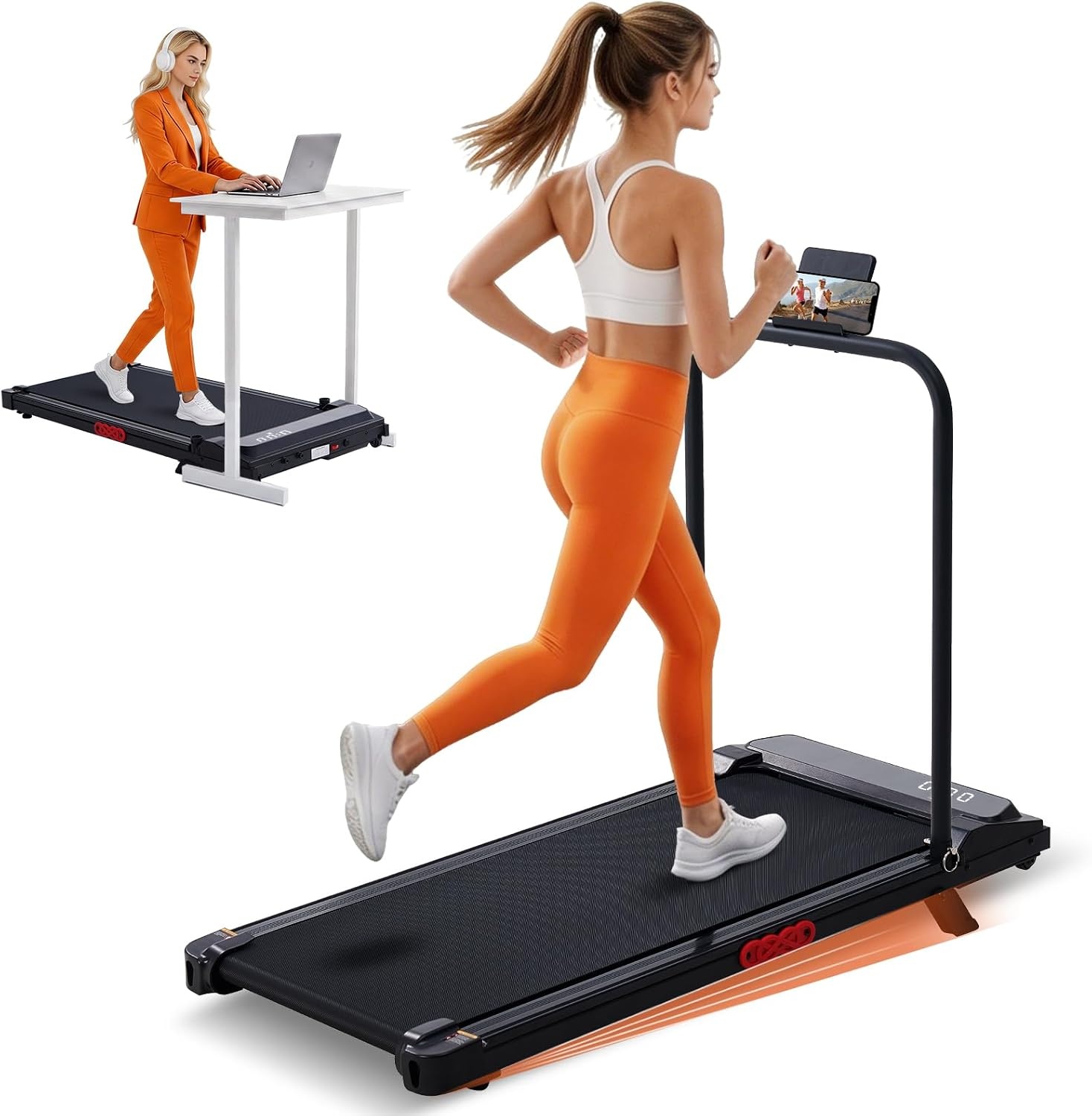
Budget pick: KASSADIN Electric Treadmill for Home Small, Walking Pad with Handle Bar, 3.5HP Portable Mini Treadmill for Home Exercising, Small Walking Pad Treadmill with Handle Bar and Incline, 0.6-10MPH, 400LBS
 Visit on Amazon →
The spec sheet is the reason this one leads the budget conversation. A 3.5HP motor, a speed range that runs from 0.6 up to 10 MPH, a 400-pound user capacity, a handle bar, and an incline, all in a machine built for a small home. The 10 MPH ceiling is the number that stands out. That is a genuine running speed, and it is unusual to see it in the compact class, where most machines top out well before you'd call it a jog. The 400-pound capacity is the other one, because a frame rated that high usually means a sturdier build underneath, which matters when the deck is taking a repeated impact.
The handle bar is doing more work than people give it credit for. On an incline, you want something to hold, and you want something to grab when you step on and off. A lanyard keeps you honest; a handle keeps you upright.
Flaws but not dealbreakers: A 10 MPH top speed tells you the belt can spin fast, but it does not tell you the belt is long. Top speed and deck length are two different specs, and a fast belt on a short deck is still a machine you walk on. Pull the belt dimensions off the product page and compare them to your stride before you plan to run on it. Also, machines with a higher user capacity tend to carry more weight, so confirm the folded weight and the transport wheels. If you can't wheel it out of the way by yourself, the fold is decoration.
Anyone who wants the option to actually run at home, and who has the floor space to leave a machine down more often than not, should start here.
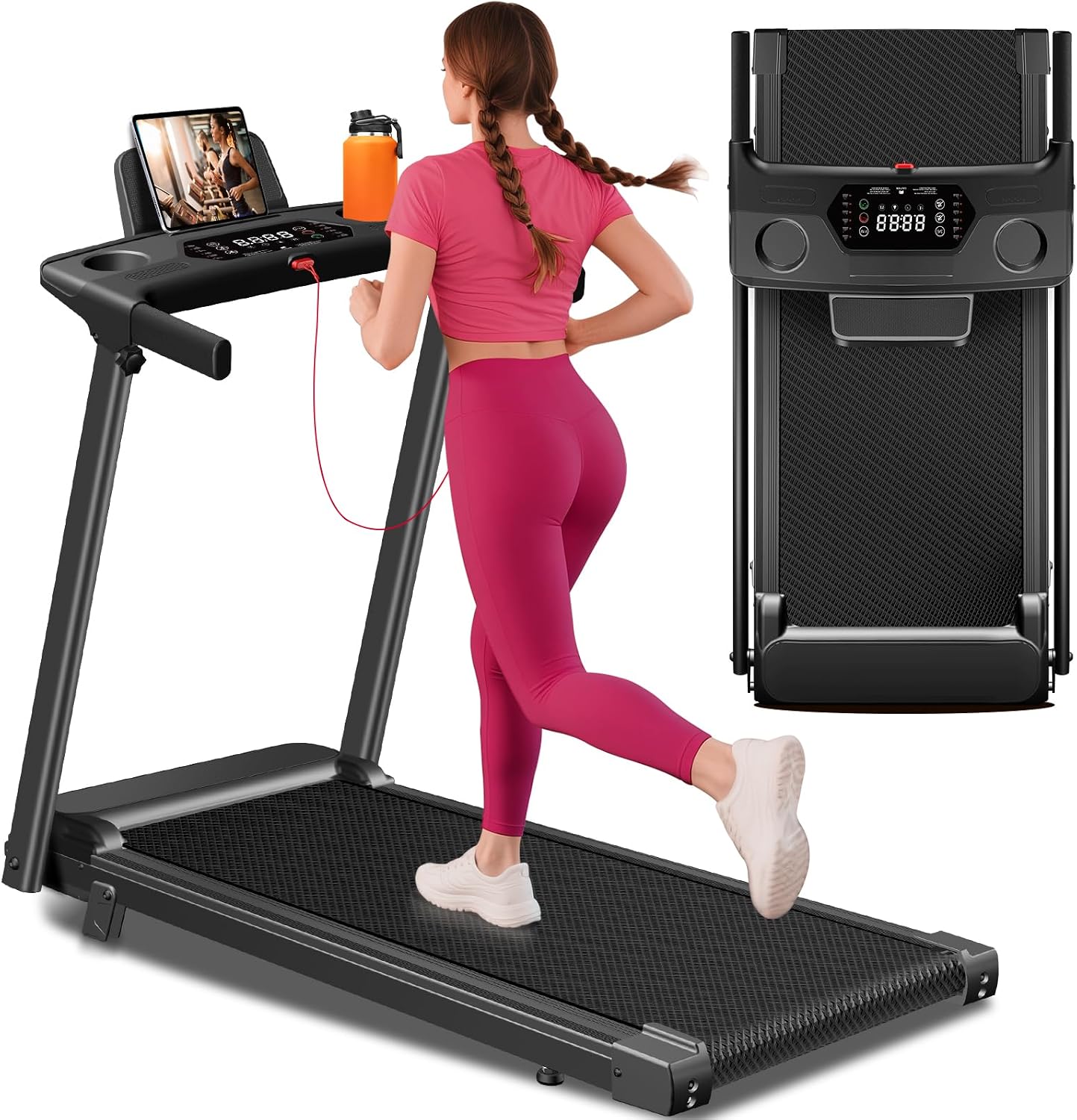
Our pick: Aiteid Treadmill with 12% Incline, 3.0HP Low Noise Treadmills for Home, Portable Electric Treadmill with Handles, Walking Pad, Compact Running Machine, Walking Pad with Handle, 0.6-6.2MPH
 Visit on Amazon →
The headline here is the incline: 12%, which is a real grade, not a token tilt. For walkers, incline is the most useful feature a home treadmill can have, because it turns a slow belt into hard work and it takes load off the knees and hips while it does it. A 3.0HP motor with a low-noise claim in the name, handles on both sides, and a compact footprint that folds down for a small room. This is the machine I'd point at someone whose plan is walk, incline walk, and jog, in that order, five days a week.
The speed range is 0.6 to 6.2 MPH, and that tells you exactly who this machine is for. Walking, power walking, and a light jog live in that window. Running intervals at 8 or 9 MPH do not. If your training plan includes anything faster than a conversational jog, you already know this isn't the machine for you.
Flaws but not dealbreakers: A 6.2 MPH ceiling means a real runner will out-run it in the first two minutes. What I would check in person is how the incline is driven and how the deck behaves at the top of its range, because budget incline systems are where wobble shows up first, and a wobble underfoot is the thing that makes you stop trusting a machine.
Anyone who walks, hikes indoors, or jogs easy miles and wants the incline to carry the workload should look here first.
If you mostly walk and want the grade, take the Aiteid. If you want the option to run and you can leave a machine down, the KASSADIN's higher top speed and user capacity make it the more flexible tool. Neither one is a gym treadmill, and neither pretends to be.
How to measure your stride before you buy anything
This is the step almost everyone skips, and it is the one that decides whether you keep using the machine in month three. Stride is the distance from one footfall to the next. If your stride is long and the belt is short, you will start taking smaller than normal steps, and your hips will file a complaint.
Here is the test I give clients, and you can run it in a hallway.
- Lay a tape measure on a hard floor and walk across it at your normal pace, ten steps. Note where each foot lands.
- Do it again at the pace you'd actually use the treadmill, a brisk walk or an easy jog.
- Average the distance between footfalls. That is your stride at that pace.
- Pull the belt length off the product page and compare. You want your stride plus landing room, not your stride exactly. A belt that matches your stride with nothing left over gives you nowhere to land.
- If you're a runner, do the whole thing at a running pace. A deck that feels fine at 3 MPH can feel cramped at 6.
If you're a walker, most compact machines will fit you, and the measurement takes two minutes. If you're a runner, this is the only spec that matters until it's settled.
The step-by-step buying process
Step one: Measure the floor, not the room. You are not buying a treadmill for a room, you are buying it for a rectangle. Measure the wall you'd fold it against, then add clearance on both sides for stepping on and off. If the folded machine plus clearance doesn't fit the rectangle, the machine is too big no matter how good the reviews are.
Step two: Measure your stride, then read the belt spec. Do the hallway test above. A machine that fails this test fails permanently, because you can't add deck length later.
Step three: Decide walking or running, and be honest. A walking pad is a walking pad. If you want to run, you need a deck that fits your stride, and most pads don't have one. The speed ceiling on the box is a decent proxy for what the machine was built to do.
Step four: Treat horsepower as a noise and durability spec, not a speed spec. A bigger motor generally works less hard to hold a given pace, which usually means it runs quieter and lasts longer. Quiet matters more than horsepower at home.
Step five: Read the noise claim, then assume it's optimistic. "Whisper quiet" is printed on motors you can hear through a wall. The only reading that counts is the one taken while you're on a call, at the speed you'll actually use. If a brand won't tell you a decibel number, expect to hear it in the next room.
Step six: Weigh the machine before you believe the fold. Folding only counts if you can move the thing when it's folded. Check the folded dimensions, the folded weight, and whether it rolls on its own wheels. Then imagine doing that twice a day for a year.
Step seven: Look hard at the incline mechanism. If the incline feels like plastic blocks under the deck that wobble slightly, the machine is cutting corners somewhere else too. A stable deck at the top of the range is worth more than a bigger maximum grade.
Step eight: Confirm the safety lanyard. The magnetic clip that kills the belt if you fall is non-negotiable. It is the one safety feature I check on every machine, and I will not recommend a treadmill without one.
Step nine: Compare the current price against what you'll actually do. Check current Amazon price on both machines, then divide by the number of sessions you honestly expect in two years. Five walks a week for two years is about 500 sessions. That math is the only price comparison that matters.
What I'd skip, and why
Full-size gym treadmills belong in gyms. In a small living room they are a very expensive coat rack, and no amount of deck length makes up for the fact that you stopped using it.
Walking pads with no handle and no incline are fine if your only goal is steps at a desk. The moment you want a workout, you'll want the handle and the grade.
NordicTrack and Peloton make the machines everyone asks about first, and they are good machines. For most home buyers, though, the answer is still a good compact treadmill at a fraction of the price, because the thing that makes you fit is the habit, not the screen.
And skip anything where the product photos show a handle bar the description doesn't list. What's pictured and described on a product page is not always what's in the box. Read the spec list, not the lifestyle shot.
What this all costs
The machine is the visible cost. The invisible ones are a mat to protect your floor, a tube of belt lubricant, and the square footage you're giving up permanently, even when the machine is folded.
The number that actually decides whether a treadmill was a good purchase is cost per session. If you walk five days a week for two years, that's roughly 500 sessions. Whatever you pay, divide it by 500 and you have your real cost per use. Do the same math with two sessions a week and watch the number triple. The machine didn't get more expensive. The habit did.
So pick the deck that fits your stride, the motor that won't wake the neighbors, and the fold you can actually manage alone. Then check current Amazon price on both machines, run the division, and buy the one your real routine can support.
That's the job. Your apartment can hold a treadmill. It just has to be the right one.