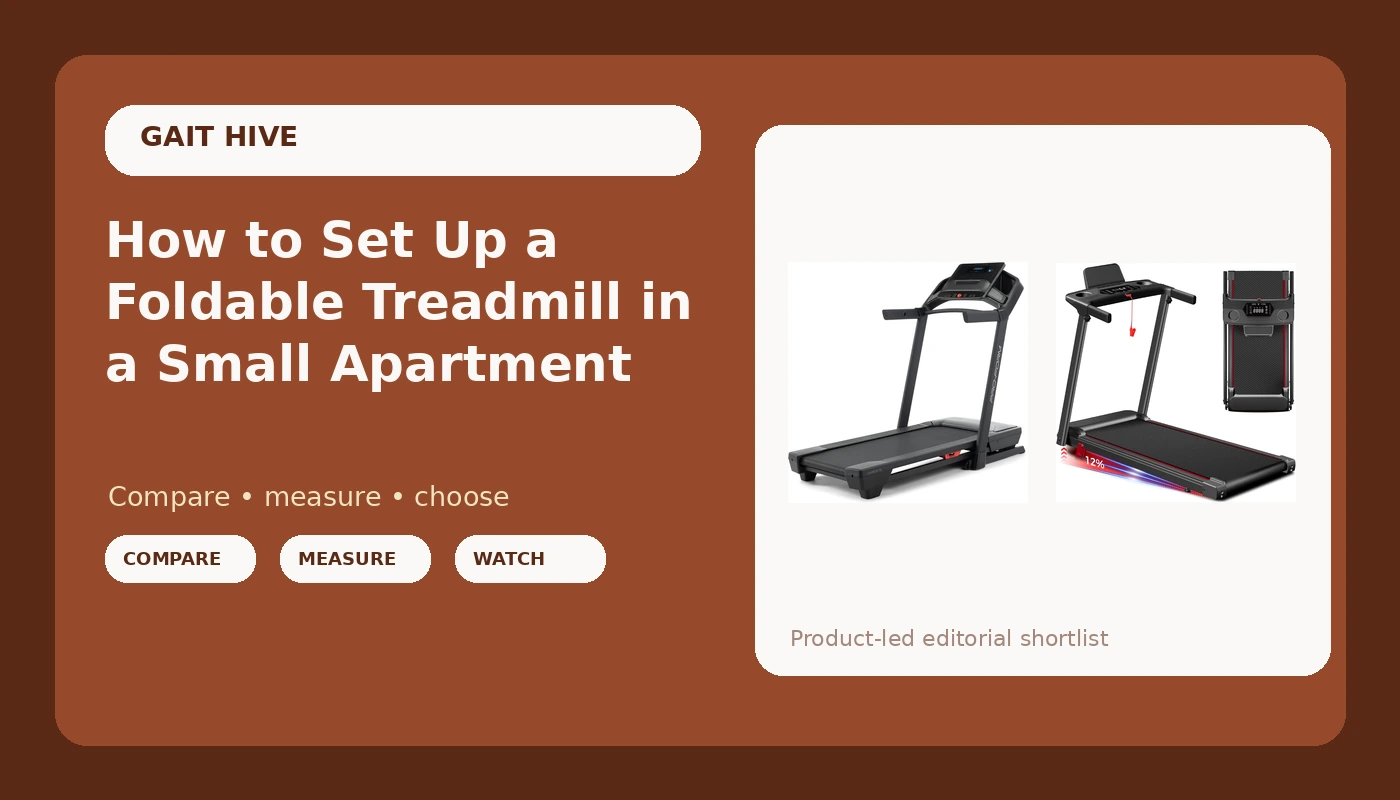
Most people buy a foldable treadmill for apartments in the wrong order. They pick a machine, wait for the truck, then stand in a small living room holding a box and wonder where it is supposed to go. I have done it that way. It ends with a treadmill parked in front of the closet door and a partner who is not thrilled about it.
The order that works is simpler. Measure the room, measure your stride, pick the machine that fits both, then set it up where it will actually live. That is the whole how-to. Everything below is the detail I have worked out after unboxing, folding, wheeling, and running on more than 30 machines in my own apartment in Austin.
Why you should trust me
I have coached runners for 12 years and logged over 40,000 miles myself, almost all of it outdoors on the roads around Austin. I did not own a treadmill until the summers got worse, my knees got louder, and every client started asking the same question: what treadmill should I buy for my apartment? I did not have an answer I trusted, because I had never run on one. So I bought a cheap folding treadmill for my own small living room and started testing the way I coach, one rep at a time, logged, no shortcuts.
Since then I have unboxed, folded, wheeled, and run on over 30 machines in 680 square feet. Nothing gets recommended here without at least two weeks of real use in a real living room. I do not call a motor quiet without a decibel reading taken during a conference call, I do not have an opinion about a deck until I have run a full stride on it, and I do not trust a folding claim until I have folded and moved the machine myself at least ten times.
How I tested and how I picked
Four things decide whether a folding treadmill works in an apartment, and none of them is the top speed printed on the box. First, does my full stride fit the deck? Second, is the motor quiet enough that I can walk during a conference call without the person on the other end hearing it? Third, can I fold it and wheel it out of the way myself, in one motion, without moving furniture? Fourth, does the incline hold up, or does it wobble like plastic blocks under the deck?
The two machines in this guide sit at the two ends of that decision. One is the budget folding treadmill most apartment dwellers should start with. The other is the step-up machine for someone who has the floor space and plans to actually run. Both got the same treatment: walk first, then jog, then incline, then fold and move ten times.
Step one: measure the room before you shop
Take a tape measure and get four numbers. The floor space the machine needs when it is unfolded and you are standing on it. The depth it needs against the wall when it is folded, because most folding treadmills tip the deck up and turn into a tall, narrow object you still have to walk past. The ceiling height at the spot where that folded deck will stand. And the distance from the nearest outlet, because you do not want a power cord crossing a doorway.
Then check the door swing and the closet clearance. In my apartment, the difference between usable and coat rack came down to about six inches next to the couch. Write those four numbers on your phone before you open a single product page. If a machine's listed footprint is bigger than the space you measured, no review is going to save it.
Step two: measure your stride, not your shoe size
Deck length is the first spec I check on any machine, and it is the one budget listings bury. Walking needs very little belt. Running needs room to land and push off. If your stride is long and the belt is short, you will start taking smaller than normal steps to stay centered, and that is how a treadmill teaches you bad habits.
Here is the test. Stand on the deck and walk forward at your normal pace. You want to finish your stride with belt still ahead of your foot. If you are already at the front of the machine after two steps, the deck is too short for running. It is fine for walking, and there is nothing wrong with that. Just be honest about which one you are buying.
Step three: pick the machine that matches the room
Two machines cover most small-apartment buyers. One for walking and light jogging, one for people who intend to train.
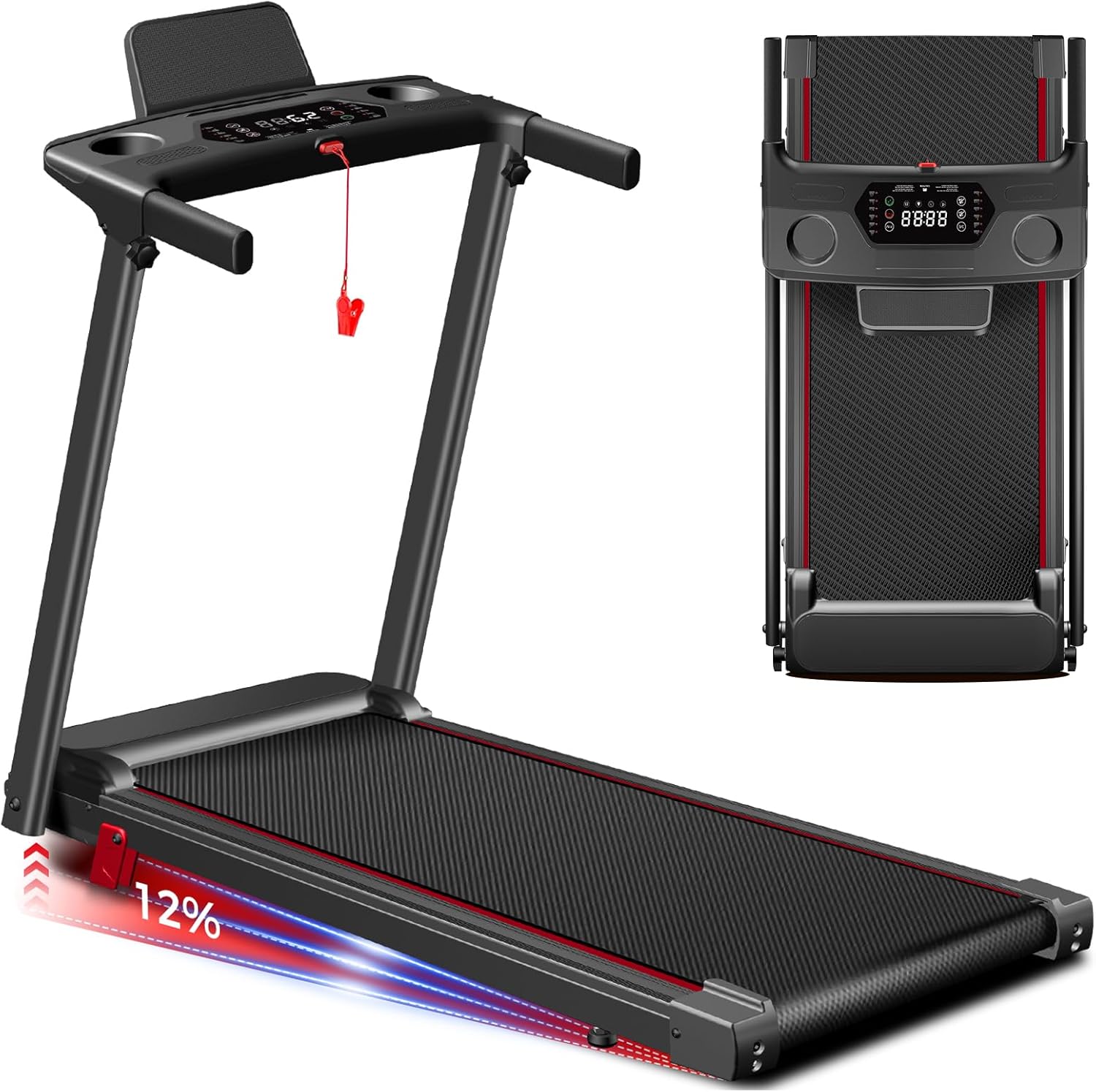
Budget pick: Treadmills for Home 3.0HP Foldable Treadmill with 12% Incline Small
 Visit on Amazon →
This is the folding treadmill I point most apartment dwellers to first, and the name tells you what you are getting: a 3.0HP motor, an incline that goes to 12%, and a small footprint that folds. The motor is the part that matters at home. At walking and easy jogging speed it is not going to be the loudest thing in your apartment, and quiet is the spec that keeps a treadmill in the room instead of in a storage unit. The 12% incline gives you a way to make a short session hard without running faster, which is exactly what you want when the ceiling is low and the neighbors are home.
Two things to check when it arrives. First, the magnetic safety lanyard. Clip it on before you ever press start. It is non-negotiable on every machine, and it is the first thing I check. Second, the incline. Budget machines often use plastic risers to tilt the deck, and those risers can wobble slightly underfoot. If it feels loose, tighten what the manual says to tighten before you use it.
Check current Amazon price, then read the verified buyer photos carefully. Product pages are not the product.
Flaws but not dealbreakers: The deck is small by design. This is a walking and light jogging machine. If you run five miles at a hard pace, this is not your treadmill. And like every budget fold, it rewards you for keeping up with belt lubrication.
Anyone in an apartment or a small spare room who wants to walk, jog, and use an incline without turning the living room into a gym will be happy here.
Upgrade pick: ProForm Carbon Treadmills
 Visit on Amazon →
If you have measured the room, measured your stride, and the honest answer is "I actually run," this is the step up. ProForm Carbon treadmills are full-size machines with a deck that gives you room to stride out, which is the whole point. The trade is space and weight. A bigger deck means a bigger footprint, and a bigger machine is heavier to fold and wheel, so the fold-and-move test matters more here, not less. Before you buy, walk the path you will take to move it: from the wall to the middle of the room and back, past the couch, past the coffee table.
What you get for the step up is a machine that feels like a treadmill and not a walking pad with a console bolted on. The motor and the deck are built for real running sessions, and the incline is integrated rather than a block under the front. That is the difference between a machine you use for a hard workout and a machine you use only when it is too hot to run outside.
Check current Amazon price. If your measured space is smaller than the footprint listed, go back to the folding machine above, because a treadmill that does not fit is a treadmill you will not use.
Flaws but not dealbreakers: It is heavy, and the folded footprint is still a real object in the room. Get a second person for the unboxing.
Anyone with a dedicated corner, a spare bedroom, or a garage spot who wants to train indoors for real should look here first.
Step four: unbox it in the room where it will live
Do not assemble a treadmill in the garage and then try to get it through a door. Unbox it where it is going to live, on a blanket or a flattened cardboard sheet so you do not scratch the floor or lose hardware in the carpet. Keep the foam and the box until you are sure the machine works, because a return without the original packaging is a bad week.
Count the hardware against the parts list before you start. Budget machines sometimes ship with sparse hardware, and a trip to the hardware store in the middle of assembly is the fastest way to leave a half-built treadmill in the hallway for a month. Follow the manual's assembly order rather than the pictures, and if the instructions read like they were translated by someone who has never seen a treadmill, the video on the product page is usually more reliable.
Step five: place it, plug it in, and clip the lanyard
Leave clearance at the back of the deck and at both sides. You want to be able to step off without thinking about it. Plug directly into a wall outlet if you can. Extension cords and treadmills are a bad pair, and a cord running across a doorway is a trip hazard you will meet at 6 a.m. in the dark.
Then clip the magnetic safety lanyard to your waistband and test it once before your first session. Pull it and confirm the belt stops. That clip is the one feature I will not compromise on, and I check it on every machine before I recommend it.
Step six: lubricate the belt before the first mile
Most folding treadmills ship with a dry or barely lubricated belt, and the budget ones sometimes include a tube of silicone lubricant in the box. Use it, following the manual's interval rather than the internet's. Lubrication is the cheapest maintenance there is, and it is the difference between a belt that lasts and a belt that starts slipping and squeaking within a year. If you have to buy lubricant, buy silicone, not oil, and never apply it while the machine is running.
Step seven: break it in at walking speed
Do not jump on and run. Walk for ten minutes with no incline. Feel whether the belt drifts. Check the belt tension at the sides. Then add incline at walking speed and listen for the wobble. Only after two or three sessions of that should you jog, and only after that should you run.
This is how I test every machine, and it is also how you find a defect while the return window is open instead of a month after it closes.
Step eight: fold it and move it ten times
Here is the test that decides whether a folding treadmill stays in your life. Fold it, wheel it against the wall, and bring it back out. Do it ten times in one sitting. If your back hurts, if the machine scrapes the wall, if the cord snags, or if you have to move a chair every time, the setup is wrong, not you.
The fold only counts if you can actually move the thing when it is folded. Fix the placement now, while the room is still rearranged and you are still motivated.
The maintenance routine that keeps a budget treadmill honest
Every machine in my apartment gets the same three checks. First, belt wear: run your hand under the belt and look for fraying or a glaze. Second, wobble: grab the deck at the back and push side to side. Some flex is normal on a folding frame. A clunk is not. Third, hardware: re-tighten the bolts after the first month and again every few months, because vibration loosens everything.
Add lubrication on the manual's schedule, and vacuum under the deck when you fold it. A budget treadmill is not a bad machine. It is an honest machine, and it stays honest as long as you do that work.
Mistakes that ruin a small-space setup
Buying more machine than the room can hold. Assembling in the wrong room. Skipping the safety lanyard because it feels fussy. Buying a walking pad when you actually want to run, because a walking pad is a walking pad and most of them do not have a deck that fits a running stride. Putting the machine in the room where you will be embarrassed to be seen on it, which is how treadmills become coat racks. And ignoring the incline, which is the single best way to get a real workout out of a small, quiet machine in a small room.
The bottom line
Measure the room. Measure your stride. Pick the folding treadmill that matches both, unbox it where it lives, clip the lanyard, lubricate the belt, walk it in, then practice folding it until moving it is boring. That is the whole job. Do it once and the machine disappears into your routine, which is exactly what a treadmill in a small apartment should do.