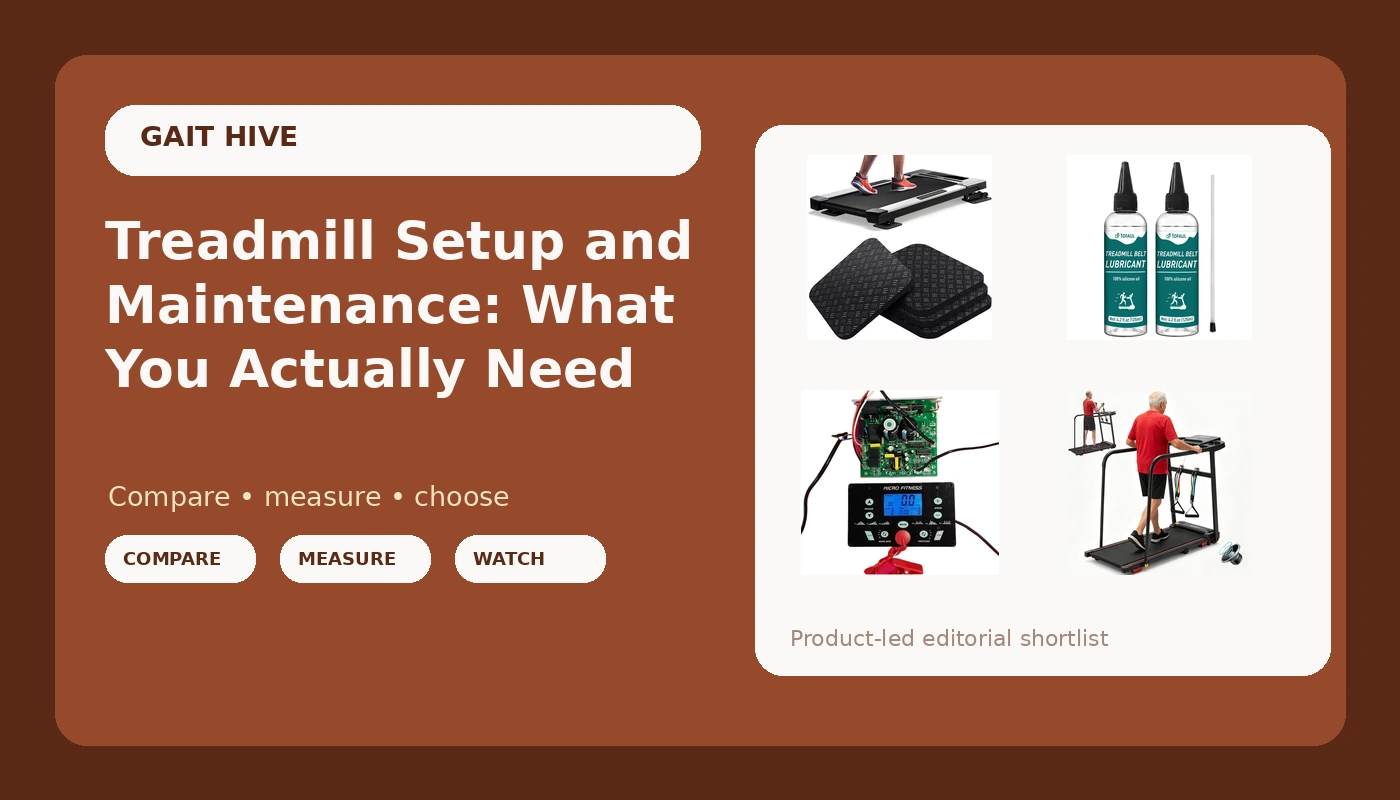
Most people shopping for a home treadmill spend every research hour on the machine and almost none on what happens after the box arrives. That is backwards. A treadmill is a system: the belt, the deck, the motor controller, and the floor underneath all of it interact, and treadmill setup and maintenance is what decides whether the thing still feels solid in year three or turns into a wobbly noise machine that lives under a sheet.
This is not a guide to the fastest motor or the biggest screen. It is a plain explanation of the four pieces that make a home treadmill work, how they fit together, and when each one is the right purchase. If you are setting up a first machine in a small apartment, or trying to decide whether a slipping belt needs oil or a new control board, the order below is the one that saves money.
Related: Treadmill Deck Length: How Belt Size Changes Your Stride →
Quick answer
The machine comes first, because everything else exists to support it. A walking treadmill with long handrails is the sensible starting point for anyone who wants stability and support rather than top speed, and it is the piece the mat, the lubricant, and any future repair part are built around. Add a non-slip, anti-vibration mat if the machine sits on hardwood, keep a bottle of silicone belt lubricant on hand for routine belt care, and consider a universal control board only when an existing treadmill's electronics have failed and the frame and motor are still worth saving. Listings and prices move constantly, so verify current details on each product page before you commit.
Four useful options
| Model | Best fit | What stands out |
|---|---|---|
| Treadmill for Seniors with Long Handrails - Walking Treadmill | A first home machine where stability matters more than speed | Long handrails running the length of the walking area, built as a walking treadmill |
| Treadmill Mat Pads 4PCS- Double-Sided Non-Slip - Anti Vibration Mat for Treadmill, Walking Pad, Exercise Bike - Hardwood Floors Protection | Any treadmill, walking pad, or bike sitting on hardwood or laminate | Four pads, double-sided non-slip surface, anti-vibration and floor protection |
| 1DFAUL Treadmill Lubricant for Belt, 250ml Silicone Treadmill Oil Belt | Routine belt maintenance on any belt-driven treadmill | 250ml of silicone belt oil, the standard lubricant for treadmill decks |
| bdfndjnm Universal Treadmill Circuit Board & Console Display - Comprehensive Motor Control for 1HP-4.0HP Motors, High Compatibility, Enhanced Performance(4HP Lower Controller) | Reviving a treadmill whose electronics have failed | Universal motor control rated for 1HP to 4.0HP motors, includes console display |
The machine: Treadmill for Seniors with Long Handrails - Walking Treadmill
Handrails are the most underrated feature on a home treadmill. They change how confident you feel stepping on, how easily you steady yourself if a stride goes wrong, and how willing you are to use the machine on a day when you are tired. A walking treadmill with rails that run the length of the deck is doing one job well rather than pretending to do five.
The trade-off is honest: this is a walking machine, not a running machine. If your goal is a full running stride at speed, the deck length and motor class of a walking treadmill will not be enough, and you would be taking smaller than normal steps to stay on the belt. If your goal is daily walking volume at home, indoors, in whatever clothes you already have on, this is the piece the rest of the setup is built around. Whichever machine you buy, check that the magnetic safety lanyard is present and that the clip actually engages before your first session.
Floor protection: Treadmill Mat Pads 4PCS- Double-Sided Non-Slip - Anti Vibration Mat for Treadmill, Walking Pad, Exercise Bike - Hardwood Floors Protection
Two things happen when a treadmill sits directly on hardwood. First, the machine can creep. Walking belts transmit a small forward force, and over weeks a machine without grip under its feet drifts toward the wall or the doorway. Second, vibration travels straight into the floor structure, and in an apartment that means the neighbors hear a low thump they cannot identify. Pads address both problems at the contact points, which is where they originate.
The honest limitation is that pads are not soundproofing. They reduce transfer at the feet, they do not silence a motor or a belt. If you can hear the machine clearly through a wall, the fix is a different machine or a different room, not a thicker mat. What pads do well is cheap and unglamorous: protect the finish you paid for, keep the machine where you put it, and take the edge off the vibration your downstairs neighbor notices most.
Belt care: 1DFAUL Treadmill Lubricant for Belt, 250ml Silicone Treadmill Oil Belt
A treadmill belt slides on a deck, and that interface is the single biggest source of wear on a budget machine. Dry belts drag, drag makes the motor work harder, and a motor working harder gets louder and hotter. Lubrication is not a performance upgrade. It is the difference between a belt that lasts and a belt that starts slipping and glazing.
Silicone is the right chemistry here because it does not degrade rubber the way petroleum-based oils can. The practical rule most manufacturers publish is to check the belt and deck on a schedule rather than waiting for a symptom, and to apply oil sparingly along the deck under the belt, then walk the machine at low speed to spread it. Over-oiling is a real mistake: excess oil can migrate onto the belt surface and cause slipping. Follow the machine's own manual for interval and quantity, because deck material and belt type vary. What this bottle gives you is the correct fluid in a size that lasts through several maintenance cycles.
Repair part: bdfndjnm Universal Treadmill Circuit Board & Console Display - Comprehensive Motor Control for 1HP-4.0HP Motors, High Compatibility, Enhanced Performance(4HP Lower Controller)
Control boards fail in a specific, recognizable way. The machine powers on but the belt does not move, or the console lights up and then goes dark, or the belt surges and cuts out. In a treadmill that is otherwise sound, that failure is an electronics problem, not a mechanical one, and the frame, deck, motor, and rollers are all still perfectly usable.
This is the narrowest of the four picks, and it deserves a warning rather than a sales pitch. Replacing a control board is a real repair: you need to match the board to your motor's rating, confirm the wiring and connector layout, and be comfortable working inside a machine that has been unplugged and allowed to sit. If your treadmill is a no-name model with no documentation, matching a universal board can be guesswork, and a machine still under warranty should go back to the manufacturer first. The reason a universal board exists is that electronics are often the first thing to fail and the cheapest thing to replace relative to buying a whole new treadmill. Treat it as a repair decision, not an upgrade.
Prices and availability may change. Product images, names, and retailer links must be matched by verified ASIN. Do not state a current price, rating, stock status, or measured result without current evidence.
Why setup order matters more than specs
Buyers compare motors, top speeds, and screen sizes, then discover the things that actually annoy them were never on the spec sheet. Vibration transfer, belt drag, and whether the machine stays put are setup outcomes. A 2.5HP motor in a machine with a dry belt and hard plastic feet on hardwood will feel worse in daily use than a modest motor that has been lubricated and isolated from the floor.
Think in layers. The floor is layer one. The pads or mat are layer two. The machine's feet and frame are layer three. The belt and deck interface is layer four. The electronics that drive it all are layer five. Problems travel down that stack as easily as up it. A grinding noise you blame on the motor can start as a dry belt. A creeping machine you blame on the frame can start as missing grip under the feet. Diagnosing from the floor up saves you from buying the wrong replacement part.
There is also a safety layer that sits outside all of it. The magnetic safety lanyard is the one feature to check on every machine, every time, before you start. It is a clip that kills the belt if you fall, and it costs manufacturers almost nothing, which is exactly why you should confirm it exists and works rather than assuming it does.
When a part is worth replacing instead of the machine
- Identify the symptom precisely. A belt that will not move at all points at electronics. A belt that slips underfoot but moves fine points at tension or lubrication. A machine that shakes the floor points at isolation and placement.
- Rule out the cheap fixes first. Confirm the belt is lubricated and correctly tensioned, confirm the machine is on a level surface, and confirm the outlet and cord are sound before you spend money on parts.
- Match the part to the machine's rating. A universal control board is specified by motor horsepower range, so read your machine's motor rating before ordering anything.
- Weigh the repair against replacement honestly. If the frame is bent, the deck is gouged, or the motor is failing, a new board will not save the machine. If only the electronics died, the repair usually makes sense.
- Check the warranty before you open the housing. Many treadmills void coverage the moment the motor cover comes off, and a machine still in warranty should be handled by the manufacturer.
Practical setup and upkeep checklist
- Place the machine on a hard, level surface and use non-slip, anti-vibration pads if that surface is hardwood, laminate, or tile.
- Confirm the magnetic safety lanyard is present, attached, and functioning before your first walk.
- Check belt lubrication and tension on the schedule your machine's manual specifies rather than waiting for a noise.
- Keep silicone belt lubricant on hand and apply it sparingly, then run the machine at low speed to distribute it.
- Test the machine at walking speed before you test it at higher speed, and give yourself a clear landing zone behind it.
- Log when you lubricate the belt. Maintenance intervals are easier to keep when the last one is written down.
Which option should you choose?
Choose the Treadmill for Seniors with Long Handrails - Walking Treadmill when you want a home walking machine with support you can hold onto and you are not trying to run. Choose the Treadmill Mat Pads 4PCS- Double-Sided Non-Slip - Anti Vibration Mat for Treadmill, Walking Pad, Exercise Bike - Hardwood Floors Protection when your machine sits on hardwood or another hard floor and you want to reduce creeping and vibration transfer. Choose the 1DFAUL Treadmill Lubricant for Belt, 250ml Silicone Treadmill Oil Belt when you own any belt-driven treadmill and want to keep the belt and deck interface maintained. Choose the bdfndjnm Universal Treadmill Circuit Board & Console Display - Comprehensive Motor Control for 1HP-4.0HP Motors, High Compatibility, Enhanced Performance(4HP Lower Controller) only when a treadmill you already own has lost its electronics and the mechanical parts are still worth keeping.
One caveat on all four. These are different categories of purchase, not competing versions of the same product, so nothing here is a universal upgrade. A mat will not fix a worn belt, a bottle of lubricant will not revive a dead controller, and a control board will not make a walking treadmill suitable for running. Also be aware that compatibility matters most on the repair part and least on the consumables, and that product pages, photos, and listings can change without notice, so confirm the details of the exact item you are ordering.
The bottom line
Home treadmill ownership is mostly a maintenance story, not a shopping story. The machine sets your ceiling, and a walking treadmill with long handrails sets a sensible one for home walking. Everything after that is about protecting the investment: pads to keep it in place and off your floor, silicone lubricant to keep the belt gliding, and a universal control board as a last-resort repair for a machine whose frame still has years left. Buy the machine that matches how you actually move, then take care of the belt and the floor under it. That is the whole system.