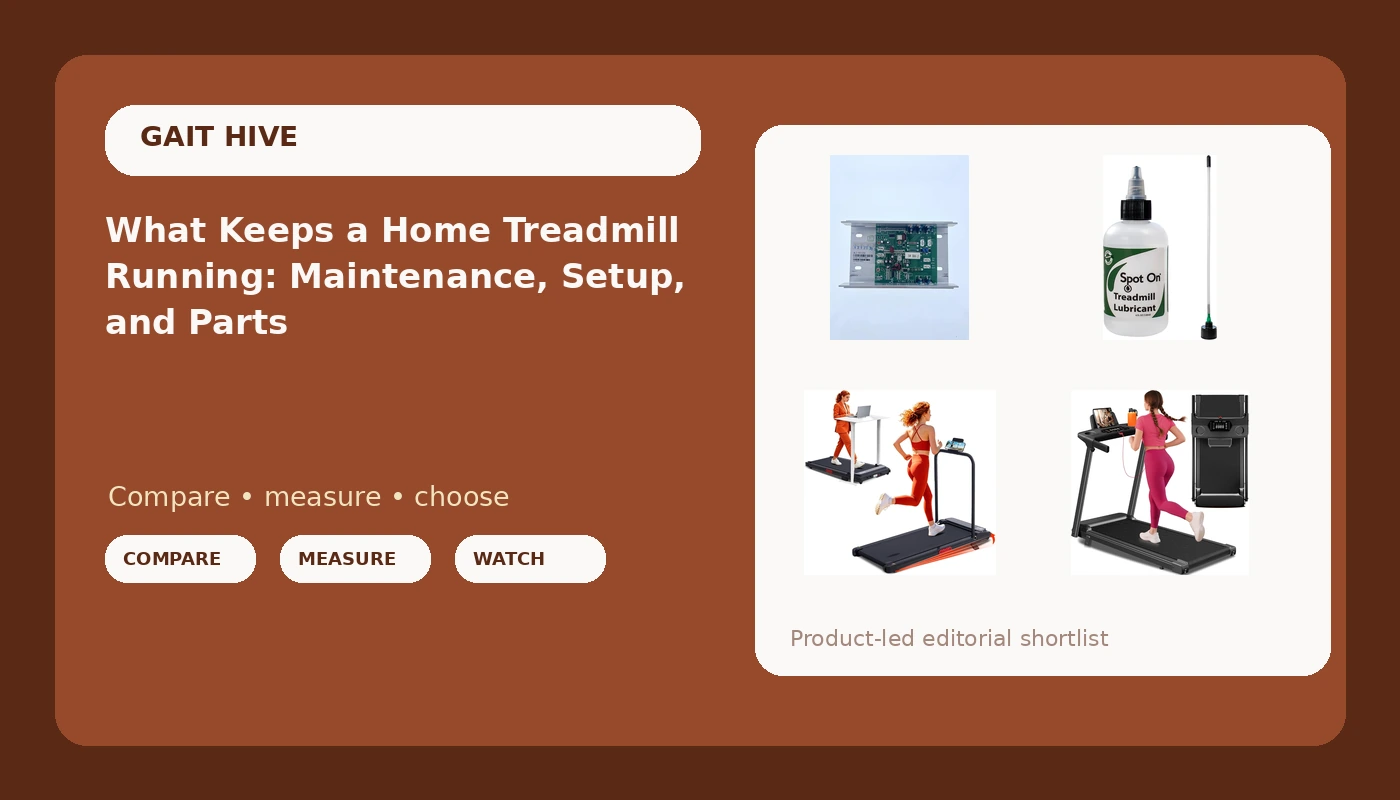
Most people shopping for a home treadmill spend their entire research budget on the machine and none of it on what keeps the machine alive. Then the belt starts dragging, the console throws an error code, and a piece of equipment that cost real money becomes a very heavy coat rack in the corner of the living room. Home treadmill maintenance is neither glamorous nor complicated. It comes down to a short list: keep the belt and deck lubricated, keep the belt tracked straight, and recognize a failed motor control board before you assume the whole treadmill is dead. The four products below sit at different points on that list. Two are machines you can buy, and two are the parts that keep a machine you already own out of the landfill.
Related: Walking Pad vs Folding Treadmill: Which Fits a Small Apartment? →
Quick answer
If you are buying new for a small space, a compact folding treadmill with an incline and handles covers walking and light jogging, while a walking pad covers the days when you only want to walk. If you already own a treadmill, the two items most likely to bring it back into service are a replacement motor control board and a tube of pure silicone belt lubricant. Match the machine to your stride and your room first, then treat the parts as routine upkeep rather than emergencies.
4 useful options
| Model | Best fit | What stands out |
|---|---|---|
| Aiteid Treadmill with 12% Incline, 3.0HP Low Noise Treadmills for Home, Portable Electric Treadmill with Handles, Walking Pad, Compact Running Machine, Walking Pad with Handle, 0.6-6.2MPH | Walkers and light joggers in a small apartment | 12% incline, 3.0HP motor, 0.6 to 6.2 MPH range, and handles on a folding frame |
| Portable Treadmills for Home Compact Walking Pad with Handle Bar Incline | Walking-first setups where the machine stays out of the way | Compact, portable build with a handle bar and an incline |
| Treadmill Doctor MC-60 Upgraded Treadmill Motor Control Board | Reviving an existing treadmill with failed electronics | A replacement control board for machines built on the MC-60 platform |
| Premium Treadmill Belt Lubricant - Made in The USA - Patented 8 inch Application Tube and Precision Twist Cap - 100% Pure Silicone - Spot On | Routine belt and deck upkeep on almost any treadmill | 100% pure silicone in a patented 8 inch application tube with a precision twist cap |
The compact running option: Aiteid Treadmill with 12% Incline
The trade-off here is the top speed. A 6.2 MPH ceiling covers a brisk walk, a steady jog, and incline walking, but it is not a machine for fast interval work or tempo runs at race pace. That is fine, because most home buyers overestimate how fast they will actually set the belt. The incline is the more interesting number. Twelve percent is steep enough to make walking genuinely hard work, which means someone who does not want to run at all can still get a real session out of the machine. Before you buy any folding treadmill, measure your stride against the belt and confirm you can lift and roll the folded unit yourself, because a fold you cannot move does not save any space.
The replacement part: Treadmill Doctor MC-60 Upgraded Treadmill Motor Control Board
This is the least exciting product in the group and the one that saves the most money. A treadmill that powers on while the belt sits still is usually a control board problem, not a dead motor, and replacing the board costs a fraction of a new machine. The catch is fitment. Boards are matched to specific motor and console configurations, so before ordering anything you need to confirm the make and model of your treadmill and that it uses this platform. If you are not comfortable working inside a machine that has capacitors in it, unplug it and hand the job to someone who is.
The walking pad: Portable Treadmills for Home Compact Walking Pad with Handle Bar Incline
A walking pad is a walking pad. It is the right answer for someone who wants steps during conference calls, in front of the TV, or during the hour of the day when the weather outside is unusable. It is the wrong answer for someone who intends to run, because pads generally do not have the belt length or the stability for a full running stride, and a stride that gets cut short will show up in your hips and knees long before it shows up on a workout log. The handle bar on this one is worth noting, since it makes the machine easier to manage at the start and end of a session, and the incline adds a way to raise the effort without raising the speed.
The consumable: Premium Treadmill Belt Lubricant
Lubricant is the item people forget to buy until the belt already feels warm. The 8 inch application tube is the practical detail here, because you generally apply lubricant between the deck and the underside of the belt without disassembling the machine, and a long tube makes that reachable. Check your treadmill's manual for the recommended lubricant type and interval first, since some belts are designed to run dry and should not be lubricated at all.
Prices and availability may change. Product images, names, and retailer links must be matched by verified ASIN. Do not state a current price, rating, stock status, or measured result without current evidence.
What actually wears out on a home treadmill
Two systems fail most often on a home treadmill, and neither one is the motor itself.
The first is the belt and deck interface. Every footfall presses the belt against the deck, and the friction between those two surfaces wears both of them down over time. Silicone lubricant exists to reduce that friction. A dry belt runs hotter, pulls harder on the motor, and can begin to slip or hesitate underfoot. How often you lubricate depends on how much you use the machine and what the manufacturer specifies, but the warning signs are consistent: a belt that feels warm after a short session, a motor that sounds strained at speeds it used to handle easily, and a slight catch with each step.
The second system is the electronics, and the motor control board is usually the part that gives out. The board regulates voltage to the belt motor, and it lives in an enclosed housing where heat and dust work against it. When a board fails, the symptom tends to be dramatic: the treadmill powers on and the belt does not move, the machine trips a breaker, or the console reports a fault. That is the moment most owners assume the motor is dead and start shopping for a new treadmill. Often the motor is fine and the board is the only part that needs replacing.
There is a third, quieter failure: belt tracking. If the belt drifts to one side, it will fray along the edge and drag on the frame. Checking alignment is a two minute habit that prevents an expensive repair.
How to match a machine to your space and stride
Deck length comes first. A belt that is too short for your stride forces you into smaller than normal steps without you noticing, which changes your gait and puts load where it does not belong. Walkers can get away with a short deck. Runners cannot, and a machine that feels fine in a showroom for thirty seconds can feel cramped at mile two.
Speed range is the second filter. If you plan to walk and jog, a machine topping out around 6 MPH covers you. If you plan to run intervals or hold a fast pace, you need headroom above that, and you should expect to pay for it in size, weight, and noise.
Then there is folding. A fold is only useful if the folded machine can be moved by the person who owns it. Look at the weight, the wheels, and whether the fold locks. A machine that folds into a shape you cannot wheel out of the way has not solved your space problem.
Finally, think about the sound. At walking speed, a treadmill you can hold a call next to is worth more in a small apartment than a faster machine you have to shout over.
- Measure your natural stride, then compare it to the belt length on any machine you are considering.
- Measure the floor space you actually have, including the clearance you need behind the machine.
- Decide whether you are walking, jogging, or running, and pick a speed range that matches.
- If you already own a treadmill, diagnose it first: a belt that will not move points at the board, a belt that drags points at lubrication or tracking.
- Set a maintenance rhythm the day the machine arrives, so lubricant and belt checks happen before something fails.
Practical guidance before you buy or repair
- Check the deck length against your stride before you look at any other specification.
- Confirm the folded dimensions and the weight, then picture yourself moving it alone.
- If your treadmill will not start, test the cheap possibilities first, including the safety lanyard and the outlet, before assuming the board is gone.
- Verify your treadmill's model and control board compatibility before ordering a replacement part.
- Buy lubricant when you buy the machine, and follow the manual for the correct type and interval.
Which option should you choose?
Choose the Aiteid Treadmill with 12% Incline when you want one machine that handles walking, incline sessions, and light jogging in a small room. Choose the Portable Treadmills for Home Compact Walking Pad with Handle Bar Incline when you only intend to walk and want something you can move without help. Choose the Treadmill Doctor MC-60 Upgraded Treadmill Motor Control Board when an existing treadmill has stopped driving the belt and you have confirmed the machine uses that platform. Choose the Premium Treadmill Belt Lubricant when you own any treadmill with a belt and deck that call for silicone.
Board fitment varies by treadmill model, and the correct replacement depends on your specific motor and console, so verify compatibility before you order anything. The specs above come from the product listings, and no machine in this group has been measured here, so treat the numbers as a starting point for your own comparison.
The bottom line
A home treadmill is two purchases, not one. The machine gets you walking or running indoors on the days the weather will not cooperate, and the upkeep keeps that machine worth owning two years later. For a small apartment, a compact folding treadmill with an incline covers the widest range of uses, a walking pad covers walking-only routines, and a replacement control board plus a tube of silicone lubricant can keep a machine you already own running instead of sending it to the curb. Buy for the stride and the room you have, then maintain it like the tool it is.