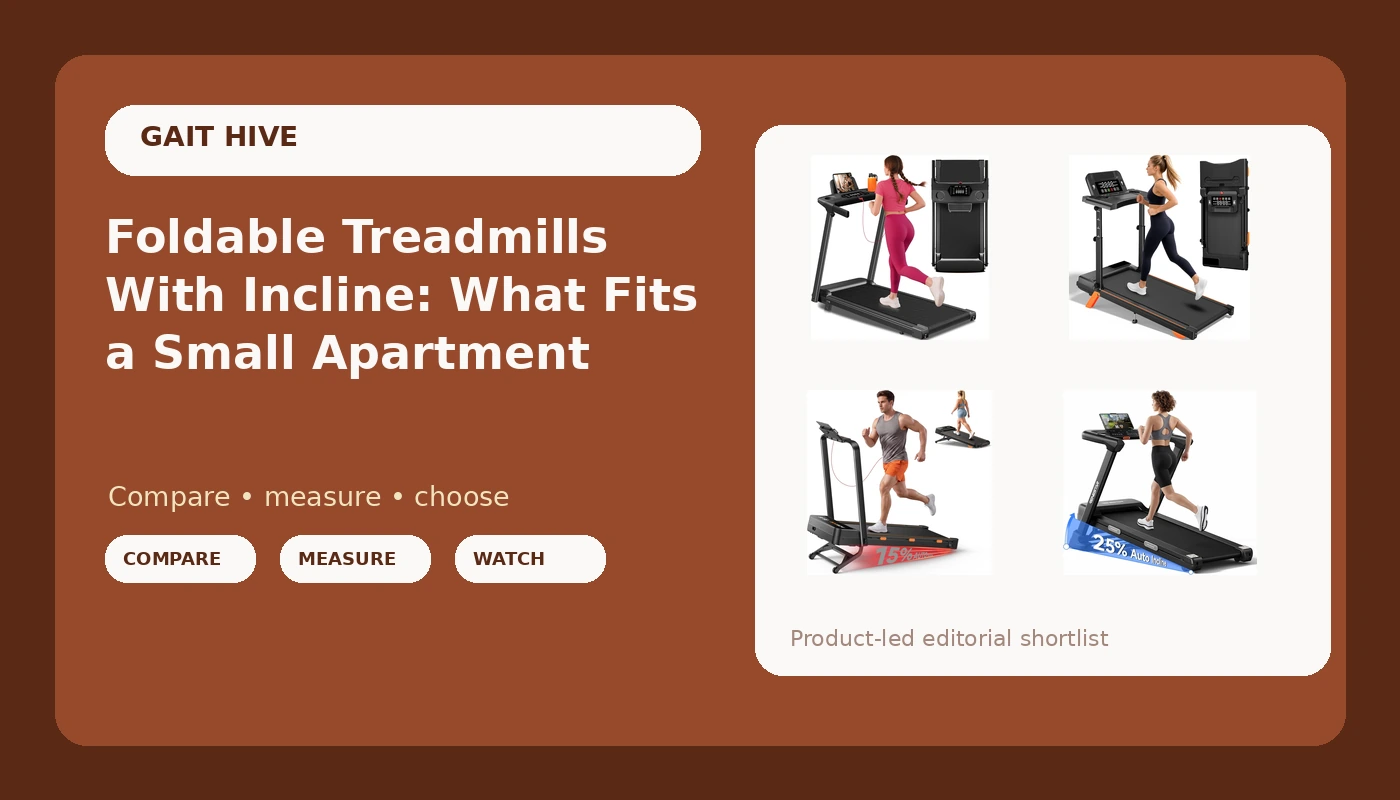
A home treadmill is a tool for the days you cannot get outside, and the foldable treadmills with incline that fill that category are not all solving the same problem. Some are walking pads with a handle bolted on. Some are running machines that happen to fold. The listing photos rarely make the difference obvious, and the details that decide whether you keep using the thing, deck length, motor noise at walking speed, and whether you can actually move it once it is folded, tend to be the ones buried below the fold. This guide walks through four machines that fold, what each one is built for, and how to tell which category you need before you spend anything.
Related: Deck Length and Stride: The First Spec to Check on a Home Treadmill →
Quick answer
Match the machine to your stride first, then to your room. If you walk while you work, a low-profile pad with a handle is enough machine and takes up the least floor. If you want to run indoors, you want a deck long enough that your feet are not chopping your stride short, plus a motor you can live with at walking speed. Among these four, the listed incline figures run from 12% up to 25%, and the listed speed range on the Aiteid tops out at 6.2 MPH. Incline percentage is the easiest number to compare and the least important one on its own. The deck and the noise are what you live with daily.
Four useful options
| Model | Best fit | What stands out |
|---|---|---|
| RENESTAR Treadmill with 25% Auto Incline for Home, Foldable Running Machine | Runners who want the steepest incline and a folding frame | 25% auto incline, built as a running machine rather than a walking pad |
| Aiteid Treadmill with 12% Incline, 3.0HP Low Noise Treadmills for Home, Portable Electric Treadmill with Handles, Walking Pad, Compact Running Machine, Walking Pad with Handle, 0.6-6.2MPH | Small spaces that need handles and a compact footprint | Listed 3.0HP low-noise motor, 12% incline, 0.6 to 6.2 MPH speed range |
| Foldable Walking Pad Treadmill with Handle Bar and 12% Incline | Walkers who want a pad first and a handle for balance | Walking-pad format with a handle bar and a 12% incline |
| Folding Treadmill with 15% AUTO Incline and Handle Bar for Home Exercise | Buyers who want motorized incline in a folding frame | 15% auto incline with a handle bar |
The auto-incline runner: RENESTAR Treadmill with 25% Auto Incline for Home, Foldable Running Machine
A 25% incline is a real training tool, not a decoration. Walking at a steep grade raises the effort at a speed you can hold for a long time, and for runners it lets you load the legs without the pounding of flat fast miles. The trade-off is that steep auto incline mechanisms add weight and complexity, and weight is what decides whether folding is a feature or a story you tell yourself. If the machine is heavy enough that you dread pulling it out, the fold does nothing for you. Ask yourself where it lives when it is down, not just where it lives when it is up.
The handle-equipped compact runner: Aiteid Treadmill with 12% Incline
This is the machine in the group that tries to cover the most ground. Handles make it steadier for walking and for anyone coming back from an injury, and a 0.6 MPH floor is slow enough for genuine desk-adjacent walking. The caution is that a machine marketed as both a walking pad and a running machine is usually better at one than the other, and the listing itself is the only evidence you have until it arrives. Read the description twice and study the photos, because on budget machines what is pictured is not always what is in the box. The handle bar is the detail worth confirming.
The walking-first option: Foldable Walking Pad Treadmill with Handle Bar and 12% Incline
A walking pad is a walking pad. That is not a knock. If your goal is steps during phone calls and a machine that slides under a couch, a slim pad with a handle is the honest purchase, and the 12% incline gives you a way to make a thirty-minute walk count for more than a flat one. The limit is the deck. Pads are built around a walking stride, and if you try to run on one, you will shorten your steps without noticing until your hips tell you. Buy this if you walk. If you want to run, buy the machine built for running.
The middle ground: Folding Treadmill with 15% AUTO Incline and Handle Bar for Home Exercise
Auto incline means you change the grade while you are on the machine, which is the difference between using incline as a real training variable and using it as a setting you touched once. Fifteen percent is steep enough for walking intervals and gentle enough that a beginner will not fight it. The thing to verify before buying any folding treadmill in this range is the incline mechanism itself. A motorized incline that moves smoothly is a good sign. A system that feels like plastic blocks shifting under the deck is a sign the rest of the machine is cutting corners too.
Prices and availability may change. Product images, names, and retailer links are matched to verified listings. No current price, rating, stock status, or measured result is stated here without current evidence.
Deck length and stride come before every other spec
Your stride is the distance from one footfall to the next. A treadmill deck is the surface you land on. When the deck is shorter than your stride wants to be, you do not stop and measure it. You just start taking smaller than normal steps, and over weeks that shows up in your hips, your calves, and your willingness to keep using the machine. This is the reason a walking pad and a running treadmill are not interchangeable, even when the belt widths look similar in photos.
The practical test is simple. Walk on the machine first, then jog, then run at the pace you actually intend to train at, and pay attention to whether your feet feel crowded. If you are shopping online and cannot try before buying, use your own stride as the guide: walkers can live with a short deck, and runners generally cannot. Deck length is the first spec to check because nothing else on the machine can compensate for a deck that does not fit you. A quiet motor on a deck that is too short is still a machine you will stop using.
What an incline percentage actually changes
Incline raises the effort of the same speed. Walking at a grade makes a thirty-minute session metabolically harder without asking you to go faster, which matters at home where fast running is loud and hard on the floor. For runners, incline is how you add hill work when the roads outside are flat, and it lets you build leg strength at a lower speed.
The percentage itself is less interesting than the mechanism. On the four machines here, the listed figures are 12%, 12%, 15%, and 25%, and every one of those numbers is a maximum, not a training plan. What separates them in daily use is how the incline is set. A motorized auto incline lets you change grade mid-session and holds it. Manual systems that rely on risers under the deck work, but they tend to wobble slightly, and a wobbling incline is usually a tell about the overall build quality rather than a problem confined to the incline.
- Measure the floor space where the machine will live when it is unfolded, and the space where it will live when it is folded. Both matter.
- Decide whether you are walking, running, or both. This determines the deck you need more than any other choice you will make.
- Compare listed incline and speed ranges only after the deck question is settled, since these are the easiest numbers to over-value.
- Check the weight and the wheels, then picture yourself folding and moving the machine ten times in a week. If that sounds like a chore, it will become one.
- Confirm the safety lanyard, the folding mechanism, and the return terms before you buy, because those are the details you cannot change after delivery.
Setting the machine up so you keep using it
- Put the machine where you will see it, not where it hides. A folded treadmill behind a door is a folded treadmill you forget.
- Set the incline before you start walking, not during your first session, so you are not fumbling with controls while the belt moves.
- Clip the magnetic safety lanyard every single time. It is the one safety feature worth checking on any machine, and it costs you two seconds.
- Keep the belt clean and follow the lubrication guidance in the manual. Belt wear is the most common reason a budget machine starts to feel rough.
- Test the noise at walking speed, not at your fastest pace, because walking speed is where you will spend most of your time and where a loud motor is most annoying through a wall.
Which option should you choose?
Choose the RENESTAR Treadmill with 25% Auto Incline for Home, Foldable Running Machine when you want the steepest listed incline in this group and you intend to run indoors rather than walk. Choose the Aiteid Treadmill with 12% Incline when you want handles, a compact folding frame, and a listed speed range that starts slow enough for desk-adjacent walking. Choose the Foldable Walking Pad Treadmill with Handle Bar and 12% Incline when you are a walker first and want the smallest footprint that still gives you a handle and a grade. Choose the Folding Treadmill with 15% AUTO Incline and Handle Bar for Home Exercise when motorized incline and a handle bar matter more to you than the steepest possible grade.
One caveat applies to all four. The specs above are what the listings state, not what I measured, and listed figures are not the same as lived experience. A deck that fits your stride and a motor you can tolerate at walking speed will decide whether you use the machine in month three. Incline percentage will not.
The bottom line
Buy the machine that matches the way you move. Walkers should look at the two 12% incline machines and accept that a walking pad is a walking pad. Runners should look at the machines built to be run on, and treat the 15% and 25% auto incline figures as the useful part of the comparison. Whichever you pick, measure your space first, confirm what is actually in the box before it ships, and check the current Amazon price on the listing rather than trusting a number in an article. The right treadmill is the one you fold out on a Tuesday in August without sighing.