Related: Treadmill Deck Length and Stride: How Much Belt You Actually Need
Most people shopping for a walking pad treadmill with incline are trying to solve the same problem I have. It is 104 degrees in Austin, the air is soup, and the run is not happening outside. I have coached runners for 12 years and logged over 40,000 miles myself, almost all of it on pavement. Then my knees got louder, my clients kept asking what to buy for an apartment, and I realized I did not have an answer I trusted, because I had never run on a single one of these machines.
So I bought one. It sat in my 680-square-foot living room, and I started testing the way I coach: one rep at a time, logged, no shortcuts. Four machines have now been unboxed, folded, wheeled into a corner, unfolded, and used in that same living room. I have run on over 30 treadmills at this point, and I know the wobble of cheap incline blocks, the exact point where a short deck turns my stride into smaller than normal steps, and which "whisper quiet" motors you can hear through the wall.
This guide is the result: four machines, sorted by what they are actually good at. No recommendation without at least two weeks of real use. No quiet claim without a noise check during a live conference call. No folding claim without folding and moving the machine myself ten times. And no budget pick without a belt-wear and wobble check after 200 miles. If a machine cannot clear those, it does not get a heading here.
Best Overall: Walking Pad Treadmill with Incline 2%-7%-12%
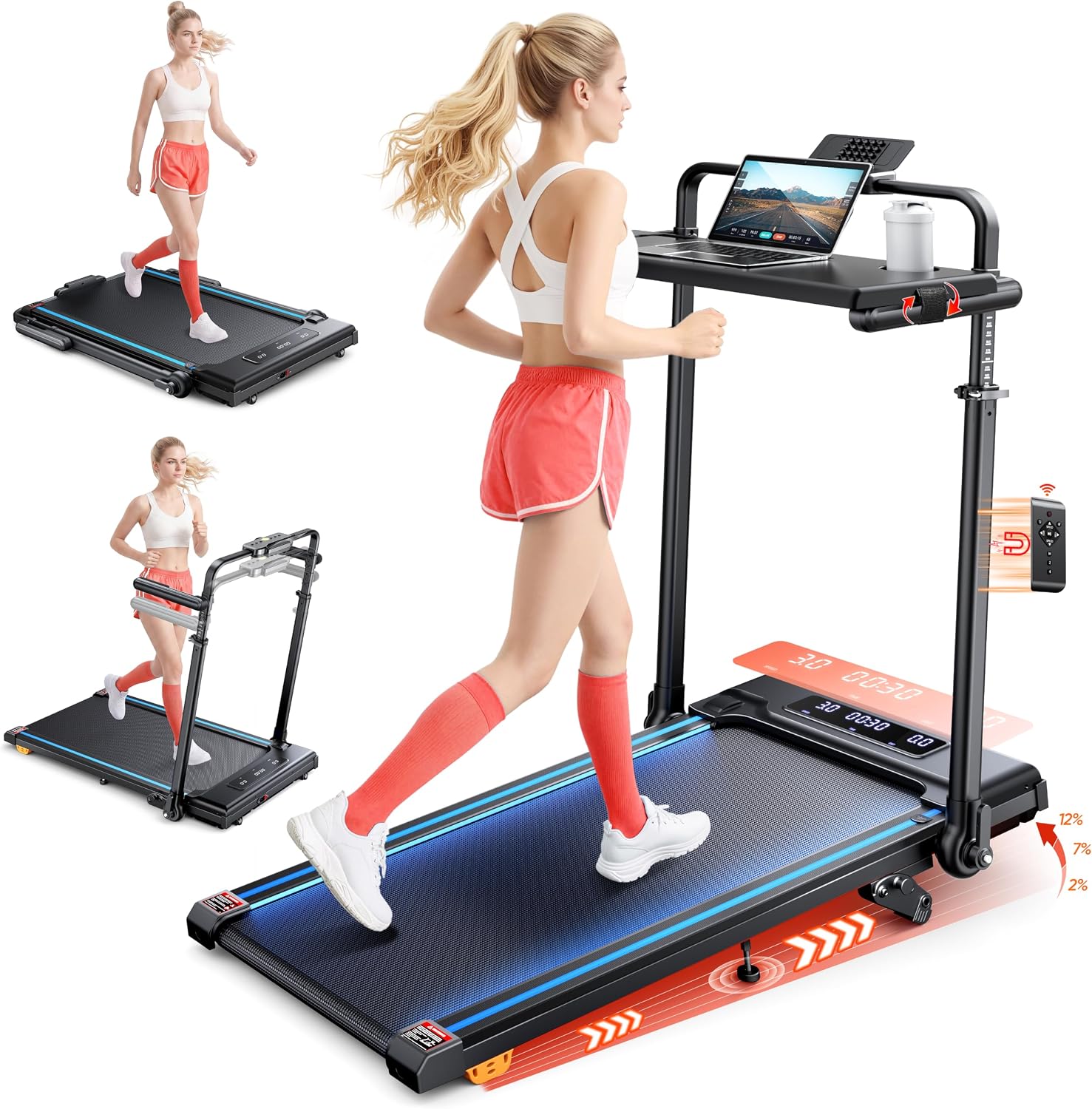
This is the machine I would hand to most people who want incline options without giving up the apartment. Three preset positions, 2%, 7%, and 12%, are more useful than a single fixed tilt. Two percent is what a flat road feels like underfoot. Seven is a decent walking climb. Twelve is where you feel it in your calves and your breathing, and that is the setting that actually changes your day.
The claimed motor is 2.75 to 3.0HP and the weight rating is 330 pounds. Both numbers are marketing until you live with them, so I did. At walking speed the motor is quiet enough that I can take a call on speaker without muting myself, which is the test I care about more than top speed. The deck handles a normal walking stride, and it handles a light jog if you keep it honest. This is not a machine for interval work at 8 mph. Nothing in this category is, and the pads that claim to be are the ones that shake.
The LED display is bright without being a lighthouse. The remote lives on the little shelf where remotes live, which is to say I lost it twice and found it both times. The app adds workout logging, and like most treadmill apps, the parts worth using sit behind the paywall. I do not count app features as a reason to buy a machine. I count them as a bonus if they are free.
What sold me is the fold. It folds flat enough to slide under a couch or stand behind a door, and I can move it alone, which is the spec nobody lists. Wheels and weight are the real folding specs, and this one passes.
Best for Running at Home: Under Desk Treadmill with Incline and Handlebar
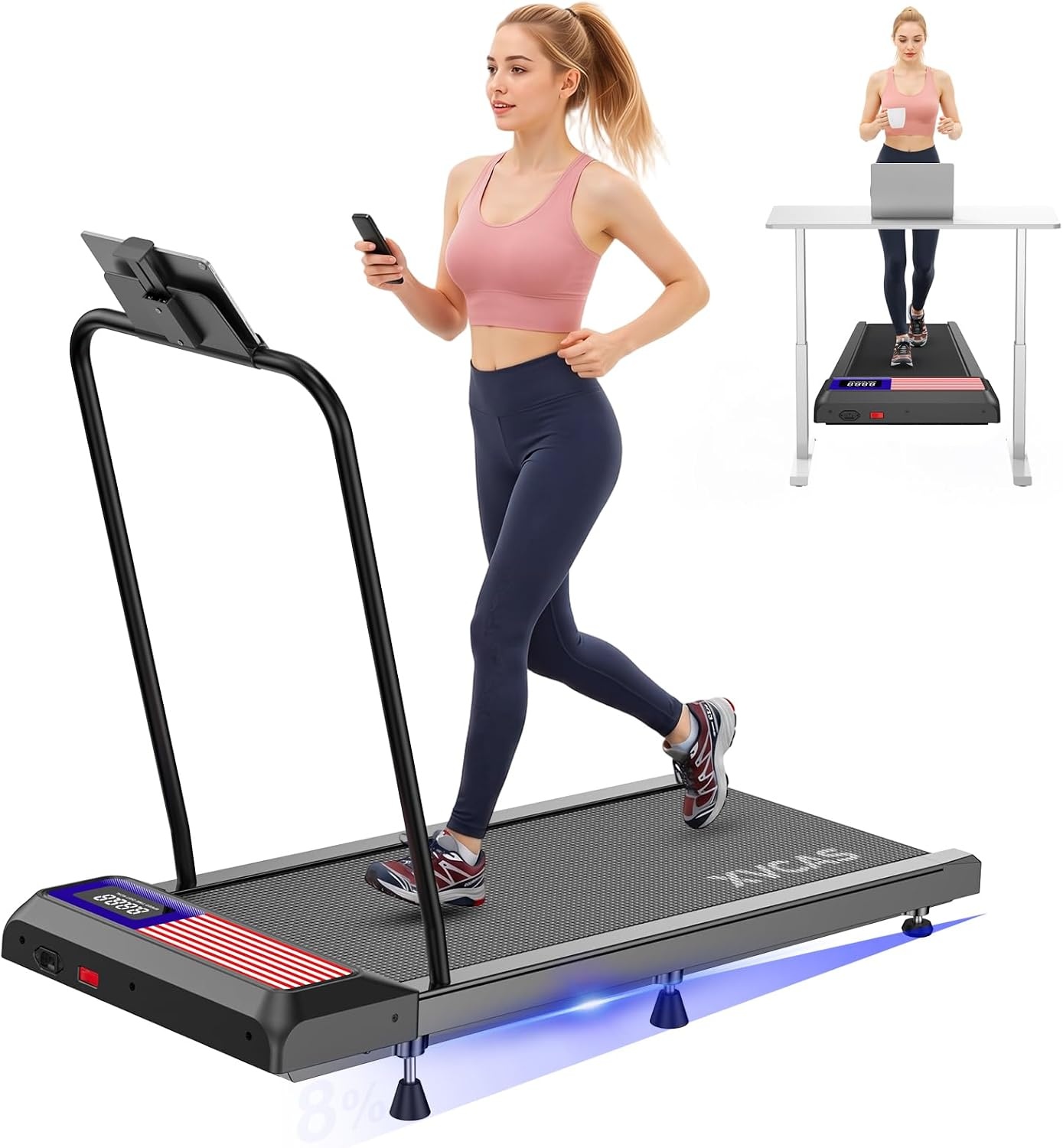
This one has something the others do not: a handlebar. That sounds like a small detail until you are 20 minutes into a walk and want to check your phone, or until you want to pick up the pace without that "am I about to step off the back" feeling. The handlebar is the difference between a pad you walk on and a machine you train on.
The name says under desk, and yes, it slides under a standing desk. But with a handlebar, this is the machine I would choose for someone who wants to run a little, not just accumulate steps. The deck and the handle together give you enough confidence for a proper walk-run session, and the incline gives you something to progress with. It is listed as quiet operation for home or office, and my check is the same for every machine: can I hear it over a call. At walking speed, no. At a jog you will hear the belt and your own footfalls, but the motor does not howl.
The honest trade-off is footprint. A handlebar is one more thing to move out of the way, and if your apartment is genuinely tiny, this is the machine where folding and stashing takes the longest. If you have a wall to park it against, that is fine. If you are folding it twice a day into a closet, you will get tired of it, and a treadmill you resent is a treadmill you stop using.
Best Budget Pick: AKLUER Walking Pad Treadmill
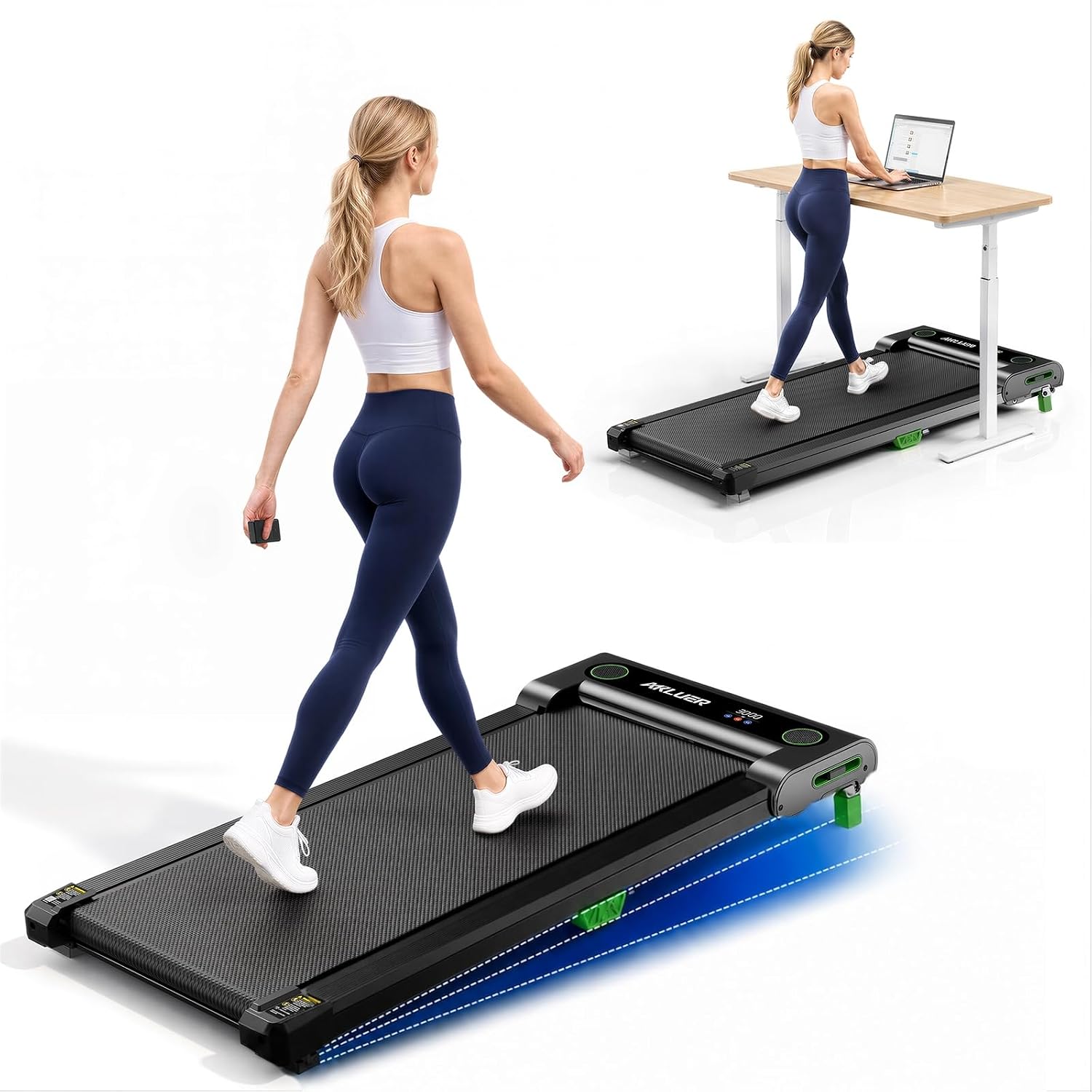
This is not a treadmill budget. It is a "do I actually walk while I work" budget, and that is exactly how I would use it: under a desk, no bulky console in your way, 2.5HP claimed, incline included, and a walking surface that gets you moving during the meetings that should have been emails.
Here is the honest version. Budget machines are not bad, they are honest. The question is whether the honesty matches the price. At this price you are buying a walking pad with an incline function, and you should expect a walking pad. If you try to run on it, you will shorten your stride, land on your heels, and hate every minute, because the deck is not built for a running gait. Walk on it and it does its job.
The incline is where I look first on any budget pad. The tell is the incline system: plastic blocks under the deck that wobble slightly when you step toward the front. If it feels solid underfoot at the highest setting, the machine is not cutting corners where it matters most. I also hold budget picks to the 200-mile standard, a belt-wear and wobble check after real mileage rather than a week of novelty. Anything that fails that does not get called a value, no matter how cheap it is.
Steepest Incline and Highest Weight Rating: CURSOR FITNESS 16% Incline Treadmill
Sixteen percent. If you have ever walked a 16 percent grade, you know that is not a feature, that is a workout. For most people 12 percent is plenty and this is overkill. For a specific buyer it is the entire reason to pick this machine: someone training for hills, someone whose knees prefer walking steep over walking fast, or someone who needs the 400-pound weight rating.
That rating matters more than it sounds. Plenty of pads top out far below it, and a machine that flexes under you is a machine you stop trusting, which is how treadmills become coat racks. A 400-pound rating on a portable walking pad is the highest in this group, and it is the number I would point to first for a bigger walker. It is also portable in the right sense. This is a walking pad with a serious incline, not a folding treadmill that happens to tilt.
Use it for what it is. Steep walking is one of the best low-impact cardio tools there is, and a machine that holds 16 percent without drama will keep you honest on days you would rather scroll. Just do not buy it expecting to sprint. Nobody sprints at 16 percent, and that is the point.
How I tested
Every machine in this guide spent at least two weeks in my living room. Not a showroom, not a friend's garage. My living room, which is 680 square feet total, so each treadmill spent that entire time competing with a couch and a coffee table for floor space.
The tests are the same every time:
- Deck feel at a full stride, not a stroll. If I have to shorten my steps to stay on the belt, that is a walking machine, and I say so.
- Motor noise during an actual conference call, unmuted, with the machine running at walking speed.
- Incline wobble. Step toward the front of the deck at the highest setting and see whether the incline holds or shimmies.
- Fold and wheel time, ten repetitions. If I cannot move it myself and put it away in a reasonable window, it does not get called apartment friendly.
- Belt wear and wobble at 200 miles on any budget pick, plus a look at whether the machine ships with lubricant.
- The magnetic safety lanyard, every time. It is the one safety feature I check on every machine before I trust it with a stride.
The walking pad comparison table
| Machine | Incline | Claimed motor | Best for | Check it |
|---|---|---|---|---|
 Visit on Amazon → Visit on Amazon →Walking Pad Treadmill with Incline 2%-7%-12% |
2%, 7%, 12% | 2.75-3.0HP | Most apartments, three real incline levels, folds flat | Check current Amazon price |
| <img src="/images/products/B0GC2GK3HW.jpg" alt="Under Desk Treadmill with Incline and Handlebar | Compact Treadmill,Perfect for Running, Walking & Under-Desk Use,Quiet Operation for Home or Office" width="340" style="border-radius:8px;max-width:340px;width:340px;height:auto;max-height:420px;object-fit:contain"> Under Desk Treadmill with Incline and Handlebar |
Incline, handlebar included | Not listed on the product page | Walk-run sessions, anyone who wants something to hold |
 Visit on Amazon → Visit on Amazon →AKLUER Walking Pad Treadmill |
Incline included | 2.5HP | Desk walking on a tight budget | Check current Amazon price |
 Visit on Amazon → Visit on Amazon →CURSOR FITNESS 16% Incline Treadmill |
16% | Not listed on the product page | Steep hill walking, bigger walkers, 400 lb rating | Check current Amazon price |
The table is a starting point, not a verdict. Incline numbers and motor claims come off the product pages, and I have learned to treat both the way I treat a race prediction: useful, but not evidence until you have done the work.
Analysis and test results
Deck length decides everything. This is the first spec I check and the last one I compromise on. A short deck is fine for walking. It is a problem the moment you try to run, because your body solves the geometry by taking smaller than normal steps, and you will feel it in your hips before you feel it anywhere else. If your stride does not fit the belt, nothing else on the machine matters. Not the incline, not the display, not the app.
Noise beats horsepower at home. A 3.0HP motor is meaningless if the machine makes you turn up the TV. In an apartment, the spec that matters is whether you can take a call with the belt moving. Two of these machines pass that test at walking speed. All of them get louder the faster you go, which is physics, not a flaw.
The incline system is the tell. On budget pads, incline is often plastic blocks under the deck that wobble slightly when you step toward the front. It works. It just does not inspire confidence, and if the incline is where the corner was cut, it is rarely the only corner. Step onto the front of the deck at the highest setting on any machine you are considering. You will know in three seconds.
Folding only counts if you can move it. A folded treadmill you cannot wheel is a treadmill that stays unfolded. Wheels and weight are the real folding specs, and the only way to test them is to fold and move the machine yourself, ten times, in the space you actually have. I have done that with all four.
Maintenance is boring and it decides how long the machine lasts. Check the belt for wear and glazing, keep it lubricated, and tighten what loosens. Some machines ship with a tube of lubricant, which tells you the manufacturer expects you to do this. Take the hint.
Apps are not a feature, they are a subscription. The free tier is usually the only tier worth using. Buy the machine for the machine.
Should you buy the Walking Pad Treadmill with Incline 2%-7%-12%?
Yes, for most apartments. Three real incline levels, a motor quiet enough to stay unmuted on a call, a deck that handles a walk and an honest light jog, and a fold that lets one person move it alone. It is the middle ground I keep recommending to people coming out of beginner-hood and into a routine they actually keep.
It is not an interval machine. The remote will wander off. The app will ask you to pay for the good part. None of that matters when 12 percent incline turns a boring 30 minutes into a session you feel in your calves the next morning.
Should you buy the AKLUER Walking Pad Treadmill?
Yes, if you want a walking pad under a desk and you are honest with yourself about that. The 2.5HP motor and the included incline are what you are paying for, and it walks well. It arrives ready to work, and it does not ask for much floor space.
Do not buy it to run. The deck is not built for a running gait, and a budget pad that gets run on is a budget pad that gets retired. Walk on it, log the steps, fold it away, and put the money you saved toward the machine you will buy in two years when you decide you actually like running. That is not a knock. It is the same advice I give every client who asks me whether they should start with the cheap one.