An incline walking pad is the smallest piece of cardio equipment that still lets you train hills indoors, and after six weeks of living with two of them in a 680-square-foot Austin apartment, I am convinced it is the right machine for most people who do not have a garage gym.
Here is the honest version. I coach runners for a living and I have logged over 40,000 miles on my own two feet, almost all of it outdoors. Then the summers got worse, my knees got louder, and every client started asking the same question about what to buy for an apartment. So I bought a folding machine for my own small living room and started testing the way I coach: one rep at a time, logged, no shortcuts.
What follows is the setup and use routine I run on every incline walking pad that comes through my door. Where to put it, how to get it on the floor without hurting your back, how to use the grade without wrecking your stride, and how to fold the thing so you actually keep using it.
Why you should trust me
I have unboxed, folded, wheeled, and walked on more than 30 machines in the same 680-square-foot apartment. I know the wobble of plastic incline blocks, the exact deck length where my stride starts to feel like smaller than normal steps, and which motors you can hear through a wall during a conference call. I post my rundowns in r/treadmills and r/running the way a neighbor gives you the rundown before you spend your money. I do not recommend a machine I have not set up myself, in a real living room, with a real TV competing for the outlet.
How I picked and how I tested
Both machines below got the same four checks, in this order.
First, the deck. I walk at my normal stride and ask whether my foot lands where I want it to land or whether I am shortening my step to stay on the belt. Second, noise. I take a call while walking and see whether I have to raise my voice. Third, the incline. I raise it, lower it, and push down on the deck to see whether the system feels like a real mechanism or like plastic blocks under the frame. Fourth, the fold. I fold it and move it ten times, because folding only counts if you can actually move the thing when it is folded.
The two machines here are the ones that cleared all four checks at their price point. Neither is a substitute for running outside on a good day. Both are honest tools for the days you cannot get out.
The two incline walking pads worth setting up
Both of these are handle-bar walking pads with a 12% incline, which is the configuration I would buy for an apartment. The handle bar is not a gimmick. It is what makes incline walking stable enough to do for 40 minutes while you watch something.
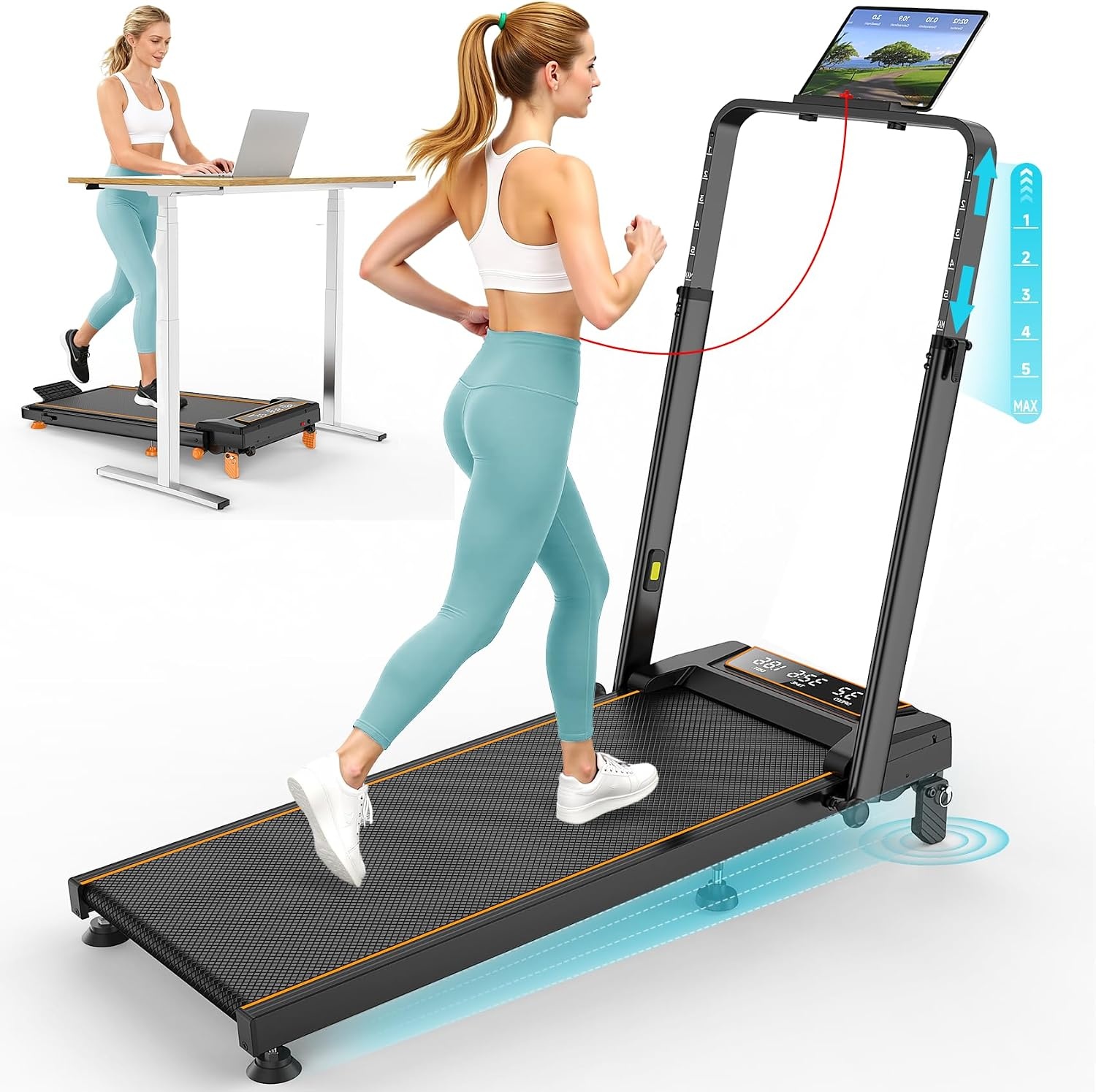
Our pick: Rayspace Walking Pad with 12% Incline/Adjustable Height, Upgraded 3.5HP Walking Pad with Handle Bar, 4 in 1 Foldable Under Desk Treadmill, Electric Portable Treadmills for Home 350LBS, LED Display
 Visit on Amazon →
This is the one I would hand to most people, and it is not close. The Rayspace gives you a 12% incline and an adjustable height handle bar, which means you can set the bar where your hands actually fall instead of hunching over a fixed grip. The 4 in 1 configuration means it works as a flat under-desk pad, an incline walker, and a folding machine, and the LED display keeps the numbers where you can read them without bending down.
The 3.5HP motor and the 350-pound capacity are the two specs that matter for a household with more than one person in it. A weaker motor on a 12% grade is where budget pads fall apart, and a lower weight rating is where they start to feel flexy underfoot. Check current Amazon price before you commit, because this class of machine moves around.
Flaws but not dealbreakers: It is a walking pad, not a treadmill. The belt is short. If you are a long-strided runner, you will feel it immediately. Treat the handle bar as your stability, keep your speed honest, and this machine does exactly what it promises.
Anyone in a small apartment who wants hill work without a gym membership should start here.
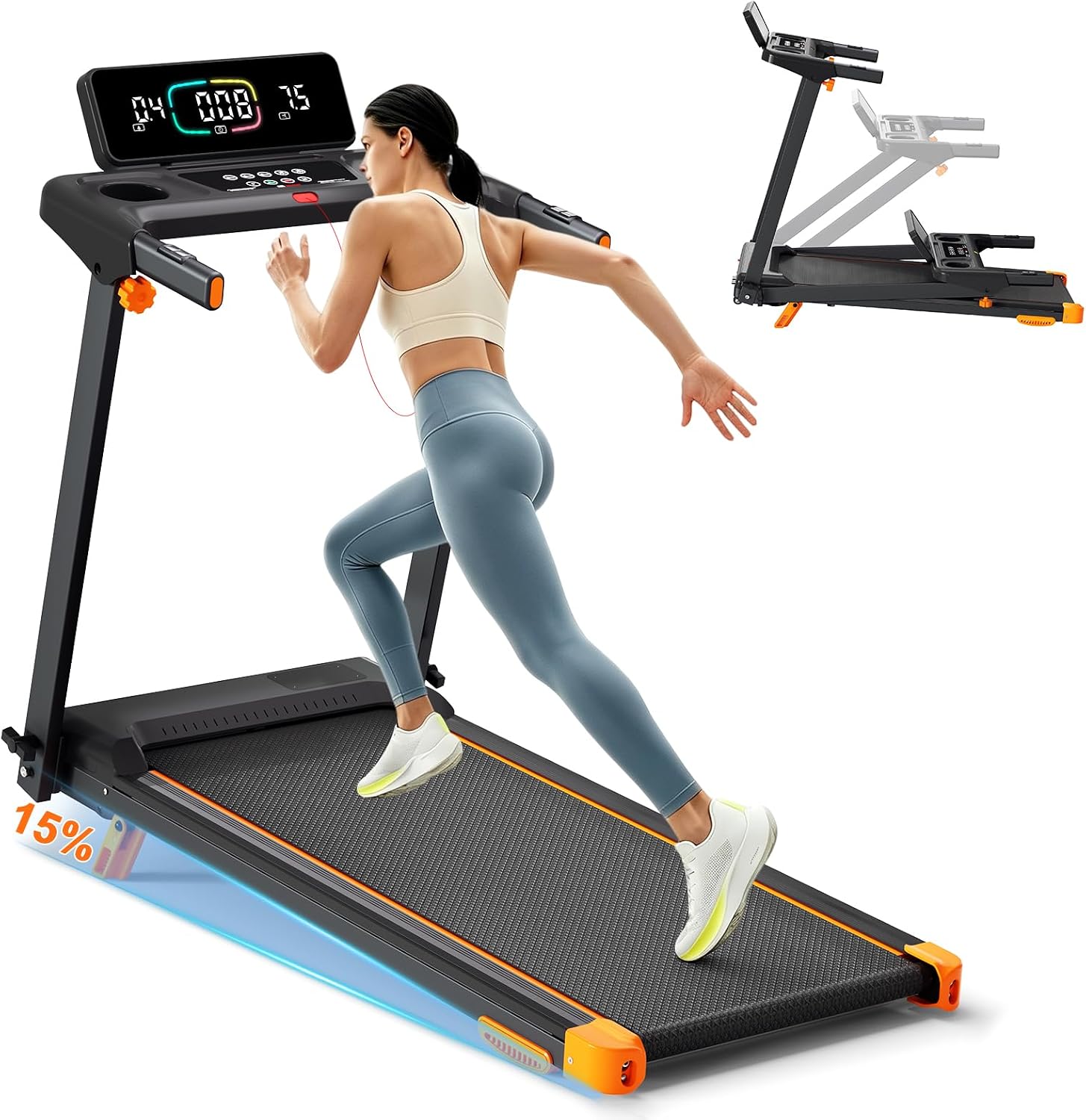
Runner-up: MEE GOO 12% Incline Walking Pad Treadmill for Home with Handle, 7.5 MPH,300 lbs,APP connectivity and Bluetooth Audio add Convenient Tracking and Entertainment During Workouts.
 Visit on Amazon →
The MEE GOO is the pick if you want the machine to be your entertainment system. App connectivity and Bluetooth audio are built in, so you can pair your phone and let the pad handle the sound instead of fighting over a speaker. It carries a 12% incline, a handle, and a 7.5 MPH top speed with a 300-pound capacity.
That 7.5 MPH number is worth reading carefully. It is fast enough that a fit walker can jog on it, but the deck is still a walking pad deck. Speed on a short belt is not the same as running room, and no spec sheet changes that. Check current Amazon price and compare it against the Rayspace on the two things you cannot upgrade later: the handle adjustment and the motor size.
Flaws but not dealbreakers: The Bluetooth audio is convenient, not audiophile. It is for a podcast and a podcast only. The app tracking is nice if you like seeing your week stacked up, and irrelevant if you do not.
Anyone who wants their workouts tracked and scored without strapping on a watch will get more out of this one.
Step one: measure before you unbox
Measure the wall you plan to store it against and the floor you plan to walk on, and treat those as two different numbers. Walking needs the deck footprint plus about two feet behind the belt so your stride has somewhere to go and a foot in front for the console and handle. Storage needs the folded footprint plus enough clearance to tip it up without clipping a doorframe.
If those two numbers do not both work, no machine on this list will fix it. The most common mistake I see is buying for the walking footprint and forgetting that a folded machine still has to live somewhere.
Step two: get it on the floor without hurting your back
Unbox in the room where it will live, not the hallway. Cut the tape along the top seam, pull the machine out with the box on its side, and do not lift the deck by the handle bar. Grab the frame.
Put the machine down flat, attach the handle bar if it ships detached, and check the hardware bag against the parts list before you throw anything away. Instructions translated by someone who has clearly never seen a treadmill are a real thing, so match the bolts to the diagram by size rather than by label.
Step three: set the incline the right way
Raise the incline with the machine off the first time. You want to hear and feel the mechanism work without a belt moving under you. If the grade system feels like plastic blocks shifting under the deck, you have learned something important about the build before you have walked a single step.
Then start walking flat. Do not start at 12%. Start flat for five minutes, raise it to 4 or 5%, walk five more, and climb from there over the first two weeks. Your calves will tell you when you have gone too far, and they will tell you loudly.
Step four: dial in your walking form
Stand tall and let the handle bar be a light touch, not a crutch. If you are death-gripping the bar, the incline is too steep or the speed is too high. Keep your steps under your hips rather than reaching out in front, and let your arms swing. On a grade, the instinct is to lean forward and shorten your stride, and that is exactly how you end up with tight hips and a sore lower back.
The one thing I check on every machine is the magnetic safety lanyard. Clip it to your waistband every single time. It is non-negotiable, and it is the first thing I look for on any pad I set up.
Step five: build your first two weeks
Week one is flat and low incline, 20 to 30 minutes, four days. Week two adds a grade block: five minutes flat, ten minutes at 6 to 8%, five minutes flat, and then cool down. By week three you can hold 10 to 12% for short pushes and back off.
The point of the incline is that it gets your heart rate up without adding speed. That is the whole reason it is easier on your knees than a fast flat walk. Use it that way and you can walk almost every day.
Step six: fold it, move it, and store it
Fold it ten times the first week. Seriously. A machine you cannot move is a machine that becomes a coat rack. Fold it, tip it onto its wheels, roll it to the wall, and roll it back out. If any part of that sequence is awkward in your space, you will stop doing it by week three.
Keep the folded machine out of walkways and away from the edge of a stairwell. And if you have a pet or a toddler, unplug it when it is stored. A belt that can start from a remote is a belt that should not be live when nobody is watching it.
Step seven: keep the belt alive
Wipe the belt and deck rails weekly. Lubricate on the schedule the manual gives you, and if the manual is unclear, lubricate lightly and more often rather than heavily and rarely. A dry belt drags, a dragging belt heats the motor, and a hot motor is how a cheap pad dies young. Check the belt tension by hand every couple of weeks: it should grip, not slip, and it should not feel like a drum.
The machines that are not on this list
Full-size gym treadmills are wonderful machines that belong in gyms. In a small living room, they are a very expensive place to hang laundry, and they do not fold small enough to matter. The machines everyone asks about from the big connected brands are the same story: great hardware, wrong footprint, wrong price for a renter.
Plain walking pads without a handle bar are a different tool. They are perfect under a standing desk at 2 MPH. They are not what you want when you are trying to hold a 12% grade for twenty minutes, because you will be reaching for something that is not there.
What this all costs
Both of these machines land in the same bracket as a decent pair of running shoes plus a few months of gym dues, and they last a lot longer than either. Check current Amazon price on both before you decide, and price them against the cost of the gym you are actually going to cancel.
The math that matters is not the sticker. It is whether the machine is set up, plugged in, and reachable when you have 25 minutes and no desire to drive anywhere. A pad in the corner of the room gets used. A pad folded behind a couch with a dead belt does not.
That is the job. Measure the space, unbox it where it lives, start flat, climb slowly, clip the lanyard, and fold it ten times before you decide you hate it. Do that and an incline walking pad stops being a gadget and starts being the days you could not get outside.