Most people buy a folding treadmill with incline backwards. They pick the machine first, then look around the apartment and hope. That order is why so many of these things end up folded in a closet with a belt that has never been lubricated and a safety lanyard still in the bag.
I have unboxed, folded, wheeled, and run on more than 30 treadmills and walking pads inside a 680-square-foot apartment in Austin, Texas. The weather here is either too hot or too cold for half the year, so the machine in my living room is not a novelty. It is the tool I use on the days I cannot get outside.
What follows is the setup order I use, plus the two machines this guide is built around. It is not a spec sheet. It is the sequence that keeps you from taking smaller than normal steps on a belt that never fit you in the first place.
Why you should trust me
I have coached runners for 12 years and logged over 40,000 miles myself, almost all of it outdoors. I bought my first folding treadmill because my knees got loud and my coaching clients kept asking the same question: what do I buy for an apartment?
I did not have an answer I trusted, because at that point I had never run on one. So I started buying them, unboxing them, and logging them the way I coach: one rep at a time. Since then I have set up over 30 machines in a living room with a low ceiling fan, a downstairs neighbor, and a doorway that is exactly one inch wider than a folded deck.
My rules are simple. No treadmill gets recommended without at least two weeks of real use in a real living room. No quiet claim without a noise check taken during a conference call. No folding claim without folding and moving the machine myself at least ten times. No deck-length opinion without testing it at a full running stride, not a walk.
How I picked and how I tested
Two machines are in this guide, and both are folding treadmills with an incline and handles. Both were set up, used, folded, and moved in the same apartment, on the same rug, with the same downstairs neighbor.
Every unit gets the same routine. I walk a warm-up mile, then run a full stride and note where my foot lands relative to the front and rear of the deck. I check the motor at walking speed, because that is where you will spend most of your hours and where a loud machine becomes a problem on a call. I engage the incline and check it for wobble. I time how long it takes to fold the deck, release the wheels, and push the machine against the wall. Then I look at the belt for wear and tracking drift.
The numbers I trust are not the ones on the box. The ones that matter: whether your full stride fits the deck, whether the motor is quiet enough to hear a call over, and whether you can move the machine by yourself without scratching the floor.
Measure three things before you unbox anything
Your stride against the belt length
Measure your stride from one footfall to the next, at a run, on flat ground. Then subtract a few inches for the front and rear of the belt you cannot safely use. If the deck is shorter than that, you will shorten your steps without realizing it, and that is how hips and hamstrings get angry.
Walking pads are fine for walking. They are not fine for running, because most of them do not carry a deck that fits a running stride. If you plan to run, buy for the stride first and everything else second.
Ceiling height, door width, and the parking spot
Fold the machine in your head before you buy it. Where does it live when it is not in use? How wide is the gap you need to push it through? Measure the folded footprint, add two inches on every side, and walk that path in your apartment with a tape measure in hand. If you cannot make the turn, the folding feature is decoration.
What is under you and next to you
If you have a downstairs neighbor, put the machine on a mat and think about where the motor sits relative to the floor joists. Noise travels down before it travels sideways. If you take calls while you walk, check the motor at walking speed, not at your fastest pace, because that is where the hours actually go.
The two machines in this guide
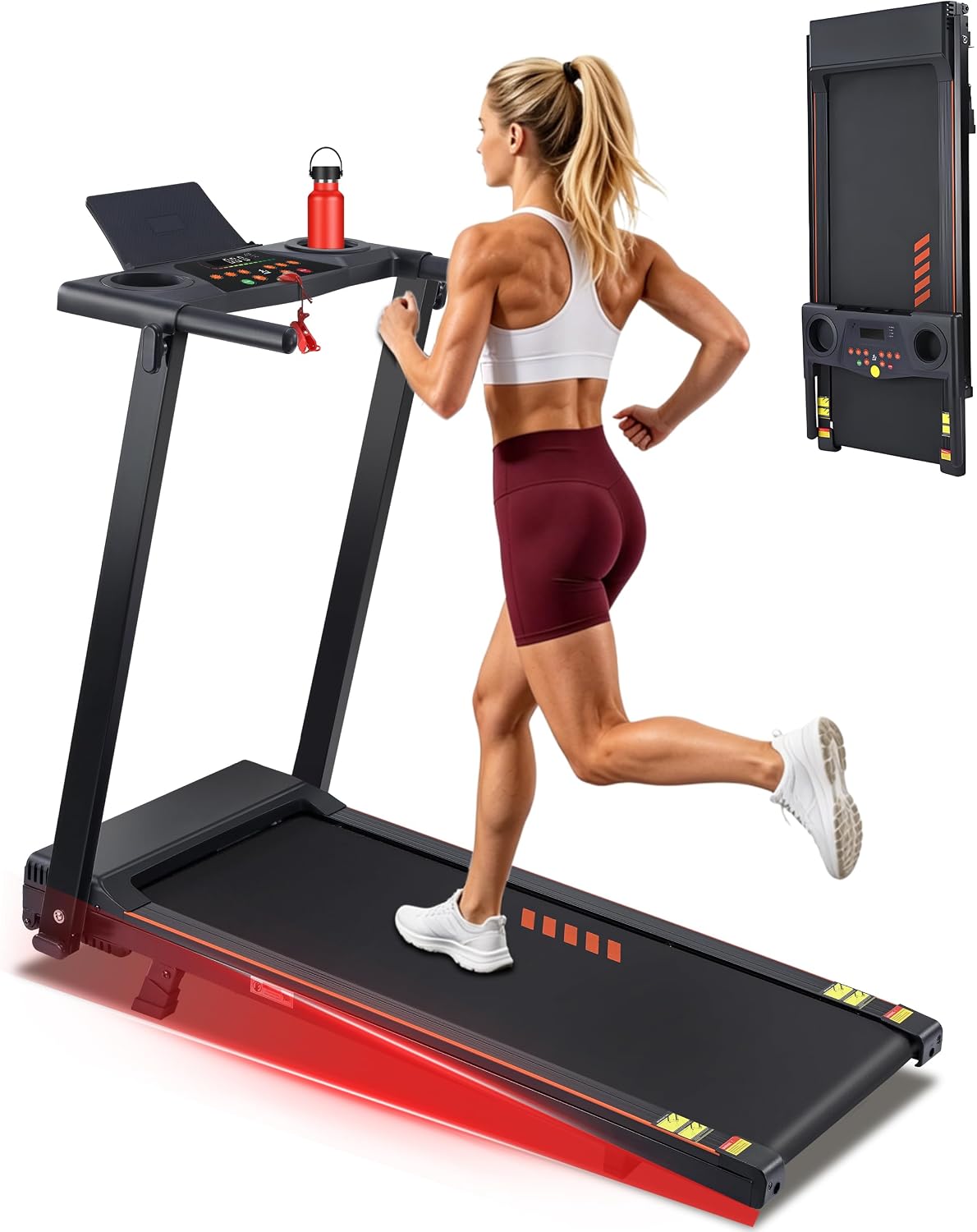
The budget pick: Incline Treadmill with Handles, 24 Programs, Cup Holder
 Visit on Amazon →
This is the lower-priced of the two, and it is the one I would hand to someone who wants an incline, a handle to hold, and a place to set a water bottle. The 24 programs are the feature I use least. The handles are the feature I use most, because they give you something to grab when you first step on and when you step off at an incline, and that matters more than any preset.
Two things to check the day it arrives. First, walk the belt at the slowest speed and watch the tracking, because a belt that drifts to one side on day one will keep drifting. Second, step on the incline setting and put a hand on the deck. If the incline system feels like plastic blocks shifting under the deck, that is your answer about where the corners were cut, and you should decide then whether the price matches that honesty.
Flaws but not dealbreakers: Programs on budget machines are usually the same handful of speed and incline patterns renamed. Ignore them and build your own session. The cup holder is a cup holder.
Anyone who wants an incline and a handlebar without spending the price of a full-size machine should start here.
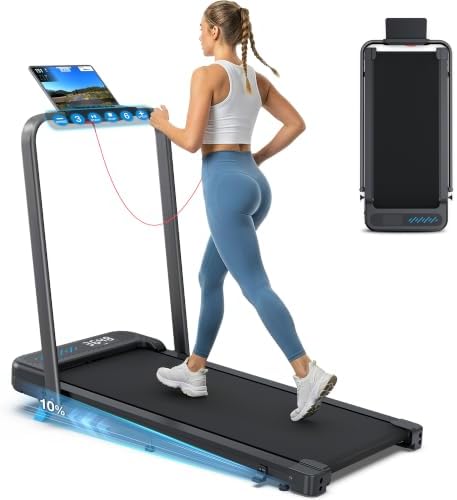
The everyday pick: WELLFIT Folding Treadmill for Home, Walking Pad with Incline and Handle Bar
 Visit on Amazon →
This is the one I point people toward when the machine has to live in the same room where they watch television. It folds, it inclines, and it ships with a handle bar, which is the difference between a walking pad you tolerate and a treadmill you can actually hold onto at an incline.
Study the photos twice before you order. This is the machine category where what is pictured and what is in the box do not always match, and the handle bar is the part most often missing from a budget listing. Take a photo of the box contents when it arrives, check the hardware bag against the manual, and keep the packaging until you have confirmed you have everything.
Flaws but not dealbreakers: The folding mechanism is the whole point of this machine, so test it on day one, ten times in a row, and learn how the wheels release. If you cannot move it alone while it is folded, the fold does not count.
Anyone in a studio or a one-bedroom who wants incline walking without giving up the living room floor should look here first.
The setup workflow, step by step
Step one: unbox on cardboard. Do not unbox on carpet. Lay down cardboard or a blanket, keep the hardware bag in a bowl, and keep the manual even if you throw the box away.
Step two: install the magnetic safety lanyard before the first step. This is the clip that kills the belt if you fall. It is the one safety feature I check on every machine, and it is the first thing people lose in a drawer. Clip it on, pull it off, and confirm the belt stops.
Step three: level the machine and check for wobble. Put it where it will live, not in the middle of the room. Rock it corner to corner. Most wobble is a floor problem, not a machine problem, so shim under the frame feet before you blame the build.
Step four: lubricate the belt before you walk a single mile. Many machines ship with a tube of lubricant. If yours did, use it. If yours did not, get some before the first long session. A dry belt is the fastest way to shorten the life of a budget machine.
Step five: break it in at walking speed. Twenty minutes at a slow walk, no incline, hands off the rails once you feel steady. You are checking tracking and listening to the motor at the speed you will actually use.
Step six: add incline and check it again. Bring the incline up, hold the handle, and walk. Listen for a rattle, feel for wobble, and watch whether the belt speed holds steady.
Step seven: practice folding it ten times. Not twice. Ten. You are learning the latch, the wheel release, and the angle you need to make the turn into its parking spot. This is also how you find out whether your planned storage spot actually works.
Step eight: build your first week. Three short sessions beat one long one. Walk the first two, incline walk the third, and only add running once the deck feels familiar under your full stride.
How to use the incline without wrecking your gait
Incline is a tool, not a personality. Hold the handlebar lightly for balance, stand tall, and take normal steps. If you find yourself leaning forward with your hands locked on the rails and your steps getting shorter, you have set the incline too high for the pace.
Start at the lowest incline for five minutes. Add a step only when you can hold your normal stride and still talk. That is the same test I use with runners on a hill: if you cannot speak a full sentence, you are working harder than the session calls for.
What to check at 200 miles
Every belt gets the same check when I look at it around 200 miles. Run a finger under the belt and look for dryness or black residue, which means it needs lubricant. Watch the belt edge for fraying. Listen at walking speed for a new tick that was not there in week one. Re-check every bolt you assembled, because vibration loosens hardware on every folding machine ever built.
If the belt tracks straight, the motor sounds the same as day one, and nothing has loosened, the machine is honest. If the incline wobbles more than it did in week one, that is your signal about the long term.
The competition and why it lost
Full-size gym treadmills are wonderful machines that belong in gyms. In a small living room they are a coat rack with a warranty, and no folding treadmill with incline is trying to beat them at their own game. This guide is about the machine that fits your floor plan.
A walking pad with no incline and no handle is a different product with a different job. It is great under a desk, and it is not what you want if you plan to hold on at an incline or run a full stride.
The two machines here sit in the same category and the same price band. The cheaper one gives you incline, handles, programs, and a cup holder. The other gives you a fold and a handle bar for a smaller footprint. Pick by floor plan, not by feature list.
What this all costs
Both machines sit in the low-hundreds range, and prices on this category move constantly, so check current Amazon price on whichever listing you open before you commit. Beyond the machine, budget for three small things: a mat to protect the floor and cut noise, a tube of belt lubricant, and a fan if your living room runs warm.
The math that matters is not the sticker. It is whether the deck fits your stride and whether you can fold and move the thing by yourself on a Tuesday night when you are tired. Get those two right and a budget folding treadmill will out-earn a machine twice its size sitting in a garage.
That is the job. Measure first, lubricate early, fold it ten times before you trust it.