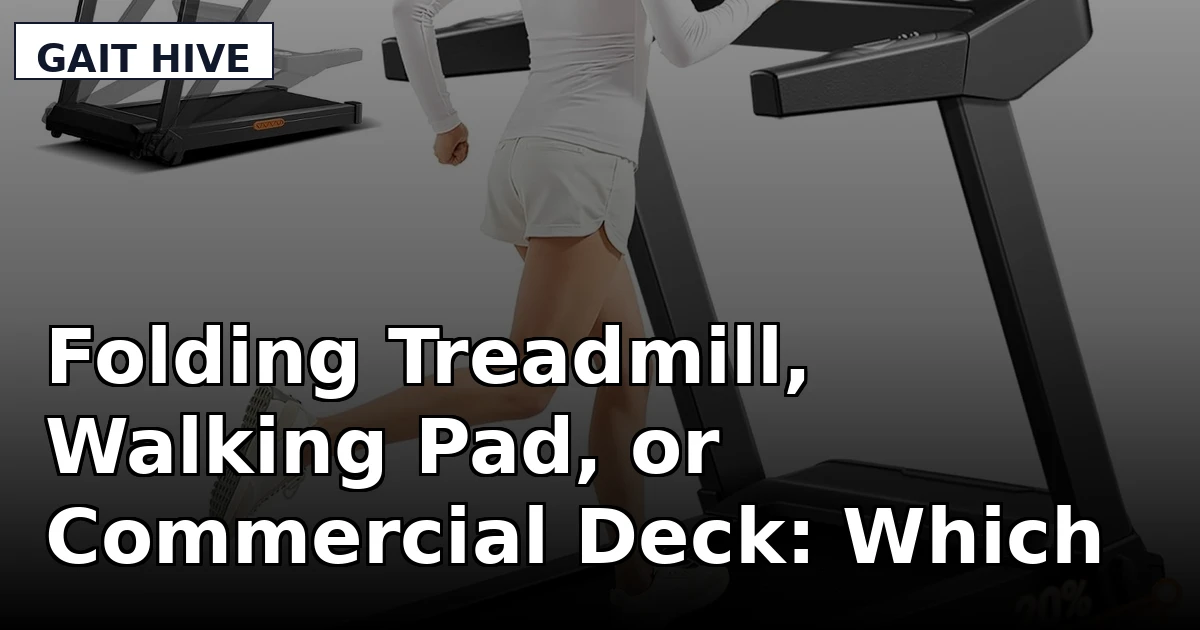
Most people shopping for a folding treadmill for small apartments start with the wrong number. They compare top speed and horsepower, order the machine, and then discover it is too long for the only free wall, too loud for a 7 a.m. call, or too short underfoot to actually run on. The four machines below sit at four different points on that spectrum: a slim walking pad built for desk hours, a compact folding treadmill that publishes a real running belt and a 20 percent incline, a mid-range folding unit rated to 400 pounds, and a commercial series machine meant for a dedicated home gym. They are not four versions of the same product. They are four answers to four different rooms, and the specs that separate them are not the ones most listings put at the top of the page.
Related: How Belt Length Changes Your Stride on a Home Treadmill →
Quick answer
There is no single best machine here, because the right answer depends on whether you walk or run, how much floor you can give up, and how much noise your household tolerates. If running is the goal, prioritize belt length and a motor that holds speed without straining, and note that the CURSOR folding treadmill is the one in this group whose listing specifies a running area, a 3.5HP brushless motor, and a 20 percent incline in a folding frame. If you mostly walk while you work, a walking pad is the honest tool for that job. If you want hardware that behaves like gym equipment and never needs to move, the Niceday TM3 is the one sold as a commercial series machine, and it is built and priced for a dedicated room rather than a living room corner.
Four useful options
| Model | Best fit | What stands out |
|---|---|---|
| CURSOR Treadmills for Home with 20% Incline, 400 lb Capacity & 8.7MPH Compact Folding Treadmill 3.5HP Brushless | Apartment runners who need a real belt in a folding footprint | 3.5HP brushless motor, 20% incline, 42.5 x 16.1 inch running area, shock absorption, 400 lb capacity |
| FUNMILY Folding Treadmill with Incline, 400lbs Capacity Treadmills for Home | Walkers and joggers who want a higher weight rating and a folding frame | 400 lb capacity and an incline deck in a machine that folds |
| Walking Pad Treadmill with Incline 2%-7%-12%, 2.75-3.0HP Foldable Desk Treadmill for Home | Desk walking and low-speed indoor steps | Three preset incline levels, LED display, remote and app control, 330 lb capacity |
| Niceday TM3 Commercial Series Treadmills for Home Gym Use | Dedicated home gyms where the machine stays in place | Commercial series build intended for home gym use |
The compact running pick: CURSOR Treadmills for Home with 20% Incline, 400 lb Capacity & 8.7MPH Compact Folding Treadmill 3.5HP Brushless
The number to think hardest about is the 42.5 inch belt. That is on the shorter side for a running deck, and 16.1 inches of width is on the narrow side too. For walking, jogging at moderate pace, and most people under roughly six feet, that surface is workable. For a tall runner or a long, loose stride, it is the spec that will decide whether the machine feels fine or feels like taking smaller than normal steps without meaning to. The brushless motor is the other detail worth understanding: brushless designs generally run cooler and with less mechanical wear than brushed equivalents, though how quiet a treadmill sounds in your apartment depends as much on belt tension, deck construction, and the floor under it as on the motor itself. Treat "quiet" as something to verify in the return window, not something to take from a product title.
The mid-range folding treadmill: FUNMILY Folding Treadmill with Incline, 400lbs Capacity Treadmills for Home
A high weight rating is a structural promise, and it usually comes with a heavier machine. That matters more than most buyers expect, because folding is only a real feature if you can move the folded unit yourself. A treadmill that folds to a slim profile but weighs as much as a small appliance will still live against your wall permanently. Before ordering anything in this class, check the folded dimensions and the shipping weight on the listing, then walk the path from your storage spot to your training spot and ask whether you would actually do that twice a day. Also confirm the belt size, since the listing here does not lead with it, and belt length is the spec that decides whether you can run or only walk.
The desk walking option: Walking Pad Treadmill with Incline 2%-7%-12%, 2.75-3.0HP Foldable Desk Treadmill for Home with LED Display, Remote&APP Control, Max 330LBS Capacity
A walking pad is a walking pad. That is not a knock, it is the whole point. These machines are low, slim, and designed to be stepped onto in socks while you take a call or read, and their belts are short because the gait they serve is short. Three preset incline steps are a practical touch for adding grade to a walk without a console full of programs, and preset steps are also what you get at this size and price: there is no continuous incline motor to drift or fail, and no need to wonder whether the incline actually engaged. The trade-off is everything else. If you want to run, the deck will not be long enough and the frame will not be stable enough, and no amount of horsepower in the listing changes that. Buy this one for steps, not for training.
The commercial upgrade: Niceday TM3 Commercial Series Treadmills for Home Gym Use
At this end of the market, the specs that matter are the ones a commercial frame is supposed to deliver: a longer and wider deck, a continuous duty motor rating rather than a peak number, a heavier flywheel, and a warranty that reflects how long the machine is expected to last. The listing for the TM3 is the only source for those numbers, so read it closely and compare them line by line against a folding machine before you decide the extra spend is justified. In a small apartment, a commercial treadmill is a very expensive coat rack, and the honest answer for most renters is that the folding machine at a fraction of the size does the job. In a garage or spare bedroom that is already set up for training, the calculus flips entirely.
Prices and availability may change. Product images, names, and retailer links must be matched by verified ASIN. Do not state a current price, rating, stock status, or measured result without current evidence.
Belt length and stride: the spec that decides what a machine is for
Your stride is the distance from one footfall to the next, and the deck is the surface you land on. Those two numbers have to agree, or the machine quietly changes how you run. When the belt is shorter than your natural stride, you shorten your steps without noticing, your cadence climbs, and your hips and calves take the difference. That is why the first thing to check on any treadmill is not horsepower and not top speed, it is the running area, usually printed as length by width in inches. Walking pads exist at the short end of that range because walking strides are short. Folding treadmills sit in the middle. Commercial machines sit at the long end. A belt in the low forties is a reasonable compromise for walkers and many joggers. A belt in the fifties gives a long-striding runner room to open up. Width matters too: sixteen inches is narrow enough that a runner with a wide footfall will feel the edges, while eighteen inches and up is more forgiving.
Incline, motors, and the real cost of folding
Incline percentage tells you how steep the deck can tilt. Some budget machines achieve it with plastic risers under the front of the frame, which work but tend to wobble slightly and do not inspire a ton of confidence. Others use a motorized incline that moves continuously. Preset steps, like the 2, 7, and 12 percent settings on the walking pad above, are a middle path: less flexible than continuous adjustment, more predictable than a riser block. Horsepower is the most misleading number on any treadmill listing, because peak ratings and continuous ratings are not the same measurement, and a peak figure can describe a motor that would overheat under sustained use. Brushless motors are generally the more durable design. And folding is not a spec, it is a workflow: a machine folds only if the folded dimensions fit your space, the wheels roll on your floor, and the weight is something you can handle alone. That is why the folded size and the shipping weight belong on your comparison list right next to the belt.
- Decide whether you walk or run first. Walking pads and running treadmills are different tools, and no spec sheet reconciles them.
- Measure the floor space and the folded footprint before you compare anything else.
- Check the running area against your stride, not against the number in a marketing headline.
- Think about noise in terms of your building: motor type, belt tension, deck design, and what is under the machine all contribute.
- Compare weight capacity against your heaviest user with margin left over, and remember that a higher rating usually means a heavier machine to move.
What to check before you buy
- Put a mat under the machine. It protects the floor and takes some of the vibration out of the structure.
- Lubricate the belt on the schedule in the manual, not on a schedule you invented. Under-lubricated belts drag and get loud.
- Clip the magnetic safety lanyard every single time. It is the one feature that matters if you fall.
- Read the return window and the warranty before the box arrives, and keep the packaging until you have decided.
- Compare what is in the box against the product photos. Handle bars, lubricant, and tools are the items most often pictured and not included.
- Verify the folded dimensions and weight on the listing itself, since those numbers decide whether storage is realistic.
Which option should you choose?
Choose the CURSOR Treadmills for Home with 20% Incline, 400 lb Capacity & 8.7MPH Compact Folding Treadmill 3.5HP Brushless when you plan to run or jog and need a published running area, a brushless motor, and a 20 percent incline in a machine that still folds. Choose the FUNMILY Folding Treadmill with Incline, 400lbs Capacity Treadmills for Home when a 400 pound capacity and an incline deck matter more to you than a published belt size, and you want a folding machine you can store upright. Choose the Walking Pad Treadmill with Incline 2%-7%-12%, 2.75-3.0HP Foldable Desk Treadmill for Home with LED Display, Remote&APP Control, Max 330LBS Capacity when your goal is steps during the workday, not training, and you want something low, slim, and controllable from a remote or an app. Choose the Niceday TM3 Commercial Series Treadmills for Home Gym Use when you have a dedicated room, the machine will never move, and you are willing to pay for gym-class hardware.
The caveat that applies to all four: the listings are the only evidence available for belt size, motor rating, folded dimensions, and warranty, and listings change. Confirm the numbers you care about on the product page before you order, and treat any claim about quietness, stability, or comfort as something you verify at home during the return window.
The bottom line
The category you buy into matters more than the model you pick inside it. A walking pad is for walking, a folding treadmill is for walking and jogging in a small space, and a commercial series machine is for a room that is already a gym. Within the folding group, the spec that decides whether you will still like the machine in six months is belt length, followed closely by how quietly it runs and how easily it moves when folded. Get those three right and the rest of the decision is mostly about budget. Get them wrong, and no motor rating on the box will save the purchase.