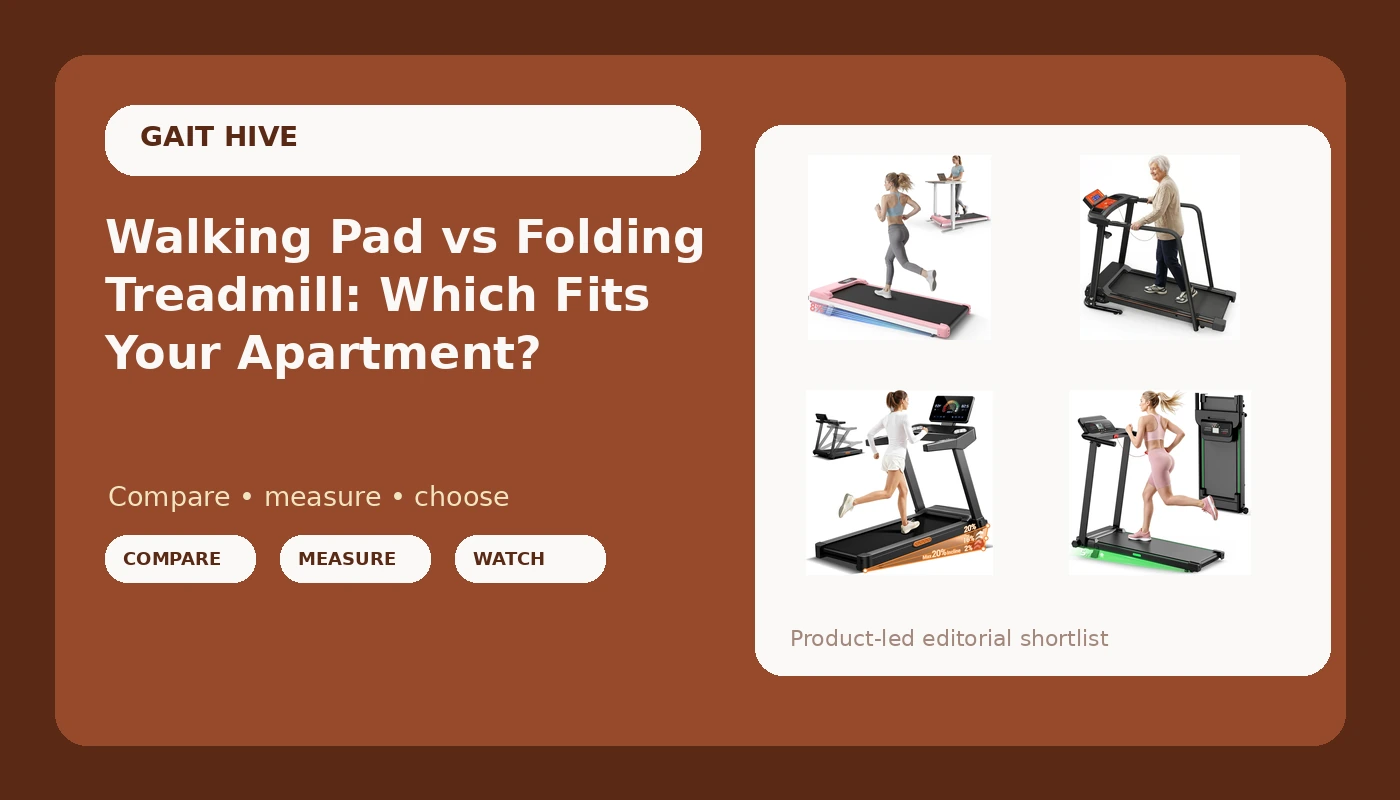
If you are shopping for something to walk or run on at home, the first real decision is not brand or price. It is walking pad vs folding treadmill, and that answer depends on your stride, your tolerance for noise, and how much floor space you are willing to surrender. I coach runners in Austin, where summer afternoons hit triple digits and winter mornings can be cold enough to cancel a workout, so I spend a lot of time thinking about the machines people actually keep using. This explainer covers four current listings: two under-desk walking pads, one walking treadmill with handrails, and one compact folding treadmill built for running. It explains what each design does well and where each one stops being the right tool for you.
Related: How to Measure Your Stride Before You Buy a Treadmill →
Quick answer
Buy a walking pad if you want to walk while you work, at roughly 0.6 to 4 MPH, and you need something slim enough to slide under a desk or stand against a wall. Buy a folding treadmill if you plan to run, because running needs a longer belt than most pads have. The listings below span a folding walking pad with a stated 0.6 to 6.2 MPH range, an incline walking pad with a stated 2.5HP motor, a handrail walking treadmill aimed at seniors and recovery, and a folding treadmill with a stated 42.5 by 16.1 inch running area. Match the belt to your stride first, then sort by noise, incline, and storage.
Four useful options
| Model | Best fit | What stands out |
|---|---|---|
| Treadmills for Home Walking Pad with Incline (0.6-6.2 MPH, folding) | Walkers on the tightest budget | Stated 0.6 to 6.2 MPH range, folding compact frame, LED display and remote |
| Incline Walking Pad with 8% Incline and 2.5HP Motor | Desk workers who want incline | Stated 8% incline, stated 2.5HP motor, stated 350 lb capacity, remote control |
| Lastforever Walking Treadmill with Extra-Long Safety Handrails | Seniors, recovery, balance-focused walking | Extra-long safety handrails, heart rate monitor, stated 310 lb capacity |
| CURSOR Folding Treadmill with 20% Incline | Home runners who need to fold and store | Stated 20% incline, stated 8.7 MPH top speed, 3.5HP brushless motor, stated 42.5 by 16.1 inch running area |
Budget pick: Treadmills for Home, Walking Pad with Incline, Caminadoras para Hacer Ejercicio, 0.6-6.2 MPH Portable Foldable Under Desk Caminadora, Eléctrica Casa Tredmill, Folding Compact Running Machine
The trade-off with any pad at this level is the belt. A pad built to fold and slide under a couch is not built around a full running stride, so treat it as a walking machine that happens to reach a jog. If your plan is thirty minutes of walking while you answer email, it does that job. If your plan is intervals, you will want to look at the folding treadmill further down this page.
Desk pick: Incline Walking Pad with Incline 8% & 2.5HP, Quiet Under Desk Treadmill≤35DB for Home Office, Upgraded Portable Treamill with High 350LB Capacity, Portable Treadmill with LED Display & Remote Control
One caution on the noise number: decibel claims in a title are measured under conditions the listing rarely spells out, and a pad that is quiet under a desk can still transmit motor hum through a wood floor into the apartment below. A cheap rubber mat under the machine does more for your neighbors than any spec on the page. The incline is the more reliable reason to pick this one over the budget pad, since it lets you make a walk harder without making it faster.
Handrail pick: Lastforever Walking Treadmill with Extra-Long Safety Handrails, Home Recovery Fitness Exercise Machine for Elder, Senior Treadmills for Home, Heart Rate Monitor, LED Display, 310 lbs Capacity
Handrails change the way you use a treadmill. On a pad with no rails, you either walk carefully or you do not walk at all. With long rails, a hesitant walker can build twenty minutes of steady movement without worrying about a stumble, and a physical therapist or family member can feel better about the setup. The cost is footprint and folding: a machine with a rail structure is not disappearing under a sofa, so measure the corner where it will live before you commit.
Running pick: CURSOR Treadmills for Home with 20% Incline, 400 lb Capacity & 8.7MPH Compact Folding Treadmill 3.5HP Brushless, 42.5" *16.1" Running Area & Shock Absorption for Running/Walking
The number to think hardest about is the running area. A stated 42.5 by 16.1 inch belt is compact for a running deck, so if you are tall or you take long strides, do the stride math before you buy. Walkers and shorter runners will be comfortable, and the incline gives you a way to build intensity indoors when the weather outside is unreasonable.
Prices and availability may change. Product images, names, and retailer links are matched to verified listings. No current price, rating, stock status, or measured result is stated here without current evidence.
Belt length and stride: the spec that decides everything
Belt length is the first number I check, and it is the number most buyers ignore. Your stride is the distance from one footfall to the next, and it grows when you speed up. If the belt is shorter than your stride, you do not notice it as a spec problem. You notice it as a run that feels like you are taking smaller than normal steps, which throws off your posture and your hips over time.
The practical rule: walking tolerates a short belt, running does not. Walking pads are designed around short decks because they need to be slim and light, and that is fine at walking speeds. Once you plan to run, look for a stated running area you can measure against your own stride, and check the width too. A 16 inch wide belt is common on compact machines, and some runners find that narrower than they like.
Height matters as much as stride. A tall walker on a low pad ends up looking down at their feet instead of ahead, which is exactly the posture you are trying to avoid. Handrails help here, both for balance and for keeping your eyes up.
Noise, incline, and folding: reading a listing without getting fooled
Three claims deserve scrutiny on any treadmill listing: quiet, incline, and folding.
Quiet is the hardest to verify. A stated decibel figure is usually measured at a specific speed, on a specific floor, at a specific distance, and none of that is in the title. My rule is simple: if a motor is loud enough that you turn up the TV, the machine failed, no matter what the box says. In an apartment, the floor matters more than the motor. A mat, and a spot that is not directly above a neighbor's bedroom, will do more than any marketing number.
Incline is the second claim to inspect. Incline at walking speed is one of the most useful features on a home machine because it raises effort without raising speed, which keeps your stride short and your joints happy. How the incline is built matters, though. Some budget designs use risers under the deck that work but shift slightly underfoot. If the incline mechanism feels like loose plastic blocks, assume the rest of the machine was built to the same standard.
Folding is the third. Folding only counts if you can actually move the machine when it is folded, which means wheels and weight, not the fold itself. A folded treadmill you cannot lift is a treadmill that stays where it is.
- Measure your stride, then compare it to the stated running area of any machine you are considering.
- Decide whether the machine is for walking, walking with incline, or running, and eliminate anything that cannot do that job.
- Check the weight capacity against the heaviest person who will use it, with margin.
- Plan where the machine lives: under a desk, against a wall, or in a corner, and confirm it fits folded and unfolded.
- Confirm the safety lanyard and the basics are there before you buy, then buy a mat and belt lubricant at the same time.
Setting up a walking pad or folding treadmill in a small space
- Put a rubber mat under the machine, especially on wood or tile floors in an apartment.
- Position the machine so the rear is not against a wall you might be pushed into, and leave clearance behind you.
- Clip the magnetic safety lanyard on every session, without exception. It kills the belt if you fall.
- Keep the belt clean and lubricate on the schedule the manual states, since dust and dry belts shorten motor life.
- For desk use, set the speed low and stand tall. A walking pad under a standing desk works best when you are not typing anything complicated.
Which option should you choose?
Choose the Treadmills for Home, Walking Pad with Incline, Caminadoras para Hacer Ejercicio, 0.6-6.2 MPH Portable Foldable Under Desk Caminadora, Eléctrica Casa Tredmill, Folding Compact Running Machine when you want the least expensive way to add walking to your day and you do not need to run. Choose the Incline Walking Pad with Incline 8% & 2.5HP, Quiet Under Desk Treadmill≤35DB for Home Office, Upgraded Portable Treamill with High 350LB Capacity, Portable Treadmill with LED Display & Remote Control when your machine lives under a desk and you want incline to make walking harder without making it faster. Choose the Lastforever Walking Treadmill with Extra-Long Safety Handrails, Home Recovery Fitness Exercise Machine for Elder, Senior Treadmills for Home, Heart Rate Monitor, LED Display, 310 lbs Capacity when balance support matters and the machine will be used for steady, supported walking. Choose the *CURSOR Treadmills for Home with 20% Incline, 400 lb Capacity & 8.7MPH Compact Folding Treadmill 3.5HP Brushless, 42.5" 16.1" Running Area & Shock Absorption for Running/Walking when you plan to run and need a folding machine that can take it.
The caveat is that all of these distinctions come from what the listings state, not from measurements taken in your living room. Weight capacity, incline percentage, motor size, and running area are manufacturer figures, and a belt length that fits one runner can feel cramped to another. Buy from a seller with a return window you can live with, and test the fit during the first week.
The bottom line
Most people shopping for an indoor machine overbuy. A walking pad handles the desk-walking job at a fraction of the size and cost, and incline pads make that walking genuinely useful. A handrail treadmill is the right answer when confidence and balance are the priority. If you actually plan to run, skip the pads entirely and get a folding treadmill with a running area you have measured against your own stride, because that is the one spec no other feature can compensate for. Check current Amazon price on the listing that matches your job, confirm the belt and capacity numbers, and buy the machine that fits the way you will really use it.