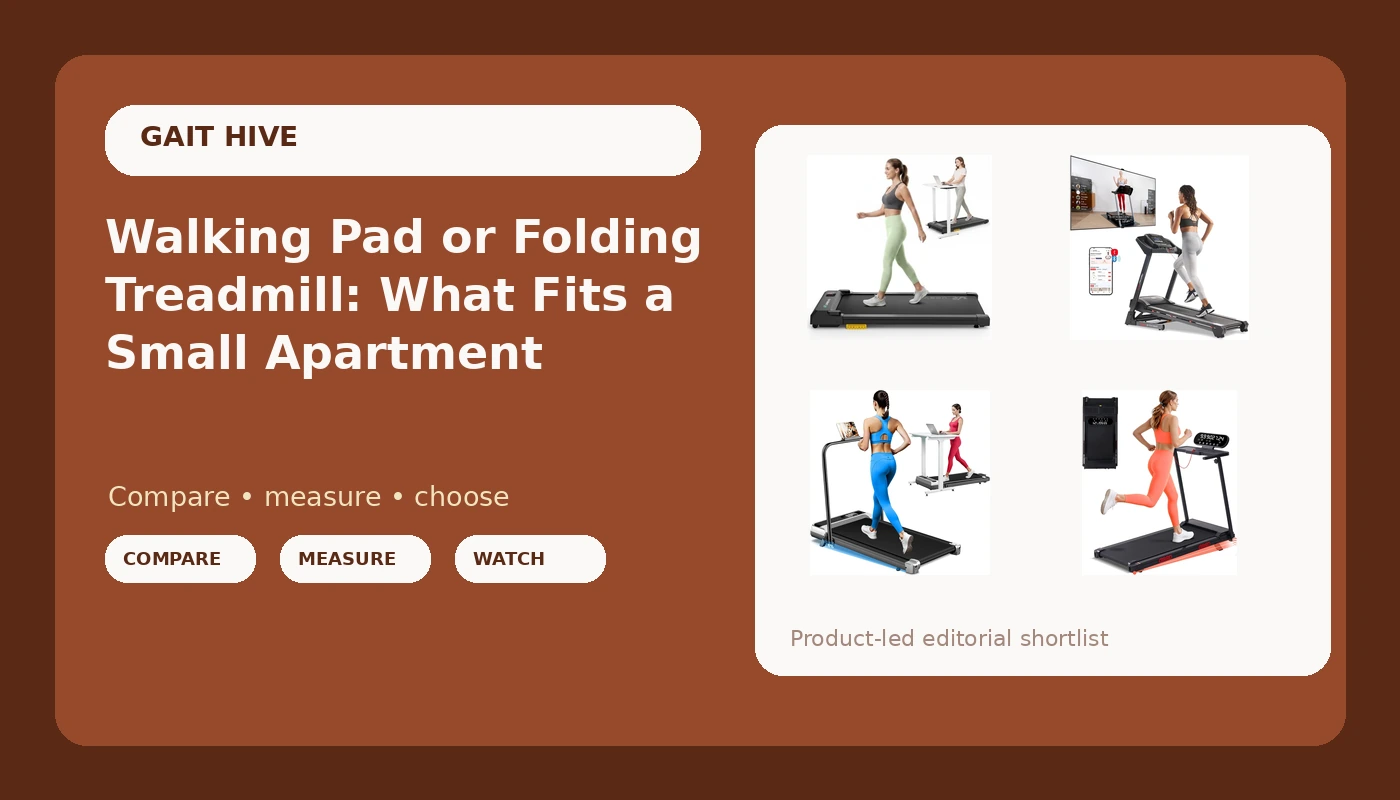
Most people shopping for a treadmill in a small apartment are asking two questions at the same time, and they do not always have the same answer. Will this machine fit my stride, and will it fit my room? A walking pad treadmill with incline is built to slide under a desk and vanish. A console treadmill with motorized incline is built to be a piece of furniture you walk up to and use. Both formats are honest, and both are wrong for somebody.
This explainer sorts four machines by what each one is actually for: the deck format, whether the incline is motorized or a stated design feature, how you control the thing, and what folding really means once it is on the floor. No hype, no prices, just the specs that decide whether you are still using the machine in February.
Related: How to Measure Your Stride Before You Buy a Treadmill →
Quick answer
If your goal is walking while you work, pick a low-profile walking pad, and pick one with a handle bar if you want the option to hold on or to tilt the deck. If your goal is running, walking with a console in front of you, or using motorized incline that adjusts without you touching the deck, pick a console treadmill such as the Sunny Health & Fitness Smart Wi-Fi Treadmill with Auto Incline. Deck length and stride fit matter more than every other spec combined, and in an apartment, motor noise at walking speed matters more than horsepower.
Four useful options
| Model | Best fit | What stands out |
|---|---|---|
| Sunny Health & Fitness Smart Wi-Fi Treadmill with Auto Incline | Runners and walkers who want a console and motorized incline | Wi-Fi connectivity with auto incline and a full console instead of a hand remote |
| UREVO Smart Walking Pad, Standing Desk Treadmill with Double Shock Absorption | Desk workers who want the machine to disappear | Double shock absorption, app with track insights and MIIT mode, remote or app control |
| Walking Pad Treadmill with 8% Incline for Home Office | Walkers and joggers who want a handle bar and a tilted deck | Stated 8% incline, stated 3.0HP motor, folding frame, handle bar, 350 lb capacity |
| MCRG Portable Walking Pad Treadmill with Handle Bar Incline | Larger users who want handles plus a wider stated speed range | Stated 3.5HP motor, 0.6 to 10 MPH, 400 lb capacity, compact frame |
The console option: Sunny Health & Fitness Smart Wi-Fi Treadmill with Auto Incline
The trade-off is footprint. A console treadmill occupies floor space permanently. It does not fold flat enough to live behind a couch, and it is not the machine you wheel out of a closet before a conference call. What you get in exchange is a deck meant for running, a console you can read without squinting at your phone, and incline that moves on command rather than a riser you set by hand. The product title does not state belt dimensions, so before you commit, open the listing and check the deck length against your own stride. If the belt is shorter than your natural step at running pace, the console and the Wi-Fi will not save the purchase.
The under-desk option: UREVO Smart Walking Pad, Standing Desk Treadmill
This is the format that makes sense for a 680-square-foot apartment, because the machine has a home when you are not using it: under the desk, against the wall, out of the walking path. What it is not is a running machine. There is no console, there are no handles on this model, and the incline story is not part of the design. The listing describes quiet operation, but that is the manufacturer's wording, not a measurement, so treat it as a claim to check against owner comments rather than a promise. If your plan is a two-mile walk during meetings and a stowed machine the rest of the day, this is the category you want.
The incline pad with a handle bar: Walking Pad Treadmill with 8% Incline for Home Office
Incline is the feature budget pads most often fake. On cheap machines it is a pair of plastic risers slipped under the front of the deck: they work, but they shift and wobble, and they tell you where else the build is cutting corners. Here the incline is a stated design feature of the machine rather than an accessory, which is a better starting point, but the wobble test is still yours to run. The handle bar matters more than people expect once the deck tilts, because walking uphill changes your balance point. Folding matters too, and folding only counts if you can lift and wheel the machine yourself.
The high-capacity option: MCRG Portable Walking Pad Treadmill with Handle Bar Incline
Ten miles per hour is a running speed, but a top speed number does not turn a pad into a running treadmill. The belt on a compact pad is still short, and a short belt is where long strides go to die: you end up taking smaller than normal steps without noticing, and your mechanics change to match the machine instead of the other way around. Read the speed range as headroom for faster walking and light jogging, and read the 400 lb capacity as the reason this one lands on the list for heavier users who still want handles. If you are tall or long-strided, deck length outranks every number on this row.
Prices and availability may change. Check the product page for current specs, belt dimensions, and warranty terms before you buy.
Deck length and stride: the spec that decides everything
Stride is the distance from one footfall to the next. Deck is the surface you land on. Those two numbers have to get along, and when they do not, the machine tells you in the first mile. A belt that is shorter than your natural stride forces you into abbreviated steps, and abbreviated steps change how your hips and knees load. Physical therapists see this constantly in treadmill buyers who chose on price and console features instead of belt length.
The measurement takes five minutes and it is the best five minutes you will spend on this purchase. Find a hallway, lay down a tape measure, and take a few strides at the pace you actually plan to train at. Walking pace and running pace produce very different numbers, so measure the one that matches your goal, not the one that flatters the machine you like. Then add margin at both ends, because you want to land in the middle of the belt, not on the edge of it. Runners need meaningfully more deck than walkers, and this is the single reason a walking pad is a poor stand-in for a treadmill if running is on your calendar.
Incline, motor noise, and folding: three claims worth verifying
Incline is the easiest spec to fake and the easiest to check. Motorized incline, like the auto incline on the Sunny Health & Fitness machine, adjusts from the controls. Manual risers tilt the deck and stay where you put them, roughly. Either can work, but if the incline system feels like plastic blocks shifting under the front of the deck, assume the same approach was taken elsewhere on the machine.
Motor noise matters more than horsepower in an apartment, because the person who hears your treadmill is not you, it is the neighbor on the other side of the wall and the coworker on your call. A "quiet operation" line in a product title is marketing copy until somebody measures it. Look for owner reports that specifically mention calls, shared walls, and upstairs floors.
Folding only counts if you can move the machine when it is folded. The real specs are folded depth, total weight, and whether there are wheels you can actually use without lifting the whole thing. If you cannot fold it, wheel it, and park it in under a minute, you will stop folding it, and at that point you have a permanent piece of furniture with a smaller footprint than advertised.
- Measure your stride at the pace you actually plan to use, not the pace you daydream about.
- Measure the floor space where the machine will run, and the storage space where it will live when it is not running.
- Decide whether you need a console and motorized incline, or whether a remote and an app are enough.
- Check how the incline works and search owner reviews for wobble, because that is where budget builds show themselves.
- Confirm the magnetic safety lanyard and the stated weight capacity before you buy, and never run without the lanyard clipped.
Practical guidance for a small apartment
- Put a mat under the machine. It protects the floor, and it takes some of the vibration out of the structure below you.
- Clip the magnetic safety lanyard every single time. It is the one safety feature worth checking on any machine you consider.
- Lubricate the belt on the schedule in the manual. Belt wear is what turns a quiet motor into a loud one.
- Measure your doorways and corners, not just the room. A machine that fits the living room but not the hallway is a machine that lives in the living room.
- Be honest about walking versus running. A pad is a walking tool. If you want to run, you are shopping for deck length first and everything else second.
Which option should you choose?
Choose the Sunny Health & Fitness Smart Wi-Fi Treadmill with Auto Incline when you plan to run, you want a console and motorized incline, and you have permanent floor space to give it. Choose the UREVO Smart Walking Pad when your goal is walking at a standing desk, you want the machine to disappear when you are done, and a remote or app is all the control you need. Choose the Walking Pad Treadmill with 8% Incline when you want a folding pad with a handle bar and a stated tilt for incline walking. Choose the MCRG Portable Walking Pad when you want handles, a stated 400 lb capacity, and the widest stated speed range of the pads here.
One caveat applies to all four. The features in this article come from the product listings and the manufacturer descriptions, not from measurements taken in your apartment. Stated horsepower, stated speed ranges, stated inclines, and stated capacities are claims until you verify them on the product page and in owner reports. The deck length, the noise level on your floor, and whether the folded machine is actually movable in your space are the three things only you can confirm.
The bottom line
The machine that works in a small apartment is the one whose deck fits your stride and whose folded footprint fits your storage. Everything else is a preference. If you run, buy the console treadmill with motorized incline and accept that it owns its corner of the room. If you walk while you work, buy a low-profile pad and get the storage problem solved on day one. If you want a middle path, a folding pad with a handle bar and a stated incline gets you tilt and balance support without a permanent footprint. Measure your stride first, measure your space second, and let those two numbers pick the machine instead of the marketing copy.