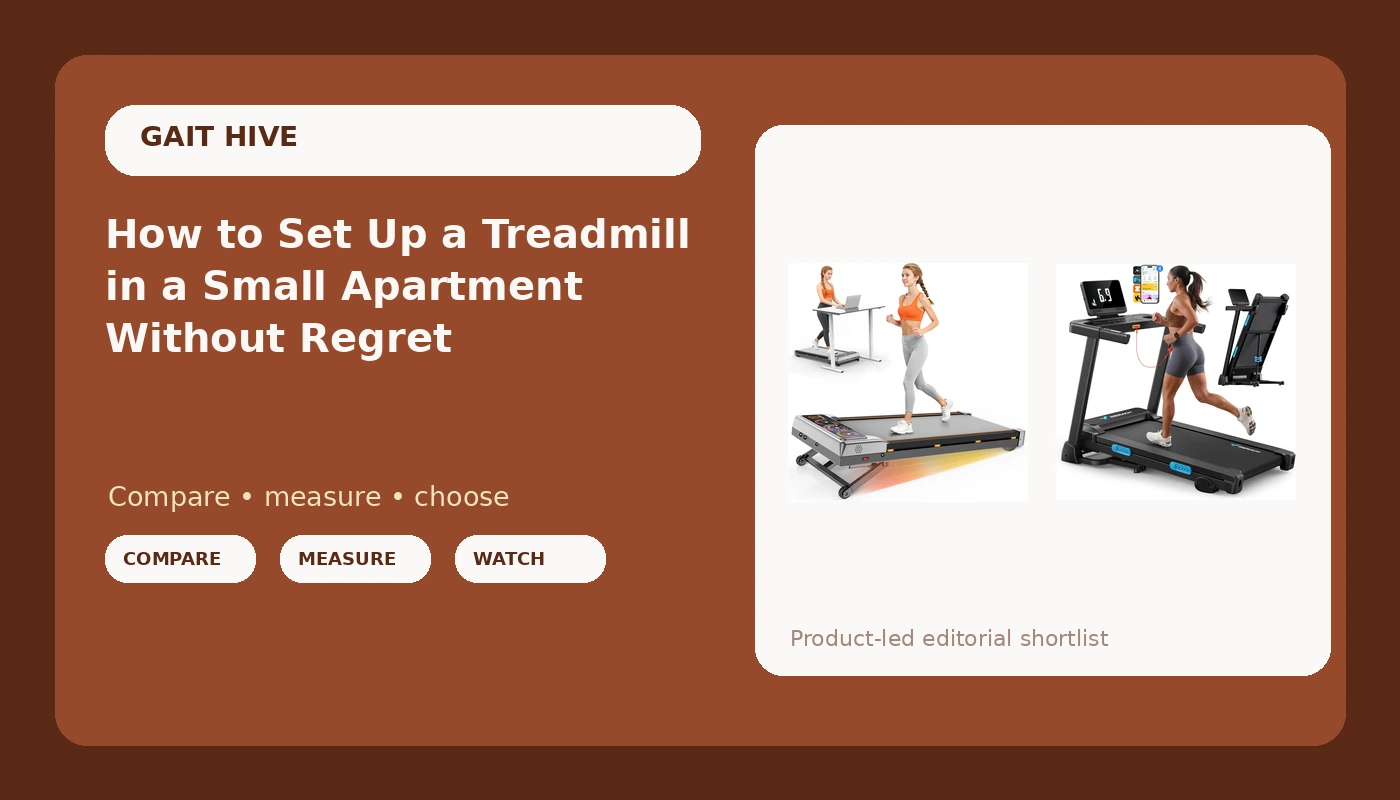
Most people set up a treadmill in an apartment backwards. They buy the machine, shove it against a wall, and then discover the things that actually matter: the belt is too short for a real stride, the motor is loud enough that the neighbor texts them, or the folded machine is too heavy to move out of the living room when guests come over.
A small apartment treadmill setup is not a shopping problem. It is a measuring problem. Get the three numbers right before you spend anything, and almost any decent folding machine will work in a 680-square-foot apartment. Get them wrong, and you have bought a coat rack with a warranty.
I have set up more than 30 machines in my own living room, and the two I point small-space buyers to most often are a walking pad with a real incline motor and a folding treadmill that can handle running. Here is how to set each one up so you still want to use it in February.
Why you should trust me
I have coached runners for 12 years and logged over 40,000 miles myself, almost all of it outdoors. Austin summers pushed me inside, my knees got louder, and my coaching clients kept asking the same question: what treadmill should I buy for an apartment? I did not have an answer I trusted, because I had never run on one. So I bought a cheap foldable, put it in my small living room, and started testing the way I coach: one rep at a time, logged, no shortcuts.
Since then I have unboxed, folded, wheeled, and run on more than 30 machines in that same apartment. I know the wobble of plastic incline blocks, the exact deck length where my stride starts to feel like smaller than normal steps, and which motors you can hear through a wall. I do not recommend a machine I have not lived with.
How I picked and how I tested
The two machines below are not a best-of list. They are the two form factors that actually survive a small apartment, and I picked them because they solve different problems.
Here is what I check, in order.
Deck length against a full stride. This is the first spec I check on any machine, and it is the one most buyers ignore. A short deck is fine for walking and miserable for running. If your stride does not fit the belt, nothing else on the machine matters, because you will spend every run taking smaller than normal steps.
Noise at walking speed. Quiet matters more than horsepower at home. A motor that makes you turn up the TV is a failed purchase no matter how fast it goes. I care about the speed most people actually use, which is a walk or an easy jog, not the top number on the spec sheet.
Folded footprint and wheels. Folding only counts if you can actually move the thing when it is folded. Wheels and weight are the real spec here, not the folded dimensions in the listing.
The incline mechanism. The incline blocks are the tell. If the incline system feels like plastic risers under the deck that wobble slightly, the machine is cutting corners somewhere else too.
The magnetic safety lanyard. Non-negotiable. It is the one safety feature I check on every machine, every time.
Belt wear. Any budget pick has to survive a belt-wear and wobble check before I will put my name on it.
I applied all six to both machines below.
The two machines that fit a small apartment
One is a walking pad for desk hours and incline walking. One is a folding treadmill for actual running. Buy the one that matches what you will do on a Tuesday night, not what you imagine doing in January.
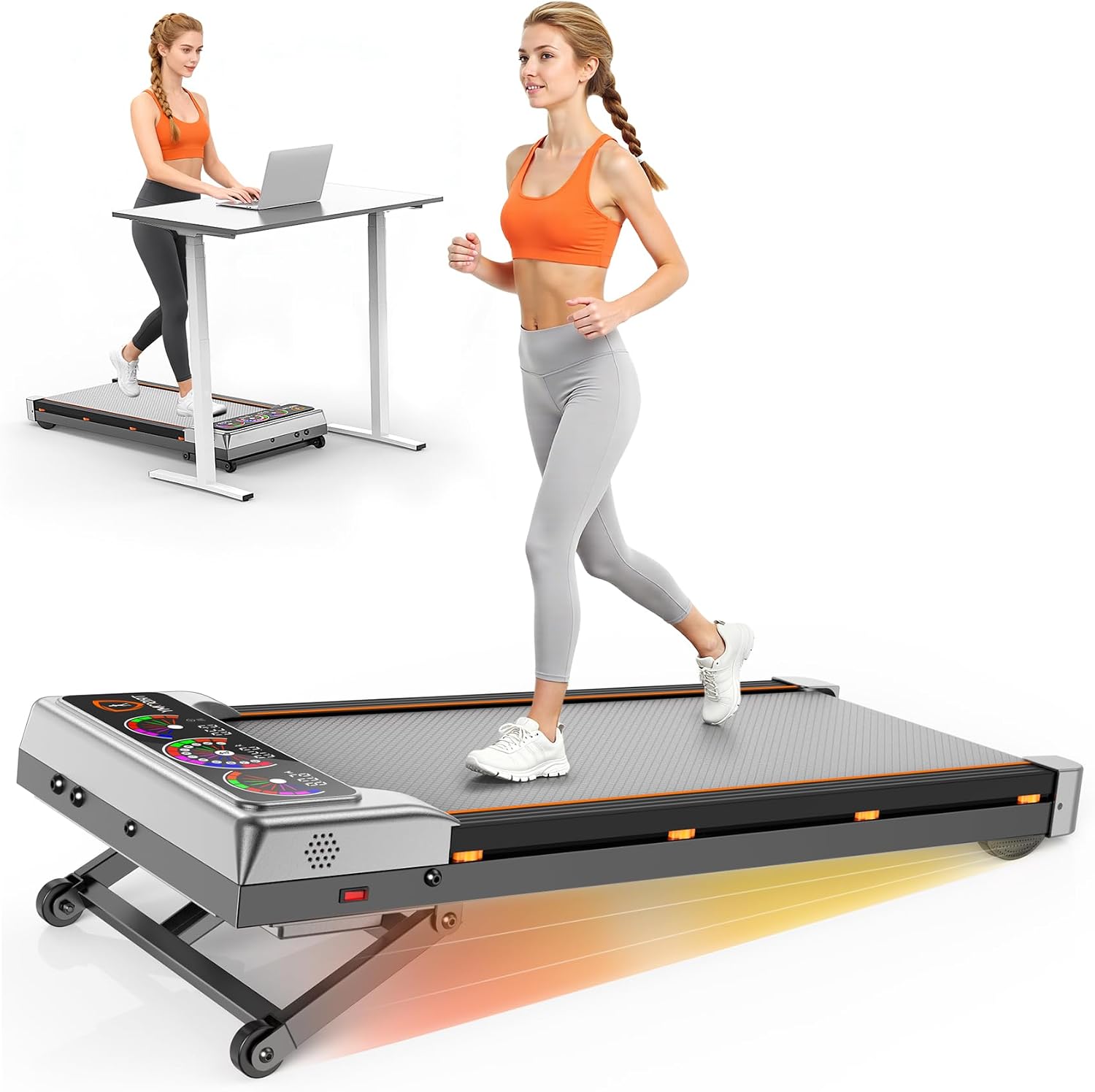
Budget pick: Walking Pad Treadmill with 15% 12-Level Incline & UI Screen, Trisomy 3.5HP Foldable Under Desk Treadmill with Bluetooth Speaker, Portable Treadmills for Home Office 450LBS, Remote, RGB Light
 Visit on Amazon →
I will be blunt about this category: a walking pad is a walking pad. If you want to run, you need a deck that fits your stride, and most pads do not have one. What a pad is genuinely good at is the hours you would otherwise spend sitting. That is the whole pitch, and it is a good one.
What separates this one from the pile is the incline. A 15% grade with 12 levels is the feature that turns a flat shuffle into something that actually loads your calves and hips, and a powered incline is a different animal from the plastic blocks some budget pads use to tilt the deck. The listed 3.5HP motor and the 450-pound capacity rating put it at the sturdier end of the walking pad class, the UI screen and remote mean you are not bending down to change speed mid-walk, and the Bluetooth speaker and RGB light are the kind of extras you either enjoy or ignore. It folds flat enough to slide under a desk or a couch, which is the only reason a pad earns its floor space in a small room.
Flaws but not dealbreakers: The deck is short by design, so treat it as a walking and incline-walking machine, not a running machine. Bluetooth speakers built into treadmills are rarely better than a cheap standalone speaker, so do not buy it for the audio. And the RGB light is decoration, not a feature.
Anyone with a desk job, a small living room, and a step goal they keep missing will get their money's worth here.
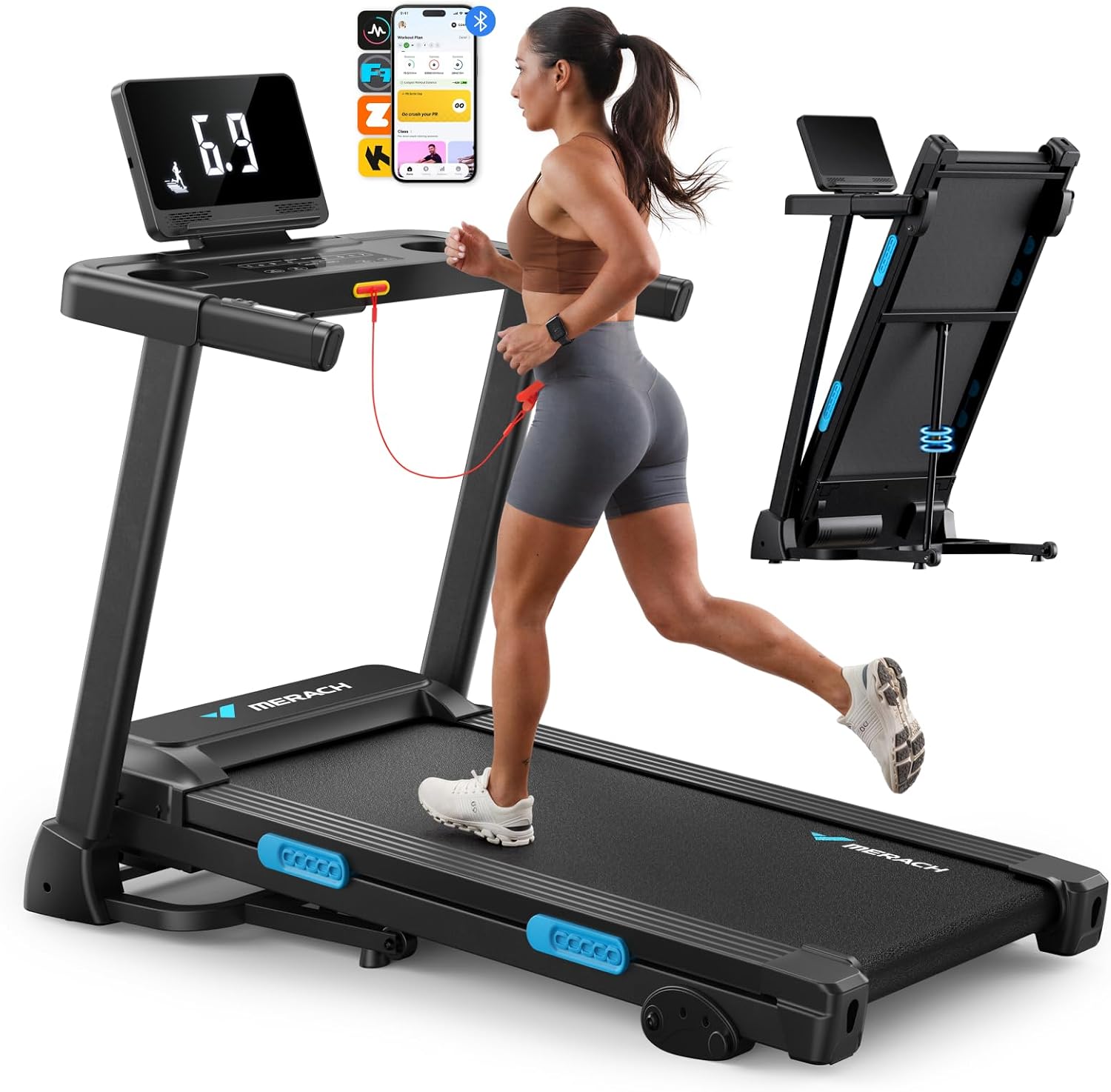
Our pick: MERACH Treadmill for Home with Incline, 300LBS Capacity Foldable Treadmill
 Visit on Amazon →
This is the one for people who actually run. It is a folding treadmill with incline and a 300-pound capacity rating, which is the spec that tells you the frame was built to take a landing, not just a footfall. It folds, it has incline, and it is the machine I point runners to when they have one wall and no second bedroom.
The reason it wins for running is simple: a full treadmill gives you a deck you can stride out on. That is the thing a walking pad cannot fake. If you are training for anything, or if you are coming back from an injury and need to control pace and grade precisely, this is the category to be in.
Flaws but not dealbreakers: It takes more floor when it is unfolded than a pad does, so measure before you commit. Folding and unfolding is a routine, and like every folding treadmill I have moved, the fold only helps if the wheels roll on your floor without catching a rug edge. Test that on day one, not in month three.
Anyone who wants to run indoors, on a schedule, in a room that also has to be a living room, should start here.
The actual setup workflow
Now the part you came for. This works whether you bought a pad or a folding treadmill.
Step one: Measure the unfolded footprint, not the folded one. Put tape on the floor in the shape of the machine at full size. The folded dimensions are what you brag about. The unfolded dimensions are what you live with.
Step two: Add three feet behind the belt. You need clear space to step off, and you need it to be clear permanently, not clear until the laundry basket lands there. This is the single most common apartment mistake.
Step three: Check ceiling height at full incline. When you raise the deck, you raise yourself with it. If you are tall and the room has a low ceiling or a ceiling fan, walk the space at the incline you plan to use before you buy anything.
Step four: Pick the wall for the outlet, not the view. Treadmill cords are a trip hazard and apartments have outlets in exactly the wrong places. Choose the spot where the cord can run along a wall and never cross a walkway, then orient the machine. If the only outlet puts the cord across a doorway, buy an extension cord rated for the load and run it along the baseboard.
Step five: Protect the floor and the neighbors. A thin mat is worse than no mat. You want something with enough density to absorb the impact of a landing, because in a wood-frame building the vibration is what travels, not the sound. Put the mat under the machine, not just under your feet.
Step six: Assemble it where it will live. Do not build the machine in the hallway and then try to drag it into the corner. Unbox it in the room, keep the hardware bag in a zip bag taped to the frame, and follow the manual in order. Instructions for these machines are sometimes translated by someone who has clearly never seen a treadmill, so when a step reads wrong, look at the diagram instead of the sentence.
Step seven: Check the belt before the first walk. Make sure the belt is centered and does not drift to one side when it moves. If it walks to the edge, stop and adjust per the manual before you put miles on it.
Step eight: Clip the safety lanyard on and test it. Start the belt at the slowest speed and pull the lanyard. The belt should stop. Do this once, on day one, so you know it works and you know what it feels like.
Step nine: Lubricate on schedule. Belt lubrication is the maintenance task that decides whether a budget machine lasts two years or six. Follow the manual's interval, and if the manual is vague, check the belt more often than you think you need to.
Step ten: Do the fold-and-move test ten times. Fold it, wheel it, unfold it, ten times in a row. If that is annoying on day one, it will be unbearable by month two, and you will stop folding it and start resenting it. This is the test that tells you whether the machine really fits your apartment.
Where small apartment setups go wrong
The mistakes are predictable, and I have made most of them.
Buying by folded footprint and then discovering the unfolded machine eats the room. Skipping the three feet of step-off space and then landing on a coffee table. Putting the machine on a thick rug, which is unstable, or a bare floor, which is loud. Running the power cord across the only path to the kitchen. Ignoring ceiling clearance and finding out at 8% incline. Never checking belt tension until the belt starts slipping mid-run. Leaving the safety lanyard in the box because it is "annoying."
Every one of those is fixable in ten minutes before the machine arrives, and none of them are fixable by spending more money afterward.
The competition and why it lost
Full-size gym treadmills are wonderful machines and wrong for this article. In a small living room they become the most expensive clothes rack in the building. If you have a dedicated room with a reinforced floor and a door you can close, by all means go bigger.
The big connected treadmills with the giant screens are the other thing people ask me about. They are fine machines, and for some buyers the subscription classes are the reason they actually show up. But if you are renting, moving every couple of years, and working with one wall of space, a screen is not the feature that gets you on the belt. Deck fit, noise, and a machine you can move are.
That leaves the two form factors here: a walking pad for desk hours, a folding treadmill for running. Pick by what you will do, not by what looks best in a photo.
What this all costs
I am not going to quote you prices, because they move. Check current Amazon price on both product pages and do the math yourself with this frame.
The walking pad sits below the folding treadmill in cost, and that gap is the honest price of running capability. Neither one is a gym membership, and neither one is a $2,000 showroom machine. Over five years, the cost-per-day on either is small enough that the real question is not price. It is whether you use it.
That math is simple. If a machine gets you on it three times a week for five years, the per-use cost is pennies, and the walking pad with the incline motor earns its keep in desk hours alone. If it gets used twice and then lives folded behind the couch, it was expensive at any price.
So do the ten-step setup properly. Measure twice, put the mat down, clip the lanyard on, and set the machine up where it will actually live. Then get on it. That is the whole job, and it is the part no product page can do for you.