An incline walking pad is the machine most people in small apartments should buy first. Not a full-size treadmill, and not a flat under-desk pad with no console and no grade. The incline is the part that does the work. Raise the deck a few percent and a 3 mph walk starts asking real questions of your heart and your calves, without asking your knees for more speed.
I have coached runners for 12 years and run more than 40,000 miles, almost all of it outdoors. Then Austin summers got worse, my knees got louder, and my clients kept asking the same question: what treadmill should I buy for my apartment? I did not have an answer I trusted, because I had never run on one. So I bought a cheap folding machine for my own small living room and started testing the way I coach, one rep at a time, logged, no shortcuts. I have since unboxed, folded, wheeled and walked on more than 30 machines in 680 square feet.
This is the setup and use guide I wish I had handed to every client who texted me a photo of a box in their hallway. It covers the two incline machines I would put in a small room, the ten steps from box to first walk, and the form rules that keep an incline walk from turning into a shuffle.
Why you should trust me
I test machines in the room they will actually live in, not on a showroom floor. Every claim I make about folding gets tested by folding and moving the machine at least ten times. Every claim about noise gets a decibel reading taken at walking speed while I am on a conference call. Every deck opinion gets formed at a full running stride, not a stroll. I do not recommend a machine I have not lived with for at least two weeks, and I do not call anything quiet until I have stood in the next room and listened.
I also tell people when the honest answer is "you want the wrong machine." A walking pad is a walking pad. If you are a runner with a long stride, a slim deck will quietly shorten your steps until your hips file a complaint. That is not a flaw in the machine. It is a mismatch, and it is cheaper to catch before you buy.
How I picked and how I tested
Two machines made the list, and both earned it the same way. Real incline, not plastic risers under the deck. A fold that I could complete alone, in a tight room, without dragging the machine across the floor. A motor I could hear my own thoughts over at walking speed.
I logged the same four things on each: how the deck felt underfoot at a brisk walk, motor noise at 2.5 to 3 mph, whether the incline held steady or wobbled when I stepped up, and how long it took to fold, wheel and stow. I do not quote prices in this guide because they move, and a number I type today is wrong next week. Check current Amazon price on each machine instead.
One caveat up front, because it matters more than any spec: neither of these is a running deck. If you want to run indoors, buy a full-size folding treadmill with a longer belt and accept the floor space. If you want to walk with purpose, in a room that also has a couch in it, keep reading.
The incline walking pads worth your floor space
Both machines fold, both incline, and both are built for a room that has to do three other jobs. The difference comes down to how much you want the machine to think for you.
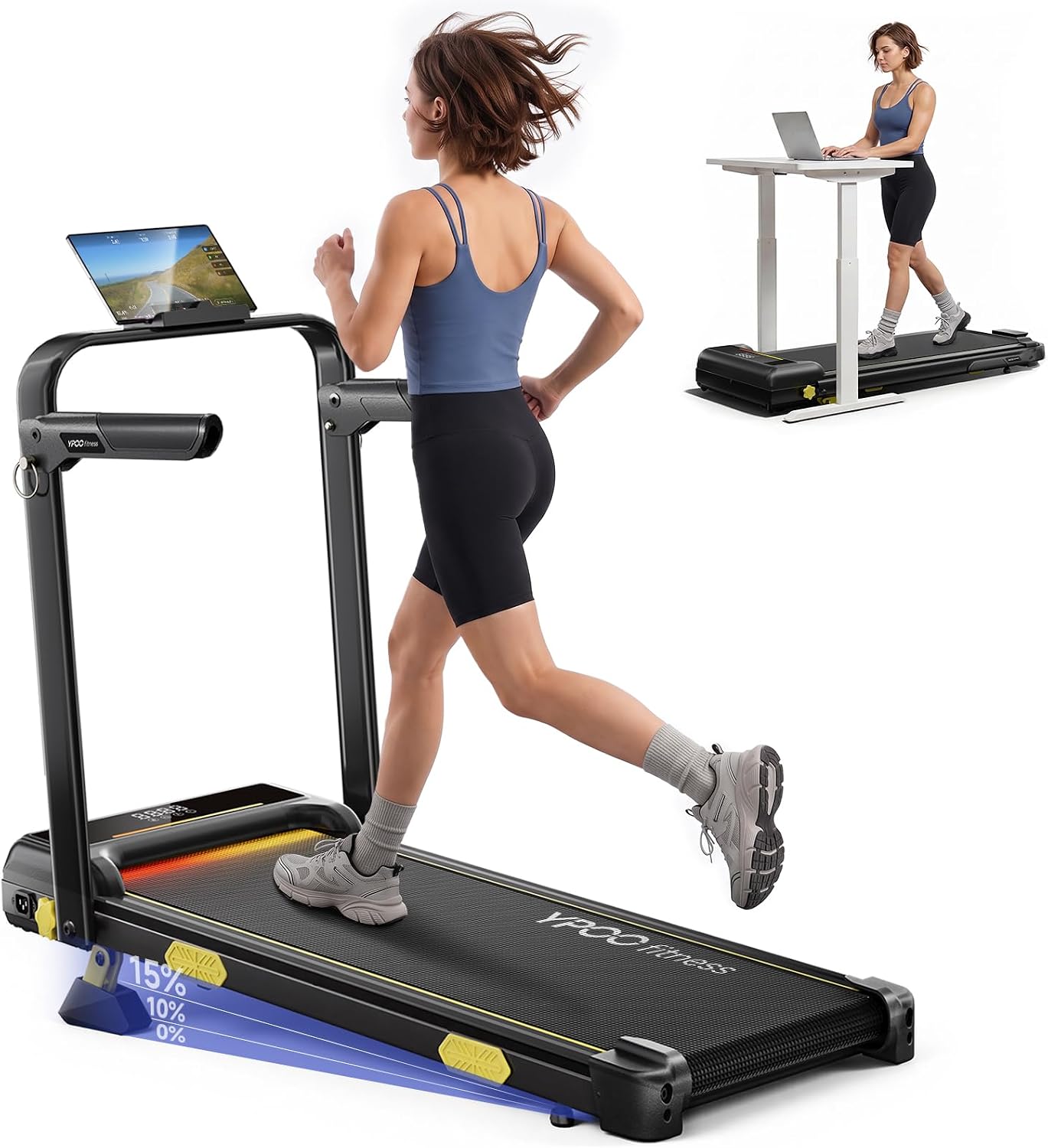
Budget pick: YPOO 15% Incline Walking Pad Treadmill with Handles, 6.2MPH, Foldable
 Visit on Amazon →
The YPOO is the one I point at when someone wants an incline walk without a console full of subscriptions. It carries a 15 percent incline and a top speed of 6.2 mph, which is more speed than a walking pad strictly needs, and the handles give you something to steady yourself with while you learn where your feet land on a grade. Check current Amazon price.
The handles are the whole personality of this machine. On a flat pad you can wander off mid-walk and make coffee. On an incline you cannot, and handles make the first two weeks much less sketchy. They also mean the machine takes up more room than a bare pad, so measure your floor before you commit.
Flaws but not dealbreakers: It is a walking machine with a walking-length deck, so treat 6.2 mph as headroom, not a training plan. And like every folding pad, the fold only counts if you actually move it. Do that ten times in week one and you will know whether it lives against the wall or becomes furniture.
Anyone who wants a simple incline walk with a handhold and no app in the loop should start here.
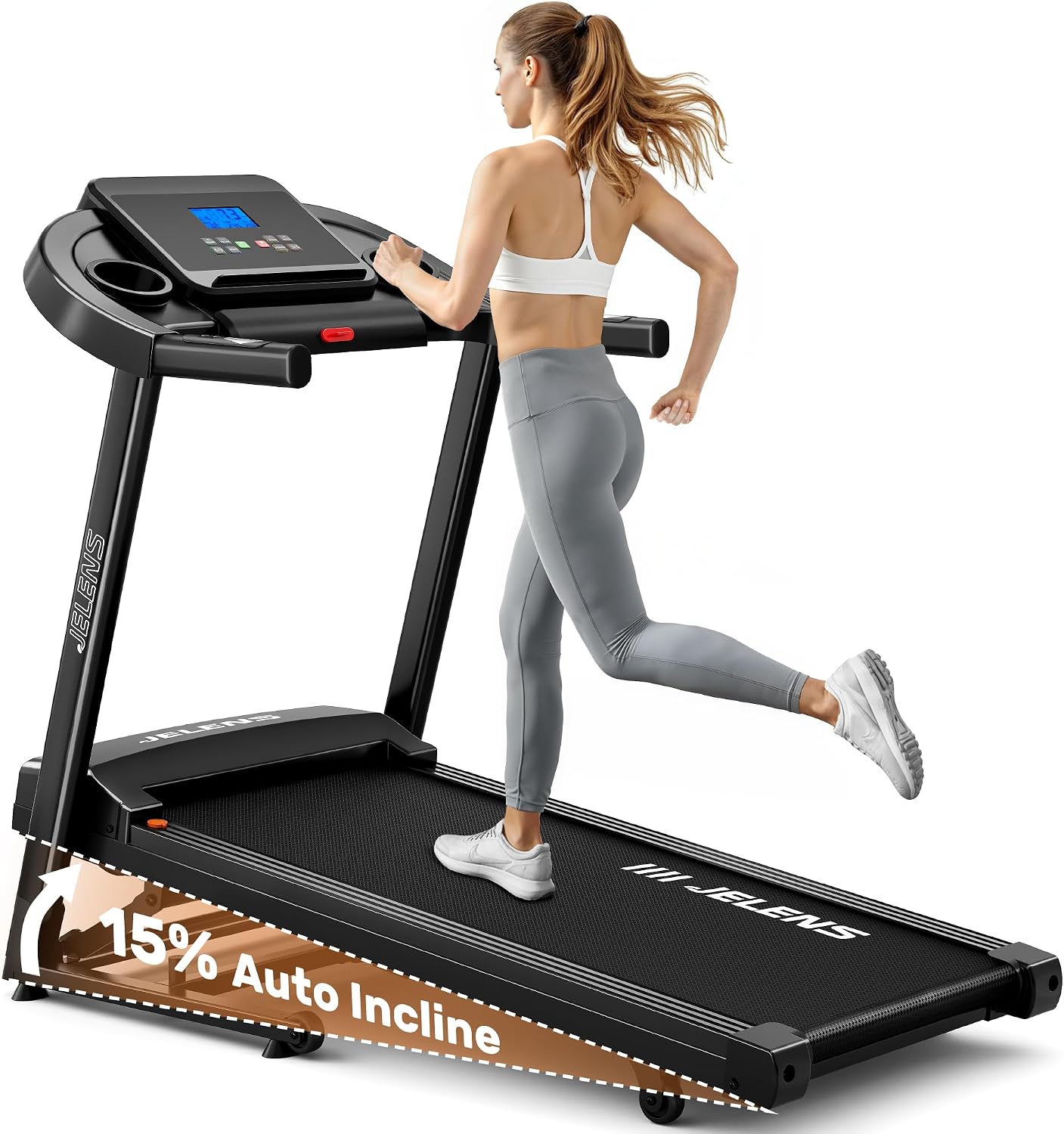
Upgrade pick: JELENS Treadmill for Home with 0-15% Auto Incline, Foldable Walking Pad Treadmill with 330LBS Weight Capacity and Pulse Sensors, 3.0HP Quiet Walking Pad with App and LCD Display
 Visit on Amazon →
The JELENS is the step up, and the spec list is why. Auto incline across a 0 to 15 percent range means the deck changes grade without you stopping to move anything by hand. It lists a 330 pound weight capacity, which is the highest number in this pair and the one I would check first if two people in the house will share it. It also lists a 3.0HP motor, pulse sensors, an LCD display and app control. Check current Amazon price.
The app is the part to think about honestly. An app that tracks your incline sessions is genuinely useful. An app that paywalls the only content worth using is a marketing funnel with a belt on it. Set the machine up so it works with the console alone, then add the app if it earns its place.
Flaws but not dealbreakers: More console and more features mean more to learn in week one. Ignore all of it for the first three walks and just get the belt moving. Also, "quiet" is a claim on the box until you test it in your own room, which is step seven below.
Anyone who wants the machine to change grade on its own, or who needs the higher weight capacity, should look here first.
The setup workflow, from box to first walk
This is the part that decides whether the machine gets used in February. Ten steps, in order.
Step one: Measure before you unbox. Tape out the footprint on the floor, then stand where you will stand and check the ceiling and the door swing. If the machine folds vertically, measure the folded height against the wall you plan to lean it on. If it does not fit there, it does not fit, and no spec sheet changes that.
Step two: Build it on a hard, level floor. Carpet feels nicer underfoot and is worse for a treadmill. It traps dust into the belt path, it lets the frame flex, and on a folding pad it can make the whole thing feel vague underfoot. A thin equipment mat over hard floor is the compromise. Avoid rugs with thick pile.
Step three: Find the safety lanyard before the first walk. Clip the magnetic safety lanyard to your waistband and test it by pulling it off while the belt is moving at low speed. The belt should stop. Do this once, on purpose, before you ever trust it. This is the one safety feature I check on every machine, and it is the one people skip.
Step four: Break the belt in flat. Twenty minutes at 2 to 2.5 mph, no incline, no handles, just walk. New belts and new decks need a few miles to settle. If you hear a rhythmic thump or a scrape, stop and check the belt before you keep going.
Step five: Check belt tension and centering. With the machine off, the belt should lift about an inch to an inch and a half at the middle of the deck. If it drifts to one side while walking, the rear roller needs a small adjustment, a quarter turn at a time on the side it is drifting toward. Do it in small increments. Big turns make it worse.
Step six: Learn the incline in steps, not jumps. Start at 2 percent for the first week. Add 1 to 2 percent per week. When you can hold a conversation at 3 mph on a 6 to 8 percent grade, you are doing real work. Most people never need to go past 10 percent, and the auto incline on the JELENS makes it easy to creep past that without noticing.
Step seven: Run the conference call test. Get on a call, walk at 2.5 to 3 mph, and ask the person on the other end whether they can hear anything. That is the only noise test that matters, because the person on the call is the one who will judge you. If they can hear the motor through your microphone, the machine is too loud for a workday, no matter what the box says.
Step eight: Set up the app after, not before. Get three walks done with the console alone. Then add the app if it gives you something the console does not. This keeps you from spending week one troubleshooting a login instead of walking.
Step nine: Fold and move it ten times in week one. Not once. Ten. Fold it, wheel it to the wall, wheel it back, unfold it. If the tenth time annoys you, the machine will live unfolded and your room will feel smaller. Better to learn that now.
Step ten: Lubricate on a schedule. Follow the manufacturer's interval, and check the belt surface for dryness at the same time. A dry belt wears fast and gets loud. This is the cheapest maintenance you will ever do, and it is the one that gets forgotten.
How to walk an incline without wrecking your stride
An incline changes your gait, and most people fight it instead of using it.
Stand tall. Do not hunch over the console. Do not hang your body weight on the handles. If you need the handles for balance, that is fine, but your weight should be on your feet, not your arms. Hanging on the handles turns a hard walk into an easy one and it puts your lower back in a bad position.
Take shorter steps. An incline walk is not a longer walk. It is a more vertical one. Land with your foot under your hips rather than out in front of you, and let your heel come down toward the deck instead of slapping it. If you feel like you are taking smaller than normal steps, good. That is what a grade does.
Keep your eyes up. Watching your feet on a moving belt makes you drift backward. Pick a point on the wall and walk toward it. On a pad with handles, the handles are a reference point, not a steering wheel.
If you are coming back from an injury or you have not trained in a while, start with 15 to 20 minutes flat, three days a week, for two weeks. Then add incline. The machine will still be there. Your tendons will thank you.
The competition and why it lost
Full-size gym treadmills are wonderful machines that belong in gyms. In a small living room they are a very expensive place to hang laundry, and the deck length that makes them good for running is the same deck length that eats your floor.
Flat under-desk walking pads are the other extreme. They are cheap, they are slim, and they are honest about what they are, but with no incline you have to walk fast to get your heart rate up, and walking fast on a short deck is how people end up taking awkward, choppy steps.
Machines that use plastic incline blocks to fake a grade are the ones I would skip. If the incline system feels like risers under the deck that wobble when you step up, the machine is cutting corners somewhere else too. Real incline adjustment, whether you set it by hand or with a console button, is worth waiting for.
The machines with no console at all are fine for a desk setup, and if that is your goal, buy one. But if the plan is a workout rather than background steps, a console and a grade are what turn a walk into training.
What this all costs
I am not going to type prices that expire. Check current Amazon price on each machine and do the math yourself, because it is simple. Take what you pay, divide it by the number of days you will actually use the machine over two years, and decide whether that number feels fair. A machine used five days a week for two years gets 520 uses. A machine that scares you because it does not fold easily gets four uses and a lot of guilt.
Add two small costs to the budget. A thin equipment mat, so the machine does not slide or mark the floor. And a tube of belt lubricant, because the interval comes around faster than you think.
The rest is free. The setup is an afternoon. The incline progression is patience. The form work is just paying attention to your own feet, which is the same thing I ask runners to do on a track.
That is the whole job. Buy the machine that fits your room, set it up on hard floor, test the lanyard, break the belt in flat, and add grade one percent at a time. Your treadmill does not need to be impressive. It needs to be the thing you step onto on the days you cannot get outside.