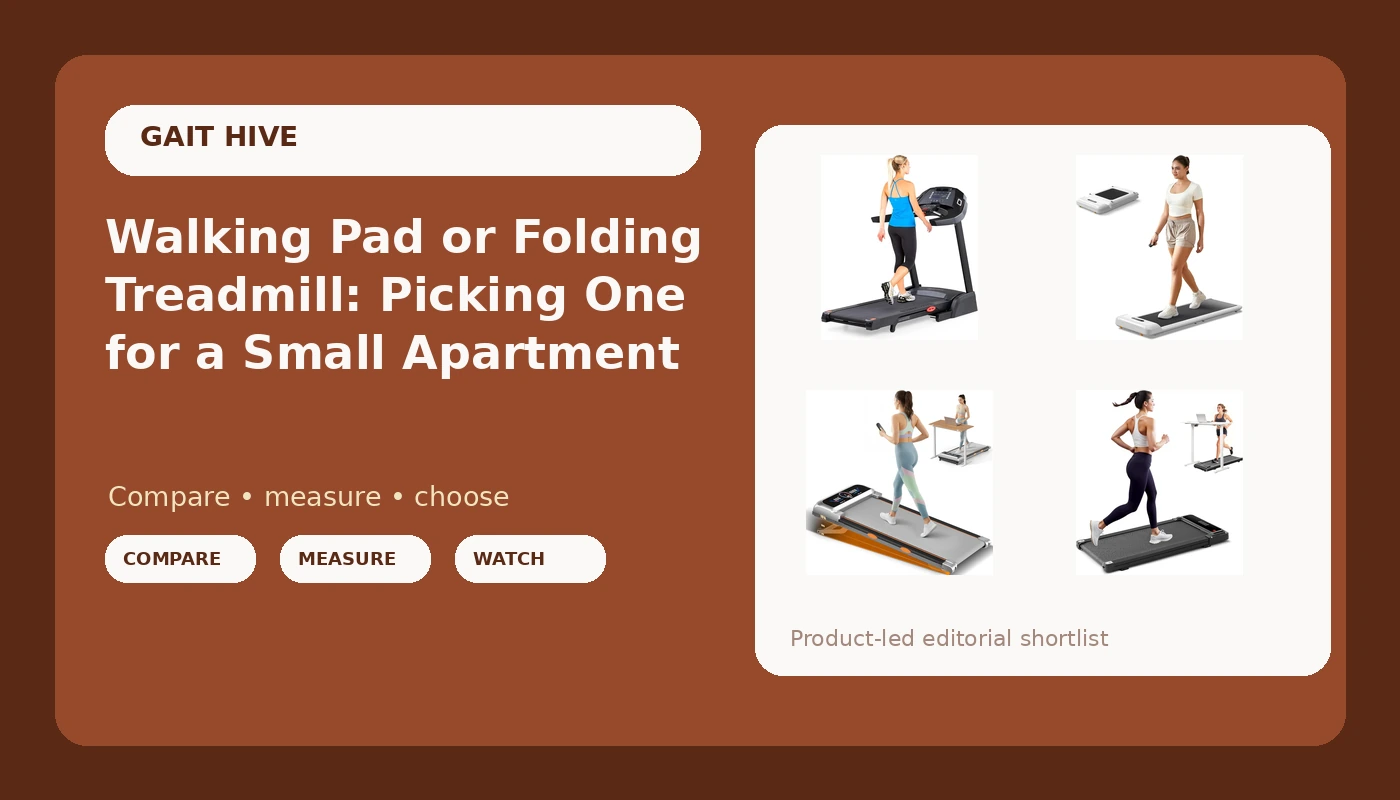
Most people shopping for a treadmill for small apartments open with the wrong question. They ask which machine is best, or which motor is biggest, or which one folds flattest. The better first question is what you are actually going to do on it. A person who wants to walk through a conference call on a walking pad and a person who wants to run five miles when the afternoon is too hot to breathe outside are not shopping for the same product, even when both searches land them on the same page of results.
That mismatch is why so many foldable treadmills end up as expensive storage. The machine was fine. The job was wrong. Below are four options that solve four genuinely different problems, plus the specs that matter before you hand over a card.
Related: Treadmill Deck Length and Stride: How Much Belt You Actually Need →
Quick answer
These four machines are not really competing for the same buyer. If you run, the 3G Cardio Pro Runner X is the only one in this group built around running: a full-size folding frame, a listed 350 lb capacity, and a low 6.5 inch step-up height that makes getting on and off easier. If you walk, one of the three walking pads covers it with a fraction of the footprint, and the choice between them comes down to whether you want incline, a folding frame, or the simplest possible setup. Match the machine to the job first, then compare the details.
Four useful options
| Model | Best fit | What stands out |
|---|---|---|
| 3G Cardio Pro Runner X Treadmill | Runners who need a full-size deck at home | Foldable frame, listed 350 lb capacity, low 6.5 inch step-up height, orthopedic belt |
| WalkingPad C2 Foldable Walking Pad Treadmill | Walkers who want a folding pad from an established walking pad line | Foldable, under desk compact design |
| Rayspace Walking Pad Treadmill with 15% 12-Level Auto Incline | Walkers who want incline without a full treadmill | 15% 12-level auto incline, 3.5HP motor, listed 500 lb capacity |
| Compact Walking Pad Under Desk Treadmill | First walking pad, simplest setup | Remote control and LED display in a portable under desk format |
The runner's option: 3G Cardio Pro Runner X Treadmill
This is the one machine here where you are buying deck real estate as much as you are buying a motor. If your stride is long, a full-size belt is the difference between running normally and taking smaller than normal steps without noticing you are doing it. The trade-off is the obvious one: it is a full treadmill, so it needs a real footprint while it is unfolded, and folding it helps with storage rather than with living space. If you mainly walk, this is more machine than the job requires. If you run, the walking pads below are not substitutes.
The folding walking pad: WalkingPad C2 Foldable Walking Pad Treadmill
Here is the honest framing on any walking pad: a walking pad is a walking pad. The deck is short by design, which is exactly what makes it livable in a small room and exactly what makes it wrong for running. Buy this category for the days you would otherwise sit for eight straight hours, not for interval work. The folding mechanism is the feature worth thinking about, because folding only counts if you can actually move the thing once it is folded. Weight and wheels matter more than the folded thickness on the spec sheet.
The incline walking pad: Rayspace Walking Pad Treadmill
Incline is the feature I would look at hardest on any budget pad, because it is where corners show up. Some low-cost pads tilt the deck with plastic blocks that sit under the frame; they work, but they wobble slightly and do not inspire a lot of confidence over a few hundred miles. An automatic multi-level incline is a different design. The trade-off with a pad this loaded is that you are paying for features beyond the walk itself. If what you want is a flat surface to log steps on while you answer email, the extras here are optional. If you want to make walking harder without adding speed, incline is the cheapest way to do it.
The entry-level walking pad: Compact Walking Pad Under Desk Treadmill
Every quiet claim deserves the same skepticism. Quiet is relative to your floor, your walls, and whether you are on a call during a meeting that matters. Two people in the same apartment building can describe the same motor differently. If noise is your deciding factor, think about how you will use it: at walking speed with a headset on, most pads are tolerable, and at running speed none of them are silent. What this option does well is stay out of the way. No incline system, no extra console, nothing to learn. That simplicity is the feature, not a shortcoming.
Prices and availability may change. Product images, names, and retailer links must be matched by verified ASIN. Do not state a current price, rating, stock status, or measured result without current evidence.
Deck length and stride: the spec that decides everything
Deck length is the first number I look at, and it is the one buyers skip. Horsepower gets advertised; belt length gets buried in a bullet point. Think about what happens when your foot lands on a belt that is too short for your natural stride. You do not stop running. You unconsciously shorten your step. Do that for thirty minutes a day, five days a week, and you have trained yourself into a different gait than the one you use outdoors. Then the outdoor run feels strange, and the treadmill gets blamed.
For walking, a short deck is genuinely fine. Walking pace means a shorter step and a lower risk of clipping the front of the machine. That is the whole reason walking pads exist in the shape they do. For running, you want a belt that lets your normal footfall land in roughly the same place every time without you thinking about it. The practical test is simple: if you find yourself counting steps or adjusting mid-run, the deck is wrong for you, no matter how good the rest of the machine is.
There is a second spec that travels with deck length, which is weight capacity and frame stiffness. A deck that flexes under a heavier runner feels unstable at speed. The two machines in this group that publish high capacity numbers, the 3G Cardio at 350 lb and the Rayspace pad at 500 lb, are both telling you something about the frame underneath. Capacity is not a quality ranking on its own, but it is a useful proxy for how seriously the frame was built.
Noise, incline, and the folding claims you should test in person
Motor noise is the spec that fails a purchase most often, because it is the one you cannot experience from a product listing. A motor that makes you turn up the TV has failed at home, no matter what top speed it reaches. The honest approach is to expect some noise, decide what your tolerance is, and be skeptical of the word whisper. If you take calls while walking, that is your real benchmark, not a decibel claim from a page.
Folding is the other claim that needs physical verification. Folding only counts if you can move the folded machine by yourself, in the room you actually have, without rearranging furniture. A flat fold is useless if the thing weighs more than you want to lift or has no rollers to move it on. The spec sheet will rarely tell you what you need here, because weight and wheel design are usually listed in different places, or not at all.
Incline sits in the middle. Automatic incline, like the 15% 12-level system on the Rayspace pad, is a designed mechanism. Manual incline blocks are a workaround. Both change the angle of the deck. Only one of them holds that angle consistently and adjusts while you are on it.
- Decide whether you are buying for running or for walking, because that single answer eliminates half the market.
- Measure the floor space where the machine will live while it is unfolded, not just where it will live when it is put away.
- Check the deck length against your natural stride if you run, and against your desk clearance if you walk.
- Walk the folded machine's weight and wheel setup in your head: can you move it alone, ten times a week, for a year?
- Confirm the safety lanyard exists and that you will actually clip it on. It is the one safety feature that has no substitute.
Practical guidance before you buy
- Measure your stride, not your height. Stand on a floor, take three natural steps, and measure the distance between footfalls to get a rough sense of what belt length you need.
- Check desk clearance if the pad goes under a standing desk. Height under the desk and pad height have to work together before you order anything.
- Plan for belt lubrication and basic belt tension checks on any treadmill or pad. A dry belt wears faster and runs louder.
- Assume the machine will be louder in your room than you expect, and buy for the use case that tolerates it: walking with a headset is far more forgiving than running under a shared ceiling.
- Keep the safety lanyard clipped to something that will not move if you fall. It is the cheapest safety feature on any machine and the one most often ignored.
Which option should you choose?
Choose the 3G Cardio Pro Runner X Treadmill when you actually run and need a full-size deck in a home that still has to fold the machine away between sessions. Choose the WalkingPad C2 Foldable Walking Pad Treadmill when your goal is walking pace, your space is tight, and you want a folding frame from a line that only makes walking pads. Choose the Rayspace Walking Pad Treadmill when you want incline to do the work of making a walk harder and you would rather have a designed automatic system than manual blocks. Choose the Compact Walking Pad Under Desk Treadmill when the job is simply to move more during the workday and you want the fewest moving parts and the least setup.
One caveat that applies to all four: the specifications above come from the product listings, and listings are marketing documents. Deck feel, motor noise, and how a fold actually behaves in your hallway are things only your own room can tell you. Treat any bright claim about quiet or smooth or whisper as something to verify during a return window, not something to plan around.
The bottom line
There is no universal winner in this group, and there should not be. The runner needs the deck; the walker needs the footprint; the incline shopper needs the mechanism; the entry-level buyer needs simplicity. Get the category right first, deck length and folding second, and the brand decision mostly takes care of itself. If you take one thing from this, make it the stride question: if your footfall does not fit the belt, nothing else on the machine will rescue the purchase.